
Protest Pandemonium: The Battle for Australia’s Right to Demonstrate Rages On
- 418 arrests in 1977 sparked a national debate on the right to protest, and it’s still raging today
- Police powers to restrict protests are under scrutiny, with critics warning of a “protest exclusion zone”
- Experts fear that if protest becomes too legally risky, it could threaten democracy itself
The day of the political street march may be over, but the debate over Australia’s right to protest is far from it. It’s a battle that has been waged for decades, with the stakes higher than ever. In 1977, then-Queensland Premier Joh Bjelke-Petersen declared, “The day of the political street march is over. Don’t bother to apply for a permit. You won’t get one. That’s government policy now.” But thousands defied him, gathering in Brisbane for an anti-uranium march that would change the course of history.
For Ian Curr, a long-time anti-nuclear activist, the memory of that day is still etched in his mind. The heat was “boiling hot”, and the tension was palpable. “It was very hard to get people to even do that as a means of solidarity and self-defence,” he says. “I believe ordinary people, especially in Australia, they’re very averse to any sort of confrontation.” But the fear of confrontation didn’t deter the protesters, who sat down on the road, arms-linked in passive defiance, as police surrounded them.
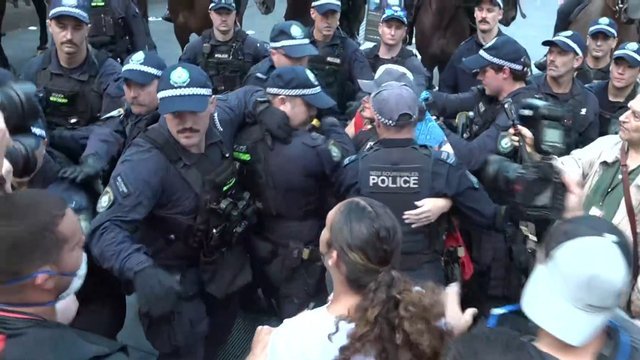
Fast-forward to today, and the debate over the right to protest is still raging. In Sydney, recent clashes between police and protesters have raised questions about the limits of free speech and assembly. The NSW government’s declaration of a “major event” gave police additional powers to issue move-on orders, close certain locations, and search people in designated parts of the city. Critics argue that this created a “protest exclusion zone”, where the right to demonstrate is severely curtailed.
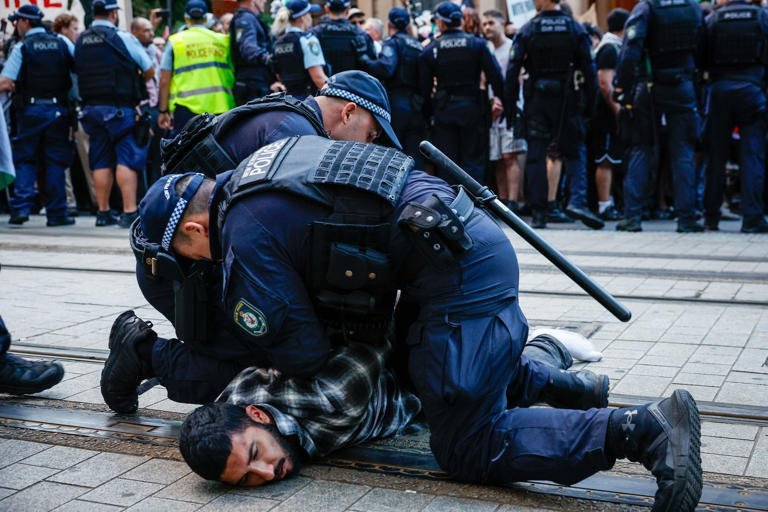
Rice, a legal expert, warns that police regulating the right to protest is a problem because they’re unaccountable in the way they do that. “The laws regarding the right to protest are in the hands of police,” he says. “Police are exercising discretion. So the manifestation of the limits on our right to protest are decisions that the police make on the ground.” He believes a national Human Rights Act would define standards against which protest laws could be measured.
Analysis: What This Means for Australia
The stakes are high. If protest becomes too legally risky, it not only impacts how public order is kept but threatens democracy itself. As Luke McNamara, a law professor at the University of NSW, argues, “Using cliches, we associate that kind of environment with other parts of the world.” The criminalisation of protest could have far-reaching consequences, exposing demonstrators to the risk of being charged and undermining the very fabric of our democracy.
But it’s not just about the right to protest; it’s about the kind of society we want to live in. As Adam Al Hayek, a healthcare worker who volunteers with Legal Observers NSW, says, “Many of the things that we can celebrate today started as protests… Whether it’s around women’s rights and social justice, environmental rights, LGBT rights, even when it comes to things like the referendum in the 1960s to include First Nations people to be able to vote.”
Sean Scalmer, a political historian at the University of Melbourne, agrees. “Protest is an ongoing process of contest and renegotiation,” he says. “If a meeting place between the right to protest and the authority of representative governments was reached, it would only be defined by representative governments and democracy itself would lose its vitality.”
The battle for the right to protest is far from over. As Ian Curr reflects on that fateful day in 1977, he knows that the struggle for democracy is ongoing. “The people who saw that violence in Sydney, in 40 or 50 years, they will not forget it. In the same way, I do not forget police brandishing batons and punching and throwing people into paddy wagons. It’s something… that marks you.”