
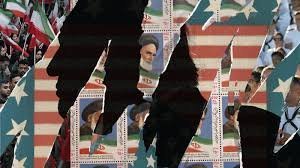
Kurdish Fighters on High Alert: Thousands of Troops Poised to Invade Iran, Sparking Fears of All-Out War
- Kurdish opposition groups amass 15,000 to 20,000 fighters near the Iraqi-Iran border, ready to enter Iran with US and Israeli air support
- Experts warn that a Kurdish ground operation without US ground support would be a “suicide mission” against the Iranian regime
- The move could open a new front in the escalating war, with far-reaching implications for regional security and global politics
A coalition of Iranian Kurdish groups, long opposed to the Iranian regime, is preparing to enter the war, threatening to open a new front in the escalating conflict. With thousands of fighters amassed near the Iraqi-Iran border, the Kurds are ready to take action as soon as they receive sufficient US and Israeli air support.
The Kurds, an ethnic minority group stretching across Türkiye, Syria, Iraq, and Iran, have long argued for greater autonomy or the establishment of their own state. They have been a thorn in the side of the Iranian regime, which has rejected proposals for federalism or regional self-rule.
A source within Komala, one of the largest Iranian Kurdish opposition groups, revealed that they have 15,000 to 20,000 fighters near the border, armed with light weapons bought on the black market in Northern Iraq. The fighters, including some who have travelled from Europe and the US, are ready to enter Iran at a moment’s notice.
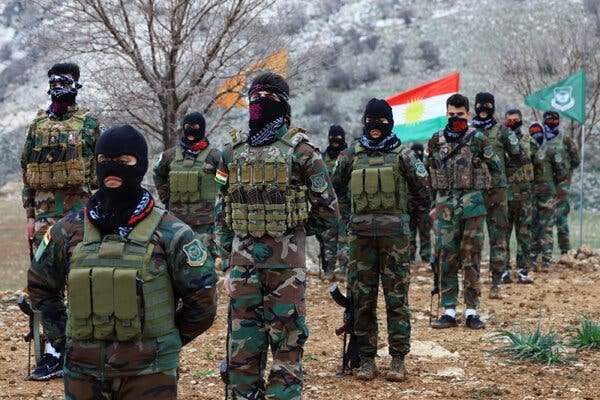
However, experts warn that a Kurdish ground operation without significant US ground support would be a “suicide mission” against the Iranian regime. The Islamic Revolutionary Guard Corps (IGRC) is a well-equipped and formidable force that would be difficult to defeat without substantial air power.
“It’s very difficult to envision using the Kurdish armed factions as a forward ground force,” said Burcu Ozcelik, a senior research fellow for Middle East security at the Royal United Services Institute in the UK. “It’s very difficult to imagine that they would succeed in toppling the regime.”
Instead, analysts believe the Kurdish forces could be used to carve out a staging ground for Israeli and American forces in western Iran, providing a safe haven for future attacks against regime targets.
Analysis: What This Means for Australia
The implications of a Kurdish invasion of Iran are far-reaching and complex. If successful, it could lead to a significant shift in the balance of power in the region, with potential consequences for global politics and security. However, it also risks drawing in other regional powers, including Türkiye, and sparking a wider conflict.
Australia, with its strategic interests in the Middle East, would need to carefully consider its response to such a development. Would it support the Kurdish forces, potentially antagonizing Iran and its allies? Or would it maintain a neutral stance, risking being seen as ineffective in the face of regional instability?
Security analysts say that the Australian government would need to carefully weigh its options, taking into account the potential risks and benefits of involvement in the conflict. One thing is certain, however: the situation bears close watching, and Australia must be prepared to adapt to a rapidly changing landscape.
As Lawk Ghafuri, an Erbil-based political analyst, noted, “The Kurds have been thrown under the bus after they have done the job for the US in Syria, and now will it be the same in Iran? What is the guarantee? What is the post-conflict plan for the Kurds?”
The answer to these questions will have significant implications for the future of the region, and Australia’s role within it.