Monster Storm Bavi: ‘Super Typhoon’ to Unleash 260km/h Winds on US Pacific Territories, Leaving Thousands Fearing for Their Lives
- Super Typhoon Bavi forecast to bring catastrophic damage and flooding to Guam and the Northern Marianas
- Residents scramble to emergency evacuation centres as storm expected to make landfall on Monday
- US National Weather Service warns of ‘tropical storm force’ winds and ‘extremely dangerous’ conditions at sea
- Experts link intensifying storms to record-breaking ocean temperatures and El Nino phenomenon
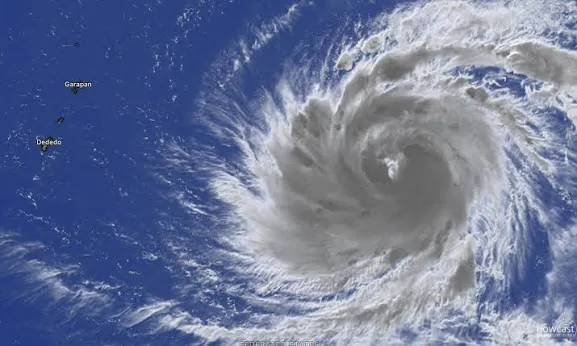
The people of Guam and the Northern Marianas are bracing themselves for the worst as Super Typhoon Bavi bears down on the US Pacific territories. With winds of up to 260km/h and gusts reaching 315km/h, the storm is expected to bring catastrophic damage and flooding to the region.
As the clock ticks down to landfall on Monday, residents are scrambling to emergency evacuation centres, fearing for their lives.
Arabella Paulino, a 48-year-old call centre employee, is trying to stay calm, but her daughters are scared. “My house is concrete, so the worst that can happen is a window could blow in,” she says, attempting to reassure herself.
Derma Soaladaob, a 51-year-old school bus driver, is taking no chances, opting to ride out the storm in a hotel. “I have a concrete house, but with the noise and the wind, it’s scary,” she admits.
The Northern Marianas, with a population of around 40,000, and Guam, with around 170,000 residents, are no strangers to severe weather events. In mid-April, Super Typhoon Sinlaku knocked out power for tens of thousands of inhabitants, uprooted trees, and ripped metal roofs off buildings.



The MV Mariana, a cargo ship, suffered engine failure and overturned in the storm, resulting in one death and five missing crew members.
This time, the storm is forecast to pass nearest to Rota, a small island roughly halfway between Guam and Saipan. Rota mayor Aubry Hocog is urging residents to take necessary precautions.
“By working together and taking the necessary precautions, we can help protect our families, neighbours and community. We pray for the safety of our people.”
Teams from the Federal Emergency Management Agency (FEMA) are on the ground in Guam, with a distribution centre stocked with 1.1 million litres of water, 1.2 million meals, 6,700 cots, and 90 generators.
The US National Weather Service warns that the “window to evacuate or seek shelter is closing”, and Guam has opened five evacuation centres in schools, primarily for those in vulnerable homes.
Analysis: What This Means for Australia
As the world grapples with the increasing frequency and intensity of severe weather events, Australia is not immune to the consequences. With the Pacific Ocean experiencing its hottest June on record, the country can expect more frequent and intense storms in the months ahead.
The World Meteorological Organization has warned that El Nino, which typically occurs every two to seven years, has already begun in the tropical Pacific and is likely to be strong.
Security analysts say that the intensification of storms like Bavi poses significant risks to Australia’s national security.
“As the Pacific region becomes increasingly vulnerable to extreme weather events, Australia’s role in providing humanitarian aid and disaster relief will become more crucial,” says one expert.
Law enforcement insiders warn that the destruction caused by such storms can also lead to increased crime and social unrest.
Industry observers believe that the economic consequences of these storms should not be underestimated. “The cost of rebuilding and recovery can be staggering, and Australia’s economy will likely feel the ripple effects,” notes one analyst.
As the country prepares to face the challenges posed by Super Typhoon Bavi, one thing is clear: the impact of severe weather events will be felt far beyond the Pacific territories.