Data Centre Invasion: How Sydney’s AI Boom is Threatening Residential Neighborhoods and the Environment
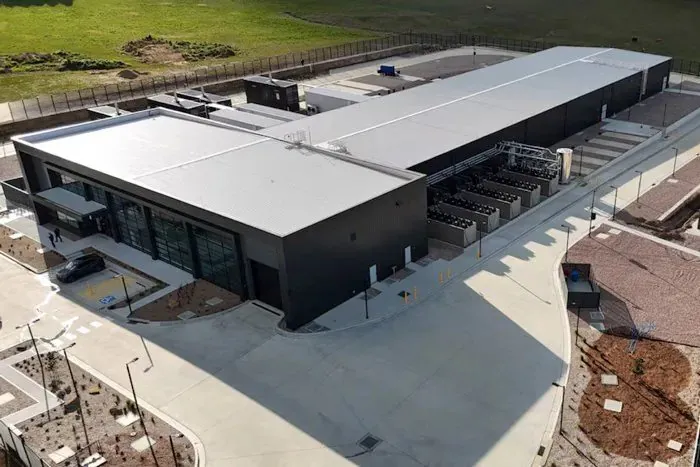
- Five data centres could soon operate within earshot of homes, a school, and the Lane Cove River, sparking fears over noise, pollution, and water usage.
- Residents like Charlotte are fighting against the construction of ‘Project Mars’ data centre, just 50 metres from her backyard and 160m from her daughters’ primary school.
- The data centre boom is a global phenomenon, but critics argue Australia is sacrificing its residential areas and natural resources for the sake of economic growth.
- The industry’s peak body, Data Centres Australia, says 162 data centres are operating nationally, with 90 more in the pipeline, but councils have limited say in development approvals.
In the quiet bushlands of Sydney’s Lane Cove West, a David and Goliath battle is unfolding.
Residents like Charlotte are fighting against the construction of ‘Project Mars’, a massive data centre proposed by developer Goodman, which would sit just 50 metres from her backyard and 160 metres from her daughters’ primary school.
The concerns are not just about the noise and pollution, but also the impact on the environment and the community’s quality of life.
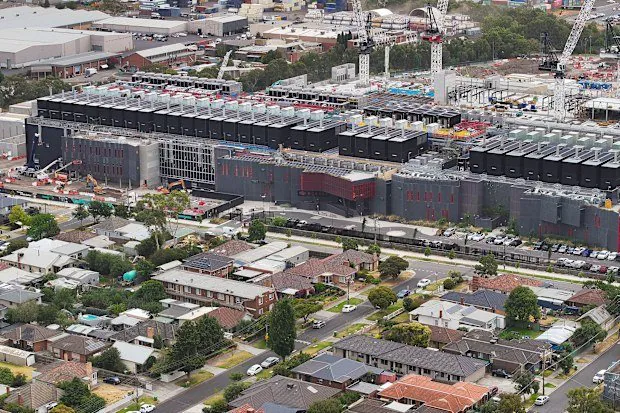
The data centre boom is a global phenomenon, driven by the rapid growth of artificial intelligence and the need for massive storage and processing facilities. But as the industry expands, it is increasingly encroaching on residential areas, sparking fears over noise, pollution, and water usage.
The industry’s peak body, Data Centres Australia, says 162 data centres are operating nationally, with 90 more in the pipeline. However, councils have limited say in development approvals, which are often granted by the state government as “state significant developments”.




The Ryde Council’s Macquarie Park precinct offers a glimpse of what could be in store for Lane Cove West. Five data centres already operate there, and another six are proposed.
The council has warned that the precinct is “dangerously nearing saturation point” and risks becoming “a residential dormitory and data centre wasteland”.
Ryde Mayor Trenton Brown argues that the land would be better used for housing or jobs, rather than data centres that provide limited benefits to the community.
Data Centres Australia chief executive Belinda Dennett acknowledges that the industry needs to do better at communicating with local residents. However, she argues that the boom is an opportunity Australia cannot afford to miss.
“There’s a global race on at the moment to attract and build the data centre infrastructure,” she says.
“If Australia becomes an unattractive location to invest, companies will simply look elsewhere.” Dennett points out that Australia’s industry is small by global standards, with the United States having over 5,000 data centres.
But critics argue that the benefits of the data centre boom are outweighed by the costs. The centres use large volumes of water for cooling, drawing on the same drinking water supplies used by homes.
Sydney Water projects that data centres could account for up to a quarter of the city’s drinking water use by 2035.
The expansion of one centre alone could use the daily equivalent of one and a half Olympic swimming pools, or enough drinking water for 18,000 people.
Analysis: What This Means for Australia
The data centre boom has significant implications for Australia’s national security, law enforcement, and community impact. The concentration of data centres in residential areas raises concerns about the potential for cyber attacks and data breaches.
The industry’s reliance on diesel generators and water usage also poses environmental risks. Furthermore, the boom is exacerbating the housing shortage, as land is diverted from residential developments to data centres.
Security analysts say that the data centre boom is a classic case of the tail wagging the dog. “The industry is driving the agenda, and the government is playing catch-up,” says one analyst.
“We need to take a step back and assess the long-term implications of this boom, rather than just chasing short-term economic gains.” Law enforcement insiders warn that the boom is creating new challenges for policing, as data centres become increasingly attractive targets for cybercrime and terrorism.
Industry observers believe that the data centre boom is a wake-up call for Australia to reassess its priorities. “We need to think about the kind of country we want to be,” says one observer.
“Do we want to be a nation of data centres and server farms, or do we want to prioritize our residential areas and natural resources?”