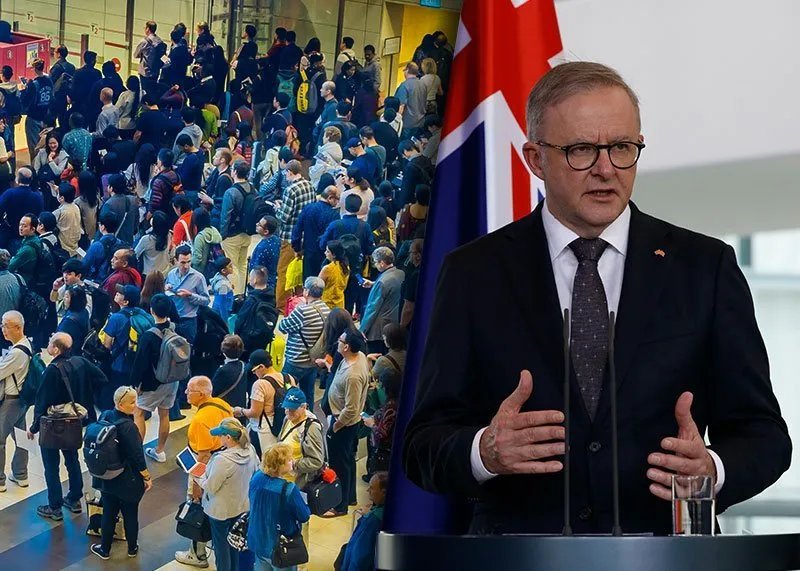
Government’s Migration Crackdown Put on Hold as Minister Tony Burke Postpones National Press Club Appearance Amid Internal Disagreements
- Home Affairs Minister Tony Burke was set to unveil sweeping cuts to migration, but has postponed his National Press Club appearance amid internal disagreements.
- The proposed reforms, aimed at quelling public anger and growing support for One Nation, included tougher family visa rules and restrictions on work and appeal rights for asylum seekers.
- The government has faced sustained criticism from One Nation and the Coalition over a post-pandemic spike in net migration, which exceeded half a million people in 2023.
- The delay has sparked concerns over the government’s ability to control net migration, with the Coalition and One Nation pledging to further cut migration if elected.
The government’s plan to crack down on migration has hit a roadblock, with Home Affairs Minister Tony Burke postponing his National Press Club appearance amid internal disagreements.
The proposed reforms, aimed at quelling public anger and growing support for One Nation, included tougher family visa rules, a cap on the number of backpackers in the country, and restrictions on the work and appeal rights of asylum seekers.
The government has faced sustained criticism from One Nation and the Coalition over a post-pandemic spike in net migration, which exceeded half a million people in 2023.

The spike was caused in part by a glut of demand that had accumulated during the pandemic, when migration was effectively halted, and also because of pandemic-era measures to encourage migrants who were already in Australia to stay for longer.
Net migration is hard for governments to control because most of the temporary visa categories are driven by demand and not formally limited.




Many of the policy suggestions understood to form part of Mr Burke’s package would give the government more control over that number, at least in the short term.
However, the delay has sparked concerns over the government’s ability to control net migration, with the Coalition and One Nation pledging to further cut migration if elected.
The proposed reforms were expected to include a restriction on the rights of humanitarian visa applicants to work while their claims were assessed, and to appeal rejections of their claims.
A similar proposal has been floated by the Coalition and One Nation, premised on a longstanding concern that some migrants make false asylum claims so that they can work in Australia while those claims are processed and repeatedly appealed.
Analysis: What This Means for Australia
The government’s migration crackdown is a response to growing public concern over the impact of migration on the economy, jobs, and social cohesion. However, the delay in announcing the reforms has raised questions over the government’s ability to control net migration and its commitment to addressing public concerns.
Security analysts say that the proposed reforms are a step in the right direction, but more needs to be done to address the root causes of migration.
“The government needs to address the underlying drivers of migration, such as poverty, conflict, and persecution, rather than just trying to control the numbers,” said one analyst.
Law enforcement insiders warn that the delay in announcing the reforms could create a window of opportunity for people smugglers and other organized crime groups to exploit loopholes in the migration system.
“The government needs to get its act together and announce the reforms as soon as possible to prevent further exploitation of the system,” said one insider.
Industry observers believe that the government’s migration crackdown could have significant economic and social consequences.
“The proposed reforms could lead to a reduction in the number of skilled workers and entrepreneurs coming to Australia, which could have a negative impact on the economy,” said one observer.
The government’s migration policy is a critical issue that affects the lives of millions of Australians. The delay in announcing the reforms has raised questions over the government’s ability to control net migration and its commitment to addressing public concerns.
As the debate over migration continues, one thing is clear: the government needs to get its act together and announce the reforms as soon as possible to prevent further exploitation of the system and to address the concerns of the Australian people.