Devastating 7.7-Magnitude Earthquake Strikes Indonesia, Leaving Trail of Destruction and Death in Its Wake
- A powerful earthquake has struck off the coast of eastern Indonesia, killing at least one person and damaging buildings, with widespread power outages and internet connectivity issues reported.
- The magnitude-7.7 quake, followed by several strong aftershocks, triggered a tsunami warning that was later cancelled, but not before panicked residents rushed to higher ground.
- Indonesia’s Disaster Management Agency has confirmed the death of one person in Sikka regency, with search and rescue teams working to verify reports of further casualties.
- The earthquake has sparked fears of a repeat of the devastating 1992 tsunami that killed 2,500 people on the island of Flores, highlighting the country’s vulnerability to seismic activity.
The earthquake struck off the coast of Flores island in eastern Indonesia at a depth of 35 kilometres, with its epicentre located 68km north-north-west of the city of Ende in East Nusa Tenggara province.
The powerful quake was felt across East Nusa Tenggara and as far as South Sulawesi, with many residents rushing from their homes in panic.
Indonesia’s Meteorology, Climatology and Geophysics Agency issued an early tsunami warning for some regions in the archipelago, but it was later cancelled after tsunami waves of less than 1 metre were recorded in several areas.
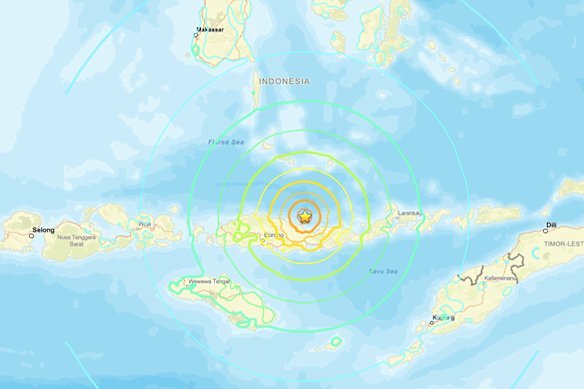
The warning was lifted about three hours after the quake, but not before residents along affected coastlines were advised to move to higher ground.
Disaster management officials said the earthquake was strongly felt across East Nusa Tenggara, with many buildings damaged, including government buildings, places of worship, and private homes.




Search and rescue workers are combing through damaged buildings, with navy boats and aircraft on standby to assist in the evacuation efforts.
Indonesia’s location on the “Ring of Fire,” an arc of volcanoes and fault lines in the Pacific Basin, makes it prone to earthquakes and volcanic activity.
The country has a long history of devastating seismic events, including the 1992 tsunami that killed 2,500 people on the island of Flores.
Jonathan Griffin, a senior seismologist at Geoscience Australia, described the earthquake as “significant,” with several aftershocks detected, including two larger than magnitude-6 and a number of magnitude-5s.
Australia’s tsunami warning centre has confirmed that there is no tsunami threat to the Australian mainland, islands, or territories.
Analysis: What This Means for Australia
While the earthquake does not pose a tsunami threat to Australia, it serves as a stark reminder of the country’s vulnerability to seismic activity.
As a neighbour to Indonesia, Australia has a vested interest in the region’s stability and is likely to provide support to the Indonesian government in the aftermath of the disaster.
Law enforcement and emergency services in Australia are also likely to be on high alert, with the potential for aftershocks and further seismic activity in the region.
The earthquake highlights the importance of disaster preparedness and response, with Australian authorities likely to review their own emergency procedures in light of the Indonesian disaster.
Security analysts say the earthquake also has implications for regional security, with the potential for instability and chaos in the aftermath of the disaster.
The Australian government is likely to be closely monitoring the situation, with a focus on providing support to the Indonesian government and ensuring the stability of the region.
Industry observers believe the earthquake will also have economic implications, with the potential for disruption to trade and commerce in the region. The Australian government may need to provide support to businesses and industries affected by the disaster, with a focus on minimizing the economic impact.