
Non-Binary Loophole: Aussie Drivers Can Slash Car Insurance by Hundreds with One Simple Tick
- A Sydney driver revealed a staggering $800 saving on car insurance by declaring as non-binary
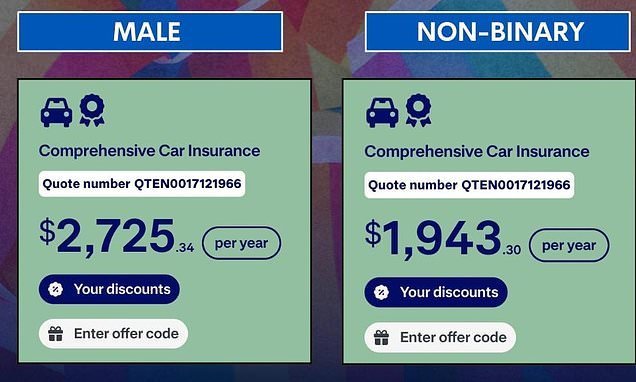
- NRMA Insurance quotes show non-binary drivers can get the best deal, with premiums up to $281 lower than male drivers
- Experts warn of a lack of data on non-binary drivers, making it difficult to determine the fairness of the system
- Not all insurance companies offer non-binary options, leaving some drivers with no choice but to misrepresent their gender
In a bombshell revelation, a Sydney driver has exposed a lucrative loophole in the car insurance system that could save Aussie motorists hundreds of dollars. Ben, a listener on Radio 2GB, called in to share his astonishing discovery that ticking the non-binary box when applying for comprehensive coverage resulted in a staggering $800 reduction in his car insurance quote.
“I found the box on there and thought I’m just going to give it a tick and see what it comes out with, it might be a bit of a joke,” Ben explained, still reeling from the shock. “A joke is right, I was absolutely stunned with what I found … I’d like to see the evidence behind it.”
Ben Fordham, the show’s host, was equally flabbergasted, exclaiming, “I can’t believe it. The best deal goes to the non-binary driver … just tick the non-binary box, because no-one is going to be able to disprove how you identify, you’re going to get a better deal.”
We put the claim to the test, obtaining three quotes from NRMA insurance for a middle-aged Sydney driver behind the wheel of an electric Kia EV3. The results were astounding: the male driver was quoted $2236 per year, the female driver $2061, and the non-binary driver a whopping $281 less at $1955.

An NRMA Insurance spokesperson attributed the difference to the company’s recent introduction of a non-binary option, stating, “We consider a number of factors when determining the premium for car insurance, including the gender of the driver, make and model of your vehicle and claims history.”
However, experts warn that the lack of data on non-binary drivers makes it challenging to determine the fairness of the system. Professor Rebecca Ivers, Head of the UNSW School of Population Health, noted, “Because current data is generally limited to binary notions of sex, there is a critical need for more nuanced research that investigates the gendered dimensions of mobility, transport and safety.”
Meanwhile, insurance broker Compare the Market revealed that men pay higher insurance costs than women, largely due to younger men having higher car insurance premiums than women of the same age. However, statistics around non-binary drivers are scarce, with the Australian Road Deaths Database listing only 32 out of almost 58,000 road fatalities as “unknown” – some dating back to 1992.
Not all insurance companies offer non-binary options, leaving some drivers with no choice but to misrepresent their gender. AAMI, for instance, does not have a non-binary option, but encourages customers to select the gender they are most comfortable with and promises to acknowledge their correct gender in future system changes.