
Police Brutality Allegations Rock Sydney as Protesters Claim Assault and Excessive Force
- NSW Greens MPs Sue Higginson, Jenny Leong, and Abigail Boyd allege police assaulted them and others at a violent protest outside Sydney Town Hall
- Footage shows police arresting dozens, with claims of excessive force and capsicum spray used on protesters
- Police defend their actions, saying they were necessary to maintain order and safety, but critics call for an independent review
The streets of Sydney were marred by violence and chaos on Tuesday night as a protest outside Town Hall turned ugly, with allegations of police brutality and excessive force levelled against authorities. The protest, which drew an estimated 30,000 attendees, was sparked by the visit of Israeli Prime Minister Isaac Herzog to Australia. While a planned march through the city was deemed unlawful by the Supreme Court, a stationary protest was allowed to proceed as a legal gathering.
However, tensions escalated when police and state MPs claimed that speakers at the rally intended to lead a march, despite the court’s ruling. As a result, officers converged on the crowd, leading to scenes of chaos and violence. Footage from the event showed police arresting dozens of people, with allegations of excessive force and the use of capsicum spray.
One disturbing video showed a young man being held down on the ground by two officers, with one of them striking him in the face twice, and the other hitting him in the face and back several times. The young man was later seen being carried away by officers with a yellow liquid on his chest, believed to be capsicum spray.
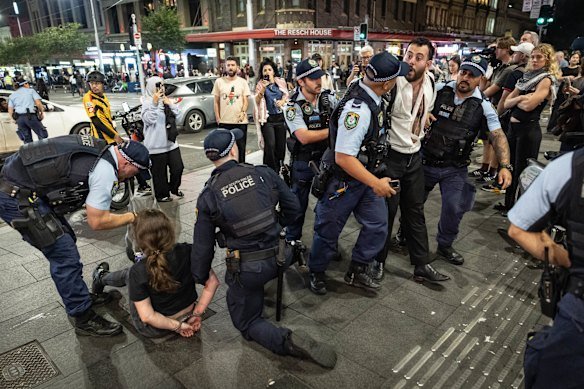
Greens NSW MPs Sue Higginson, Jenny Leong, and Abigail Boyd were among those caught up in the melee, with Higginson describing the police response as a “monumental failure” and something she “never, ever thought I would see with my own eyes”. Higginson alleged that police created a “pressure cooker” by compacting the crowd without direction, which resulted in her and Leong being capsicum sprayed, and her fellow MP Boyd being allegedly assaulted by an officer.
Boyd said she was punched in the head and arm by an officer while following orders to leave the scene, and expressed her outrage at the police response. “I don’t understand how that is a proportionate response,” she said. “I’ve never seen anything like it. I don’t trust the police to look after anybody.”
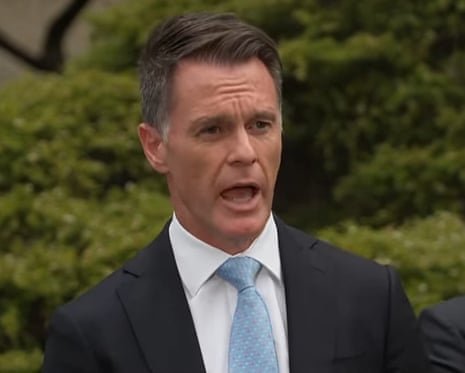
Earlier in the day, NSW Premier Chris Minns defended the actions of police, saying the operation was successful in keeping protesters away from about 7000 Jewish mourners at the TikTok Entertainment Centre, where Herzog was speaking. However, Higginson slammed Minns’ comments, saying “If that is the measure of success, friends, we are in trouble. We are in a difficult period and we need to navigate our way through this. The right of people to protest should never face this level of police violence.”
Analysis: What This Means for Australia
The events in Sydney have sparked widespread concern about police accountability and the right to peaceful protest. The use of excessive force and capsicum spray on protesters has raised questions about the tactics employed by police and the need for an independent review. Security analysts say that the incident highlights the need for better training and protocols for police handling protests, to prevent similar incidents in the future. Law enforcement insiders warn that the use of excessive force can erode trust between police and the community, making it harder to maintain public safety.
Industry observers believe that the incident has serious implications for Australia’s reputation as a democratic nation that values freedom of speech and assembly. The use of force against peaceful protesters undermines the very fabric of our society and has far-reaching consequences for our national security and social cohesion.
As the fallout from the incident continues to unfold, one thing is clear: the people of Australia demand answers and accountability from their leaders and law enforcement agencies. The right to peaceful protest is a fundamental human right, and it is the duty of our authorities to protect and uphold it.