
Revolutionary Breakthrough: Ancient Outback Rock Formation Holds Key to Storing Green Energy for Millions of Australian Homes
- A 3km-deep borehole drilled into the Adavale Basin could unlock a game-changing solution for Australia’s renewable energy storage gap
- The ancient rock formation has the potential to store hydrogen gas underground, powering millions of homes across eastern Australia
- Residents living above the caverns raise concerns about the potential risks to their only reliable source of water, the Great Artesian Basin
In a groundbreaking discovery, geologists have identified an ancient rock formation in outback Queensland as a potential solution to one of Australia’s biggest green energy problems. The Adavale Basin, hidden beneath the Great Artesian Basin, has been drilled into to explore its capacity to store hydrogen gas underground, a move that could revolutionize the country’s renewable energy landscape.
The $31 million drilling project, led by Geoscience Australia, has opened up new possibilities for storing green energy, with the potential to power millions of homes across eastern Australia. The Adavale Basin, considered “under-explored” and notoriously difficult to study, sits below the towns of Quilpie, Blackall, and Charleville, and is home to the largest underground freshwater reservoir in the world.
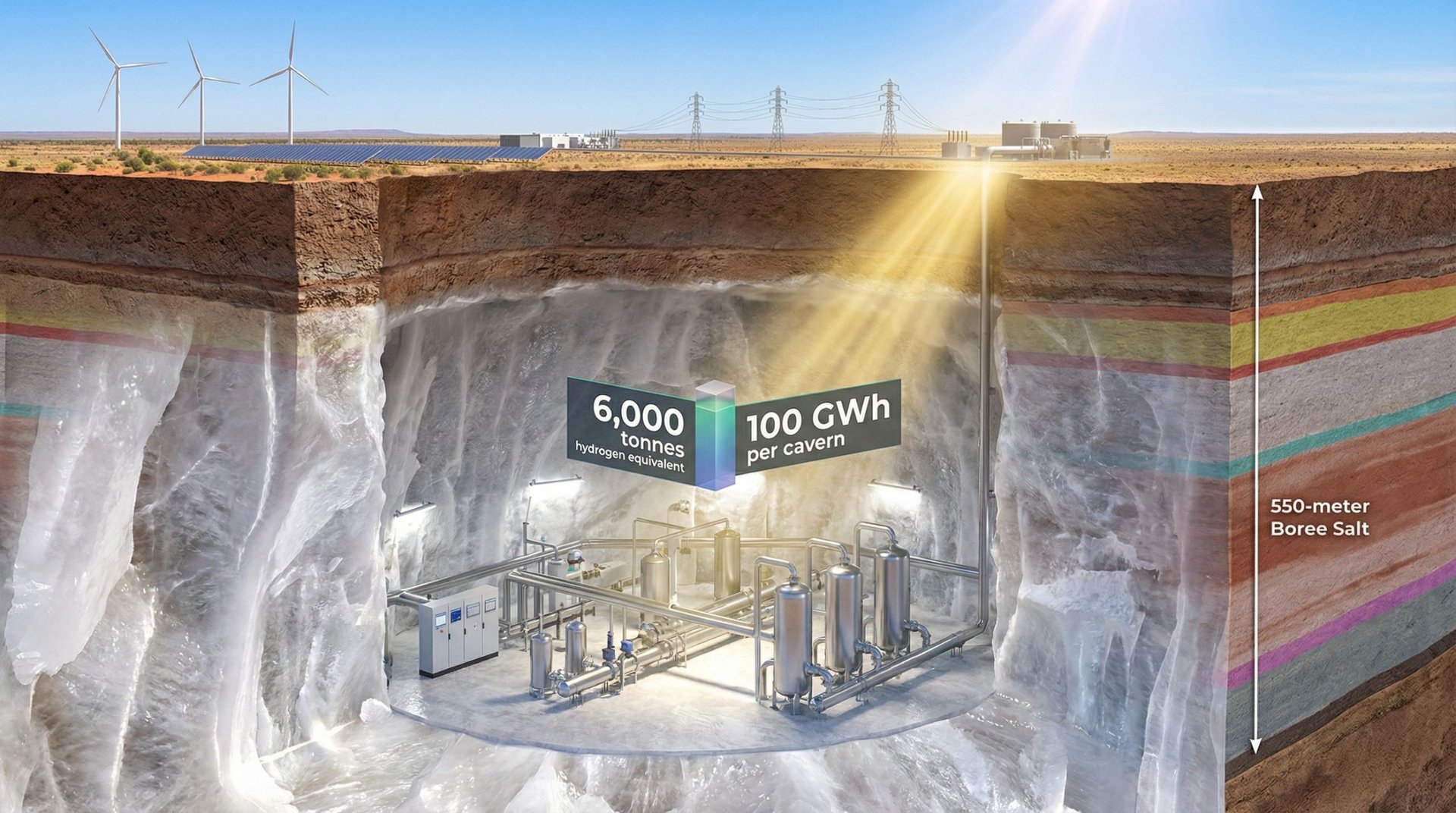
Geologists believe the Boree Salt deposit, a thick layer of rock salt, could be used to create artificial battery-like containers, allowing for the storage of hydrogen gas deep in the Earth’s crust. This technology has been used overseas for decades, with the first site operating in the UK since 1971. Independent energy geoscientist Mark Bunch from the University of Adelaide hails this kind of storage as having “enormous potential”, capable of storing industrial gases and other chemical products on a massive scale.
Analysis: What This Means for Australia
The implications of this discovery are far-reaching, with the potential to address the looming renewable energy storage gap. As Australia transitions to a cleaner energy future, the need for efficient and cost-effective storage solutions becomes increasingly critical. The Adavale Basin project offers a game-changing solution, with the potential to power 20 million homes a day, based on Brisbane’s average household demand. Moreover, underground energy storage is significantly cheaper than above-ground alternatives, eliminating the need for expensive surface infrastructure costs.
However, concerns have been raised by residents living above the caverns, who fear that any development of the Adavale Basin could jeopardize their only reliable source of water. Blackall-Tambo Shire Mayor Andrew Martin has expressed his reservations, citing the need for more evidence to ensure that any future exploration is in the best interest of his community. Dr. Bunch has sought to allay these concerns, explaining that pumping hydrogen gas into underground salt caverns is unlikely to damage the basin, due to the unique properties of salt and gas interactions.
As Geoscience Australia continues to analyze the samples collected from the drilling project, the first findings are expected to be delivered mid-year. While billions of dollars in private investment are being pulled out of green hydrogen projects, the Adavale Basin discovery offers a beacon of hope for Australia’s renewable energy future. As the country continues to navigate the challenges of transition, this ancient rock formation may hold the key to unlocking a cleaner, greener tomorrow.