
Australia’s Backyard Reveals the World’s Largest Whale Graveyard: A 5-Million-Year-Old Fossil Record of Epic Proportions
- Australian waters have yielded the world’s biggest whale graveyard, boasting 481 cetacean fossils and five actively decomposing whale carcasses.
- The 1,200km-long Diamantina Zone, 1,600km west of Australia, harbors a treasure trove of marine biodiversity and a fossil record dating back 5.3 million years.
- Researchers have discovered a new extinct beaked whale species, Pterocetus diamantinae, and identified 476 fossils, including a 5-million-year-old skull fragment.
- The whale graveyard serves as a biodiversity hotspot, with specialized communities of invertebrates and marine creatures feasting on the decomposing whales.
The discovery of the world’s largest whale graveyard in the Indian Ocean, off the coast of Australia, has left scientists awestruck.
The Diamantina Zone, a 1,200km-long area of underwater ridges and trenches, has revealed a treasure trove of marine biodiversity and a fossil record dating back 5.3 million years.
The finding has significant implications for our understanding of whale evolution, ocean ecosystems, and the impact of human activities on the marine environment. The Chinese-led research expedition, which discovered the whale graveyard in March 2023, used a human-piloted submersible vehicle, Fendouzhe, to explore the zone.
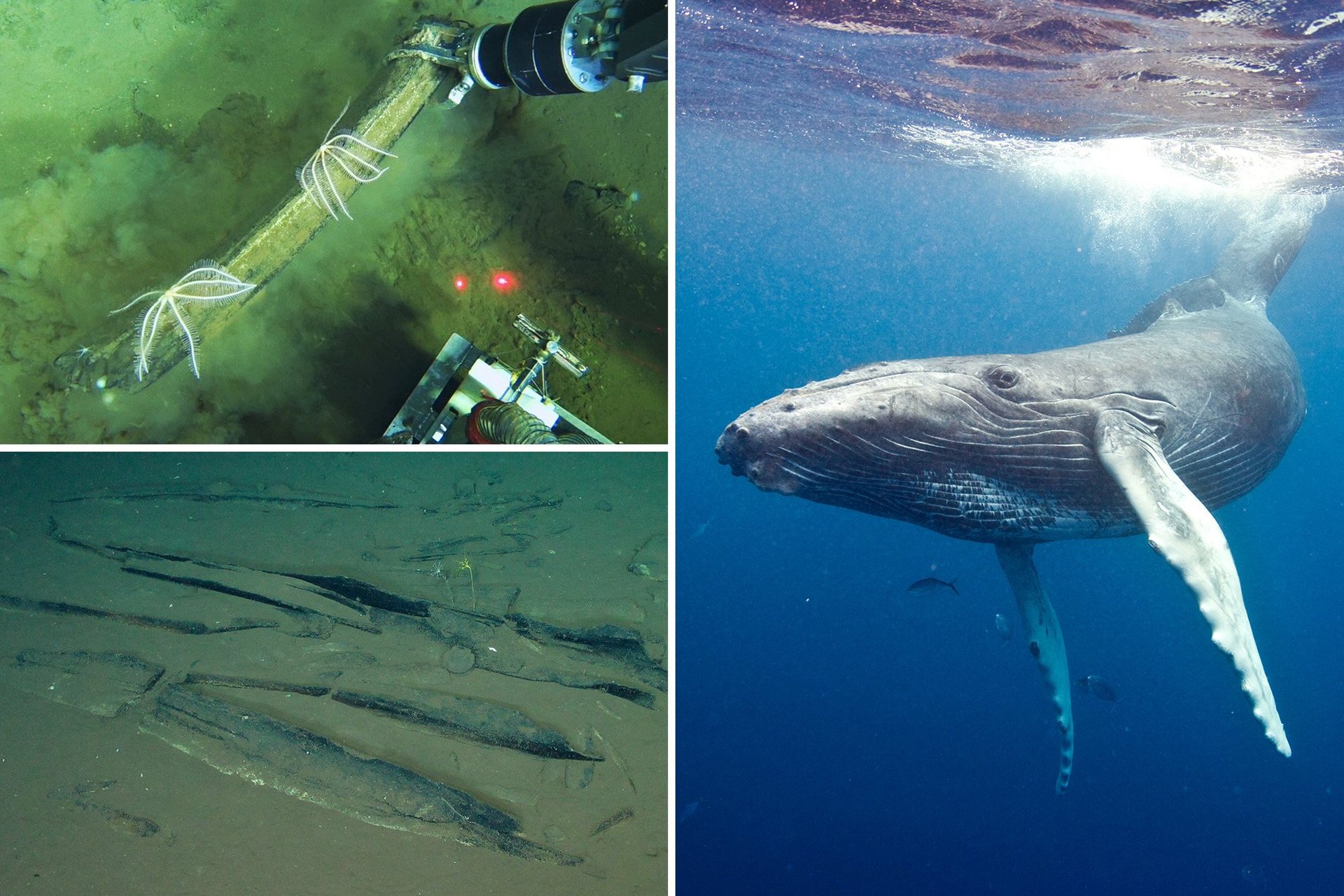
The team collected 476 fossils, including a 5-million-year-old skull fragment of a newly identified extinct beaked whale species, Pterocetus diamantinae.
The discovery has reshaped our understanding of the limits and biogeography of whale-fall ecosystems and established some deep-sea floors as a fossil archive for tracing cetacean evolution over geological time.
The Diamantina Zone is one of the major hadal trenches in the Indian Ocean, with depths ranging from 4,200m to 7,002m.
The area is characterized by a unique V-shaped topography, which may have funneled carcasses to the sea floor, contributing to the formation of the whale graveyard.
The preservation of the fossils for so long can be attributed to a combination of factors, including the low sedimentation rate, the formation of ferromanganese oxide coatings, and the cold and stable deep-sea environment.
The whale graveyard is not just a fossil record; it’s also a thriving ecosystem, with specialized communities of invertebrates and marine creatures feasting on the decomposing whales.
The largest active whale fall recorded for the study involved an Antarctic minke whale covered in creatures, many likely to be new species. The discovery supports the idea that deep-sea whale falls are biodiversity hotspots and provide stepping stones for sulphide-dependent taxa.
Analysis: What This Means for AustraliaThe discovery of the world’s largest whale graveyard in Australian waters has significant implications for the country’s marine conservation efforts.
The finding highlights the importance of protecting the ocean’s deepest parts, including sea trenches, which face threats from pollution. Establishing marine protected areas in trench ecosystems should be considered in the future to preserve Earth’s last frontiers and their unique evolutionary heritage.
Furthermore, the study emphasizes the need for continued research into the biodiversity of the deep sea, which remains one of the most under-explored ecosystems on the planet.
The discovery of new species and the expansion of our knowledge of whale evolution will have significant implications for the conservation of these magnificent creatures. Security analysts say that the discovery of the whale graveyard also raises concerns about the impact of human activities on the marine environment.
The increasing amount of plastic waste and pollution in the ocean poses a significant threat to marine life, including whales. The study serves as a reminder of the need for urgent action to protect the world’s oceans and the creatures that call them home.
Law enforcement insiders warn that the discovery of the whale graveyard also highlights the need for increased cooperation between countries to protect the world’s oceans.
The study was a collaborative effort between China, New Zealand, and other countries, demonstrating the importance of international cooperation in advancing our understanding of the ocean and its ecosystems.
Industry observers believe that the discovery of the whale graveyard will also have significant implications for the development of new technologies and industries related to ocean exploration and conservation.
The study demonstrates the importance of investing in research and development to advance our understanding of the ocean and its ecosystems.
In conclusion, the discovery of the world’s largest whale graveyard in Australian waters is a significant finding that has far-reaching implications for our understanding of whale evolution, ocean ecosystems, and the impact of human activities on the marine environment.
The study serves as a reminder of the need for urgent action to protect the world’s oceans and the creatures that call them home.
The discovery of the world’s largest whale graveyard in the Indian Ocean, off the coast of Australia, has left scientists awestruck. The Diamantina Zone, a 1,200km-long area of underwater ridges and trenches, has revealed a treasure trove of marine biodiversity and a fossil record dating back 5.3 million years. The finding has significant implications for our understanding of whale evolution, ocean ecosystems, and the impact of human activities on the marine environment.
The Chinese-led research expedition, which discovered the whale graveyard in March 2023, used a human-piloted submersible vehicle, Fendouzhe, to explore the zone. The team collected 476 fossils, including a 5-million-year-old skull fragment of a newly identified extinct beaked whale species, Pterocetus diamantinae. The discovery has reshaped our understanding of the limits and biogeography of whale-fall ecosystems and established some deep-sea floors as a fossil archive for tracing cetacean evolution over geological time.
The Diamantina Zone is one of the major hadal trenches in the Indian Ocean, with depths ranging from 4,200m to 7,002m. The area is characterized by a unique V-shaped topography, which may have funneled carcasses to the sea floor, contributing to the formation of the whale graveyard. The preservation of the fossils for so long can be attributed to a combination of factors, including the low sedimentation rate, the formation of ferromanganese oxide coatings, and the cold and stable deep-sea environment.
The whale graveyard is not just a fossil record; it’s also a thriving ecosystem, with specialized communities of invertebrates and marine creatures feasting on the decomposing whales. The largest active whale fall recorded for the study involved an Antarctic minke whale covered in creatures, many likely to be new species. The discovery supports the idea that deep-sea whale falls are biodiversity hotspots and provide stepping stones for sulphide-dependent taxa.
The discovery of the world’s largest whale graveyard in Australian waters has significant implications for the country’s marine conservation efforts. The finding highlights the importance of protecting the ocean’s deepest parts, including sea trenches, which face threats from pollution. Establishing marine protected areas in trench ecosystems should be considered in the future to preserve Earth’s last frontiers and their unique evolutionary heritage.
Furthermore, the study emphasizes the need for continued research into the biodiversity of the deep sea, which remains one of the most under-explored ecosystems on the planet. The discovery of new species and the expansion of our knowledge of whale evolution will have significant implications for the conservation of these magnificent creatures.
Security analysts say that the discovery of the whale graveyard also raises concerns about the impact of human activities on the marine environment. The increasing amount of plastic waste and pollution in the ocean poses a significant threat to marine life, including whales. The study serves as a reminder of the need for urgent action to protect the world’s oceans and the creatures that call them home.
Law enforcement insiders warn that the discovery of the whale graveyard also highlights the need for increased cooperation between countries to protect the world’s oceans. The study was a collaborative effort between China, New Zealand, and other countries, demonstrating the importance of international cooperation in advancing our understanding of the ocean and its ecosystems.
Industry observers believe that the discovery of the whale graveyard will also have significant implications for the development of new technologies and industries related to ocean exploration and conservation. The study demonstrates the importance of investing in research and development to advance our understanding of the ocean and its ecosystems.
In conclusion, the discovery of the world’s largest whale graveyard in Australian waters is a significant finding that has far-reaching implications for our understanding of whale evolution, ocean ecosystems, and the impact of human activities on the marine environment. The study serves as a reminder of the need for urgent action to protect the world’s oceans and the creatures that call them home.