
Tasmanian Timbers of Deceit: How Victoria’s Native Forest Logging Ban Has Unleashed a ‘Plundering’ of the Apple Isle’s Precious Resources
- Victoria’s decision to ban native forest logging has led to a surge in Tasmanian logs being shipped to the mainland, despite the state government’s claims to the contrary.
- Millions of dollars in taxpayer funds have been used to prop up Victorian sawmills, which are now reliant on Tasmanian timber, sparking outrage among environmentalists.
- Four Corners investigation reveals the devastating impact of the logging industry on Tasmania’s ancient forests, with some areas facing the ‘worst logging still happening in Australia today’.
- The scandal has raised questions about the Victorian government’s commitment to the environment and its handling of the transition away from native forest logging.
It’s a chilly winter morning as the Searoad Mersey II docks at Melbourne Port, carrying a secret cargo that threatens to expose the dark underbelly of the logging industry.
On board is a truck loaded with Tasmanian logs, bound for a sawmill in the Yarra Valley.
But these logs are not meant to leave the Apple Isle, and their journey raises disturbing questions about the impact of Victoria’s native forest logging ban on Tasmania’s precious resources.
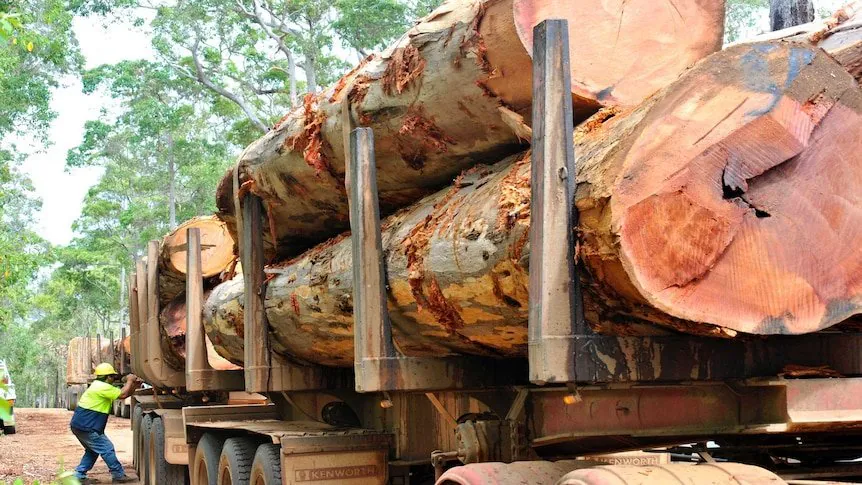
Two years after Victoria announced its decision to end native forest logging, it’s clear that the move has had an unintended consequence: a surge in Tasmanian logs being shipped to the mainland.
Environmentalists Paul O’Halloran and Patrick Johnson have spent hundreds of hours documenting the logs leaving the island, and their findings are alarming. “Tasmanian native forests are already unsustainably logged, and this is just putting more and more pressure on them,” O’Halloran says.
The Tasmanian government insists that the logs are from privately owned forests, but Johnson is skeptical.
“In my view, it’s plundering the resources of Tasmania to fill a gap that they’ve got in Victoria because the government made a decision to stop logging.” The Victorian government’s decision to ban native forest logging was meant to be a victory for the environment, but it’s had a devastating impact on Tasmania’s ancient forests.
Four Corners has discovered that Victorian taxpayers are subsidizing the practice, with millions of dollars in funding going to sawmills that are now reliant on Tasmanian timber.
The biggest native hardwood sawmill in Victoria, Australian Sustainable Hardwoods (ASH), received more than $49 million from the Victorian government’s transition fund over three years. Forensic accountant Daniela Juric says the funding has enabled the company to buy timber from Tasmania, rather than transitioning to plantation timber.
“It looks like an entity that’s struggling to stay afloat without the additional compensation from the Victorian state government.”
Analysis: What This Means for Australia
The scandal raises serious questions about the Victorian government’s commitment to the environment and its handling of the transition away from native forest logging.
Security analysts say the decision to ban native forest logging without a clear plan for the industry’s future has created a power vacuum, with devastating consequences for Tasmania’s forests.
“The Victorian taxpayer is subsidising destruction of the forests in Tasmania … that’s just appalling and inappropriate,” says David Lindenmayer, professor of ecology at Australian National University.
Law enforcement insiders warn that the lack of transparency and accountability in the logging industry has created an environment in which corruption and deceit can thrive.
“It’s a classic case of the fox guarding the henhouse,” says one insider. “The industry is being allowed to regulate itself, with disastrous consequences for the environment.”
Industry observers believe that the scandal is a symptom of a broader problem: the failure of governments to take decisive action on the environment. “We need to see a fundamental shift in the way we approach environmental policy,” says Nicola Rivers from Environmental Justice Australia.
“We can’t just keep tinkering around the edges and expecting things to change.”