
Pauline Hanson’s ‘Monoculture’ Storm: How the One Nation Leader’s Divisive Comments Expose Australia’s Deepening Cultural Divide
- Pauline Hanson sparks outrage with call for a ‘monocultural’ Australia, saying the Socceroos represent her vision for a nation with one culture and one flag.
- Angus Taylor struggles to articulate the Coalition’s position on multiculturalism, while Shadow Foreign Minister Ted O’Brien slams Hanson’s comments as ‘totalitarian’.
- Nationals leader Matt Canavan pushes back on Hanson’s push for monoculturalism, saying Australia should have a ‘common culture’ that unites the country.
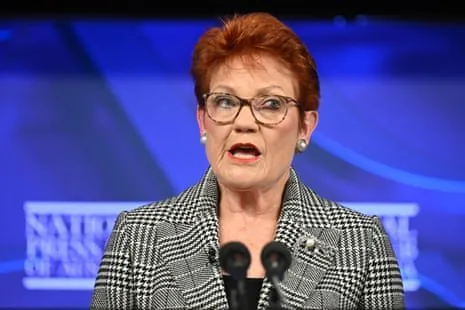
Pauline Hanson’s contentious comments on monoculturalism have ignited a firestorm in Australian politics, exposing deep divisions within the Coalition and sparking heated debates about the nation’s cultural identity.
The One Nation leader’s vision for a monocultural Australia, where everyone wears the same ‘green and gold’ and adheres to the same set of rules, has been met with fierce criticism from opponents who argue it’s a recipe for disaster.
At the heart of the controversy is Hanson’s assertion that Australia is a ‘multiracial society, but we must be monocultural’. She claims that multiculturalism has failed and that it’s time for Australians to unite under a single culture.
The Socceroos, Australia’s national soccer team, are her poster child for this vision – a team comprising players from diverse backgrounds who wear the same uniform and represent the nation on the world stage.
However, not everyone is convinced by Hanson’s argument. Shadow Foreign Minister Ted O’Brien has labelled her comments ‘totalitarian’, warning that only authoritarian regimes like North Korea try to preserve racial purity.
‘Who decides who is in the “mono”?’ he asked, highlighting the dangers of creating a culture where certain groups are excluded or marginalized.
Nationals leader Matt Canavan has also pushed back on Hanson’s push for monoculturalism, saying Australia should have a ‘common culture’ that unites the country. ‘I love Japan, it’s a great place, but Japan is not Australia,’ he said.
‘I want Australia to be Australia.’ Canavan’s comments reflect a more nuanced approach to cultural identity, one that acknowledges the nation’s diversity while emphasizing the need for a shared sense of purpose and belonging.
**Analysis: What This Means for Australia**
The debate over monoculturalism has significant implications for Australia’s national security, law enforcement, and community cohesion.
If Hanson’s vision were to become a reality, it could lead to increased tensions between different cultural groups, potentially creating divisions that would be difficult to bridge.
Moreover, it could undermine Australia’s reputation as a multicultural nation, making it harder to attract immigrants and international students who contribute to the country’s economic and social fabric.
Security analysts say that a monocultural Australia would be more vulnerable to extremist ideologies, as marginalized groups may feel forced to seek alternative identities and loyalties.
‘A diverse and inclusive society is a stronger society,’ one analyst noted. ‘When people feel like they belong, they’re less likely to be radicalized.’
Law enforcement insiders warn that Hanson’s comments could embolden far-right groups, who may see her vision as a justification for their own extremist views. ‘This kind of rhetoric can be incredibly damaging,’ one insider said.
‘It creates a sense of Us versus Them, which can lead to violence and social unrest.’
Industry observers believe that a monocultural Australia would also have significant economic consequences, as the nation would struggle to attract top talent from around the world.
‘Multiculturalism is a key part of Australia’s competitive advantage,’ one expert noted. ‘If we lose that, we’ll be left behind.’
As the debate over monoculturalism continues to simmer, one thing is clear: Australia’s cultural identity is at a crossroads. Will the nation choose a path of division and exclusion, or will it embrace its diversity and celebrate its multicultural heritage?
The answer will have far-reaching consequences for the country’s future.