
New York City’s Luxury Apartment Nightmare: ‘Localized Collapse’ Feared as Manhattan High-Rise Teeters on Collapse, Forcing Evacuations and Raising Questions About Construction Safety
- A luxury apartment complex in Manhattan’s Midtown is on the brink of disaster, with officials warning of a potential ‘localized collapse’ after columns buckled and floors sagged during construction.
- The former Pfizer headquarters, being converted into over 1,600 luxury units, has been plagued by safety issues, including fines for glass and metal falling off the building and a worker falling off a ladder.
- Emergency services are working to shore up the impacted flooring, but the building’s instability has sparked fears for the safety of nearby residents and workers.
- The incident raises serious questions about construction safety in New York City, with experts warning of the risks of rushing to meet demand for luxury housing.
As the sun rose over Manhattan’s iconic skyline on Tuesday, a sense of unease settled over the bustling streets of Midtown. The former Pfizer headquarters, a 1970s-era office building being transformed into a luxury apartment complex, stood precariously on the brink of disaster.
Officials had discovered that columns had buckled and floors had sagged during construction, sparking fears of a potential ‘localized collapse’ that could put the lives of nearby residents and workers at risk.
The building, located in a busy corridor just down the street from the Chrysler Building and Grand Central train station, had been the subject of several safety violations, including fines for glass and metal falling off the building and an incident where a worker fell off a ladder.
Despite these concerns, the project’s developer, MetroLoft, had pushed forward with the ambitious conversion, which promised to deliver over 1,600 luxury units to the city’s hungry real estate market.
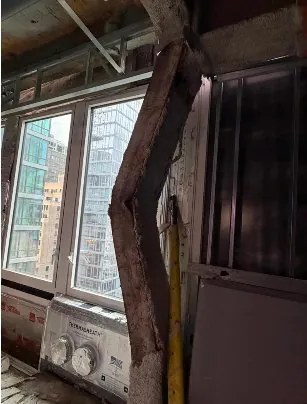
But as firefighters rushed to the scene on Tuesday morning, the true extent of the building’s instability became clear. Two columns had buckled, and multiple cracks and sagging floors had been discovered between the 21st and 26th floors.
The fire department posted images of the badly bent column, which could be seen through a large glass window from the street below.
As officials worked to assess the damage and develop a plan to shore up the impacted flooring, the city’s building commissioner, Ahmed Tigani, stressed that the building itself was not at risk of collapse.
However, the incident had already sparked evacuations in and around the construction site, with nearby buildings and streets closed off to the public.
Analysis: What This Means for Australia
While the incident may seem like a distant concern for Australians, the implications are far-reaching.
As the demand for luxury housing continues to drive construction projects around the world, the risks of cutting corners and prioritizing profit over safety are very real.
In Australia, where the construction industry is booming, the need for stricter safety regulations and enforcement is clear.
Security analysts warn that the incident highlights the importance of robust building codes and regular inspections to prevent such disasters. “The consequences of a major building collapse would be catastrophic,” said one expert.
“It’s not just a matter of property damage – it’s about human lives.”
Law enforcement insiders also point to the need for greater accountability in the construction industry. “When you’re dealing with a project of this size and scope, you need to have robust safety protocols in place,” said one source.
“It’s not just about following the rules – it’s about creating a culture of safety that prioritizes human life above all else.”
As the people of New York City wait with bated breath to see what the future holds for the struggling luxury apartment complex, Australians would do well to take heed of the lessons being learned in Manhattan.
The construction industry is a high-stakes game, and the consequences of getting it wrong can be deadly.
Industry observers believe that the incident will have far-reaching implications for the construction industry, both in the United States and around the world. “This is a wake-up call for the industry,” said one expert.
“It’s a reminder that safety should always be the top priority – not just a checkbox on a regulatory form.”
As the city works to secure the building and prevent a disaster, one thing is clear: the true cost of luxury housing is far higher than the price tag on a Manhattan apartment.
construction safetyluxury housingNew York City Department of Buildings
Australian Building and Construction Commission
New York City Department of Buildings
Australian Building and Construction Commission