London Erupts as Tens of Thousands Clash in Protests Over Immigration and Palestinian Rights, with UK Government Bracing for Leadership Challenge
- Tens of thousands of protesters took to the streets of London, with some demanding an end to high levels of immigration and others commemorating Palestinian Nakba Day.
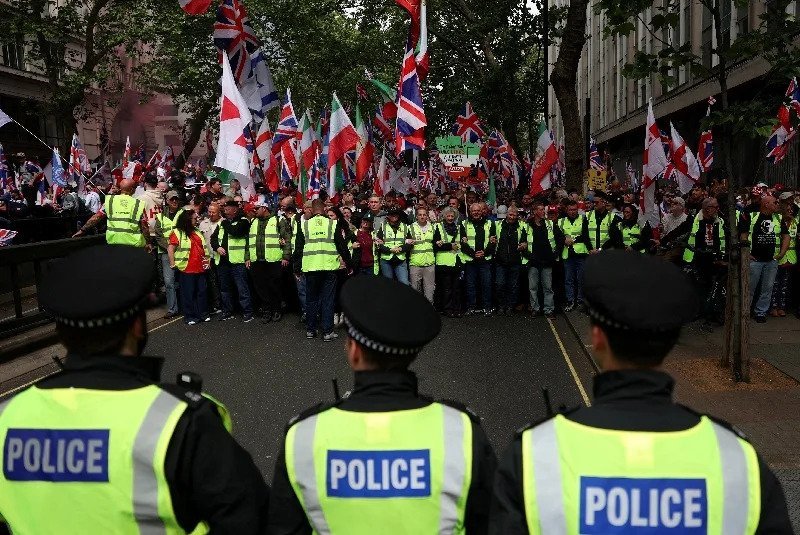
- Police deployed 4,000 officers, including reinforcements from outside the capital, and made 43 arrests for a range of offences.
- UK Prime Minister Keir Starmer’s future hangs in the balance as his popularity wanes amid concerns over immigration and a potential leadership challenge.
The streets of London were abuzz with tension as two massive protests converged on the city, one demanding an end to high levels of immigration and the other commemorating Palestinian Nakba Day.
The demonstrations, which drew tens of thousands of people, were met with a heavy police presence, with 4,000 officers deployed to maintain order.
The anti-immigration Unite the Kingdom march, organised by Stephen Yaxley-Lennon, also known as Tommy Robinson, drew a large crowd, with many waving British and English flags.
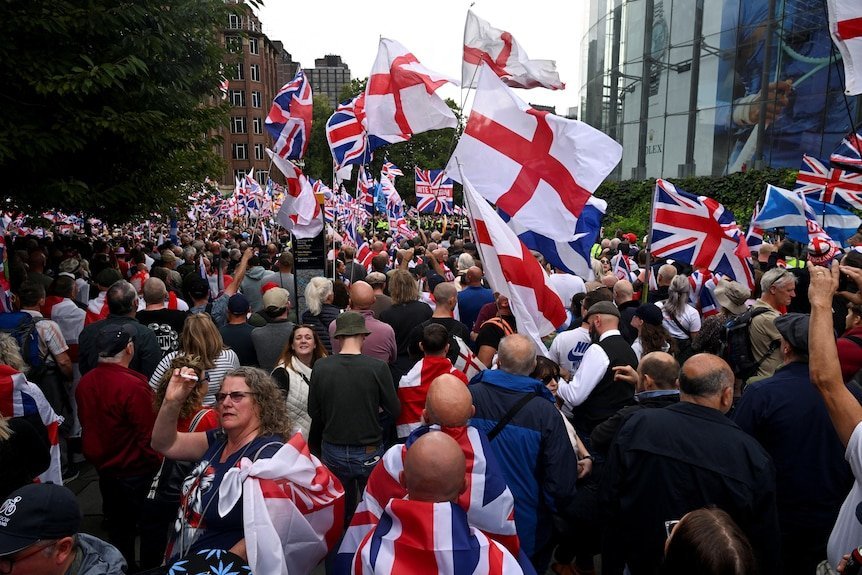
Robinson, who has convictions for assault and stalking, addressed the crowd, saying, “We are awakening Great Britain — the cultural awakening, the cultural revolution, the spiritual awakening, it’s all underway.” His supporters chanted abuse about UK Prime Minister Keir Starmer, who has been facing mounting pressure over his handling of immigration.
Meanwhile, nearby, demonstrators carrying Palestinian flags and placards called for an end to the conflict in Gaza and commemorated the 78th anniversary of the Nakba, or “catastrophe” in Arabic, which marks the displacement of Palestinians following the creation of Israel in 1948.


The march was one of 33 pro-Palestinian demonstrations held in London since the Hamas-led attack on Israel in October 2023, which have left many Jewish people feeling too intimidated to enter central London.
The UK government has been bracing for a potential leadership challenge to Prime Minister Starmer, who has seen his popularity wane amid concerns over immigration.
The right-wing Reform UK party, led by Nigel Farage, has been gaining traction, with Farage distancing himself from Robinson but capitalising on the anti-immigration sentiment.
Six-and-a-half per cent of people in England and Wales identified as Muslim in 2021, up from 4.9 per cent in 2011, according to census data.
Analysis: What This Means for Australia
The protests in London have significant implications for Australia, particularly in terms of national security and immigration policy.
As the UK grapples with the challenges of high levels of immigration and the rise of far-right extremism, Australia must also consider the potential risks and consequences of its own immigration policies.
Security analysts say that the UK’s experience serves as a warning for Australia, highlighting the need for a balanced and nuanced approach to immigration that takes into account both economic and social factors.
Law enforcement insiders warn that the rise of far-right extremism in the UK is a concern for Australia, particularly in the context of online radicalisation and the spread of hate speech.
The Australian government must be vigilant in monitoring and addressing these threats, and work to build stronger relationships with community groups to prevent the spread of extremism.
Industry observers believe that the protests in London will have economic consequences for the UK, particularly in terms of tourism and investment.
As the UK’s reputation as a tolerant and welcoming society is called into question, Australia must be mindful of the potential impact on its own economy and take steps to promote a positive and inclusive image of the country.
Ultimately, the protests in London serve as a reminder of the complex and multifaceted nature of immigration and national security policy. As Australia navigates its own challenges in these areas, it must be guided by a commitment to fairness, justice, and the protection of human rights.