‘Highest Level of Scrutiny’: Australia’s Last ‘ISIS Bride’ Wins Right to Return Home After Exclusion Order Lifted
- Australia’s last remaining ‘ISIS bride’ in a Syrian detention camp has been granted permission to return home after a lengthy legal battle.
- The Sydney-born woman will face ‘the highest level of scrutiny and surveillance’ possible under Australian law, including 24-hour notice for all telecommunications use.
- Home Affairs Minister Tony Burke confirmed the woman’s return, but warned she will be subject to strict conditions, including regular check-ins with authorities and limits on her travel and social media use.
- The decision comes after authorities exhausted all legal avenues to prevent her re-entry, sparking concerns about national security and public safety.
The Australian government has been left with no choice but to grant permission for the country’s last remaining ‘ISIS bride’ to return home, despite initial attempts to block her re-entry.
The Sydney-born woman, who has been detained in a Syrian camp, has been granted permission to return after an exclusion order against her was lifted.
Home Affairs Minister Tony Burke confirmed that the woman is one of the final people known to be in Syrian camps with links to the Islamic State.
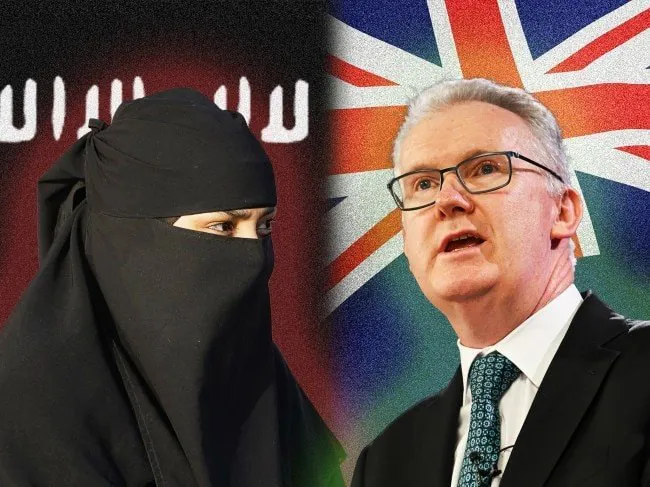
Her return has sparked concerns about national security and public safety, with many questioning whether she poses a risk to the Australian community.
Despite these concerns, the woman’s application to return was successful after all legal avenues were exhausted. The government was forced to grant her request, but not before imposing strict conditions on her return.




Under these conditions, she will be required to notify authorities of her place of residence, any workplace or study location, and all travel plans.
In an unprecedented move, the woman must also provide 24 hours’ notice before using any telecommunications device, including payphones. The same requirement applies to any social media use.
Burke emphasised that these conditions represent “the absolute legal limit” of monitoring and control that can be imposed on her return.
So, why has the Australian government been forced to grant permission for the woman’s return? The answer lies in the country’s complex and often contentious laws surrounding citizenship and national security.
Australia has a long history of grappling with the issue of citizens who have travelled overseas to fight with terrorist organisations, and the question of whether they should be allowed to return.
In recent years, the government has introduced a range of laws aimed at preventing the return of these individuals, including the Citizenship Loss Bill, which allows for the stripping of citizenship from dual nationals who have engaged in terrorist activities.
However, these laws have been subject to intense scrutiny and criticism, with many arguing that they are too broad and could unfairly target innocent individuals.
Analysis: What This Means for Australia
The decision to grant permission for the woman’s return has significant implications for national security and public safety in Australia.
While the government has imposed strict conditions on her return, many will be left wondering whether these measures are enough to mitigate the risk she poses.
Security analysts say that the return of individuals who have been involved with terrorist organisations poses a significant challenge for law enforcement agencies. “These individuals often have a high level of training and expertise, and can pose a significant threat to national security,” one analyst noted.
Law enforcement insiders warn that the conditions imposed on the woman’s return may not be enough to prevent her from re-engaging with terrorist activities. “While the conditions are strict, they are not foolproof,” one source said.
“There is always a risk that she could find ways to circumvent them and re-engage with terrorist activities.”
Industry observers believe that the decision highlights the need for a more nuanced approach to dealing with individuals who have been involved with terrorist organisations.
“We need to have a more sophisticated approach to managing the risk posed by these individuals, one that takes into account the complexities of each individual case,” one expert noted.
For now, the Australian government must balance the need to protect national security with the need to uphold the rights of its citizens.
As the woman prepares to return home, one thing is clear: her case will be closely watched, and the government’s handling of it will be subject to intense scrutiny.
As the situation unfolds, one thing is clear: the return of Australia’s last ‘ISIS bride’ has significant implications for national security, public safety, and the country’s approach to dealing with individuals who have been involved with terrorist organisations.