Australian Icon Paul Hogan Slams ‘Racist’ Pauline Hanson Over Multiculturalism Row: ‘I Want to Die in a Multicultural Australia’
- Paul Hogan has lashed out at One Nation leader Pauline Hanson, labelling her views on multiculturalism as ‘racist’
- Hanson had hailed Hogan as a symbol of Australian monoculture, citing his iconic character in Crocodile Dundee
- The 86-year-old actor has lived and worked alongside immigrants, saying Australia has always been a ‘cosmopolitan’ society
- Hanson’s comments have sparked widespread backlash, with critics accusing her of promoting a divisive and exclusionary agenda
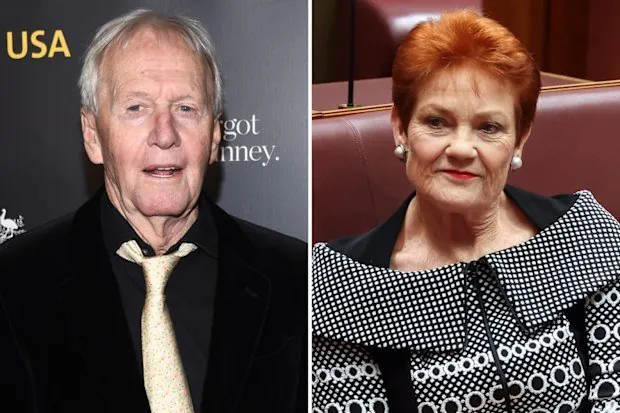
Paul Hogan, the beloved Australian actor who shot to fame with his iconic role in Crocodile Dundee, has delivered a scathing rebuke to One Nation leader Pauline Hanson over her views on multiculturalism.
Hanson had recently cited Hogan as a symbol of Australian monoculture, but the 86-year-old actor has hit back, labelling her stance as ‘racist’ and ‘ divisive’.
The row erupted after Hanson used Hogan’s character in the 1986 film as an argument against multiculturalism, saying that Australians should strive for a single, unified culture.
But Hogan, who has lived and worked alongside immigrants throughout his life, has a very different perspective. ‘How can it be a monoculture?’ he asked in an interview with the Australian Financial Review.
‘We’re all migrants, except the Aboriginals, who as far as we know have been here for 60,000 years.’
Hogan’s own life story is a testament to the diversity of Australian society. Growing up, he worked alongside immigrants from all over the world, including Assyrians, Thursday Islanders, Welshmen, and Italians.
‘My old gang was a cosmopolitan mix of people from everywhere,’ he recalled. ‘It was the same everywhere I worked – a bit of everybody was there.’
Analysis: What This Means for Australia
Hanson’s comments have sparked widespread concern among Australians who fear that her views on multiculturalism are not only divisive but also outdated.
As the country becomes increasingly diverse, with people from all over the world calling Australia home, Hanson’s call for a single, unified culture seems out of touch with reality.
Security analysts say that promoting a monoculture can actually have the opposite effect, driving a wedge between different communities and creating tensions that can boil over into violence.
Law enforcement insiders warn that Hanson’s rhetoric can also embolden extremist groups, who often use similar language to justify their own divisive agendas. ‘When politicians use language like this, it can have serious consequences,’ said one expert.
‘It can create a sense of Us versus Them, and that’s a recipe for disaster.’
Industry observers believe that Hanson’s comments are a cynical attempt to tap into the anxieties of some Australians, who may feel uneasy about the changing face of their country.
But they also say that her approach is misguided, and that promoting diversity and inclusion is the key to building a stronger, more resilient society.
For Hogan, the issue is personal.
Now living in Venice Beach, California, he says he wants to return to Australia one day and die in a multicultural society that values diversity and promotes inclusion.
‘I want to die in a multicultural Australia,’ he said. ‘I want to die in a country that’s got a bit of everybody in it.’
As the debate over multiculturalism continues to rage, one thing is clear: Australia’s future is multicultural, and it’s up to politicians like Hanson to catch up with the times.
multiculturalism in Australia Australian Human Rights Commission