Australia Forges Historic ‘Ocean of Peace’ Alliance with Fiji, Sending Shockwaves Through the Pacific
- Prime Minister Anthony Albanese signs landmark defence treaty with Fiji, paving the way for a new era of cooperation in the Pacific.
- The ‘Ocean of Peace’ alliance includes a mutual defence obligation, marking a significant escalation of Australia’s commitment to regional security.
- China is likely to view the pact as a strategic containment, as Australia seeks to bolster its influence in the Pacific and counter Beijing’s growing presence.
- The alliance is open to other Pacific nations, with New Zealand, PNG, and Tonga likely to be among the first to join.
Prime Minister Anthony Albanese has made a bold move to reshape the Pacific’s strategic landscape, signing a historic defence treaty with Fiji that promises to elevate the region’s security architecture to new heights.
The ‘Ocean of Peace’ alliance, inked in a ceremony in Suva, marks a significant escalation of Australia’s commitment to regional security and is likely to send shockwaves through the Pacific.
The treaty, which includes a mutual defence obligation, has been hailed as a “very significant elevation” of the relationship between Australia and Fiji.
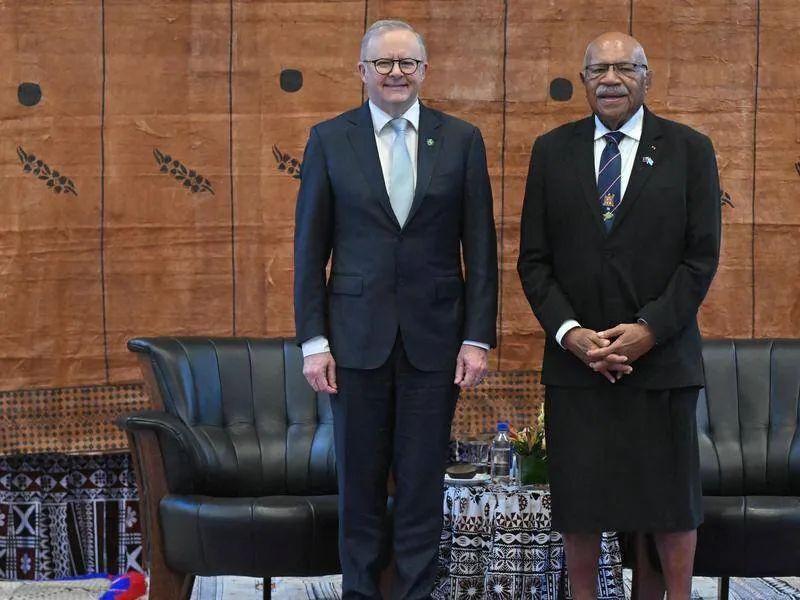
Fiji’s Prime Minister Sitiveni Rabuka said the agreement was a “clear affirmation” of Australia’s sustained commitment to the stability, resilience, and prosperity of the Blue Pacific region.
Mr Albanese described the pact as a “major development” that would strengthen the ties between the two nations.




The ‘Ocean of Peace’ alliance is not just a bilateral agreement between Australia and Fiji; it is open to other Pacific nations that are “in a position to further the purposes and principles of this treaty and to contribute to the security of the Pacific”.
New Zealand, PNG, and Tonga are likely to be among the first to join, with the ABC reporting that Vanuatu’s Prime Minister Jotham Napat has already expressed interest in signing up.
However, not everyone is welcoming the new alliance.
China has sharply criticised some of Australia’s recent strategic pacts, accusing Canberra of using them as a “geopolitical tool” to box it out of the Pacific.
Pacific security expert Anna Powles said Beijing would likely see the new alliance as a “form of strategic containment” and that it would be correct to assume that Australia’s deliberate building of a hub-and-spokes model in the Pacific reflects Canberra’s concerns about the geopolitical shifts in the region.
Analysis: What This Means for Australia
The ‘Ocean of Peace’ alliance is a significant development for Australia’s national security, as it demonstrates the country’s commitment to regional stability and its willingness to take a leadership role in the Pacific.
The mutual defence obligation contained in the treaty marks a significant escalation of Australia’s security commitments in the region and is likely to be seen as a direct challenge to China’s growing influence.
However, the alliance also raises questions about the potential risks and challenges associated with Australia’s increasing involvement in the Pacific.
As Australia seeks to bolster its influence in the region, it must also be mindful of the potential for pushback from China and other regional actors.
The government will need to carefully manage the alliance to avoid exacerbating existing tensions and to ensure that the benefits of the pact are shared equitably among all member states.
Security analysts say that the ‘Ocean of Peace’ alliance is a significant step forward for regional security, but it is only the beginning.
The real test will come in the implementation phase, where the parties will need to work together to address the complex security challenges facing the Pacific.
Law enforcement insiders warn that the alliance must be backed by a comprehensive strategy to address transnational crime, terrorism, and other security threats in the region.
Industry observers believe that the alliance will also have significant economic and social benefits for the region. The pact is expected to unlock new opportunities for trade, investment, and development, and will help to promote a more stable and prosperous Pacific.
However, the government will need to ensure that the benefits of the alliance are shared equitably among all member states and that the pact does not exacerbate existing social and economic inequalities in the region.
As Australia continues to navigate the complexities of the Pacific, the ‘Ocean of Peace’ alliance is a significant step in the right direction. However, the government must remain vigilant and adaptable, and be prepared to address the challenges and risks associated with its increasing involvement in the region.