
‘Code Red for WA’: State Braces for One of the Most Powerful Storms in Years as Forecasters Warn of Destructive Winds, Flash Flooding and Tornadoes
- Western Australia is on high alert as a massive storm system bears down on the state, threatening to unleash devastating winds, flash flooding, and even tornadoes.
- The Bureau of Meteorology has issued a severe weather warning for a vast stretch of the state, with Perth expected to bear the brunt of the system on Sunday.
- Residents are being told to “act now and stay safe” as forecasters warn of wind gusts powerful enough to bring down trees and powerlines, damage homes, and trigger flash flooding.
- The storm system is so rare that it’s only seen every four or five years, with meteorologists describing it as the “strongest winter system” of the year.
The people of Western Australia are bracing themselves for one of the most powerful storms to hit the state in years, with forecasters warning of a potentially catastrophic weather system that could bring widespread destruction and chaos.
The Bureau of Meteorology has issued a severe weather warning for a massive stretch of the state, from Kalbarri to Esperance, as the unusually powerful cold front barrels towards WA.
The warning, issued on Saturday afternoon, is for damaging, locally destructive winds and heavy rainfall, with meteorologists predicting that the system will hit the Central West on Saturday evening and then slam Perth before sunrise on Sunday.
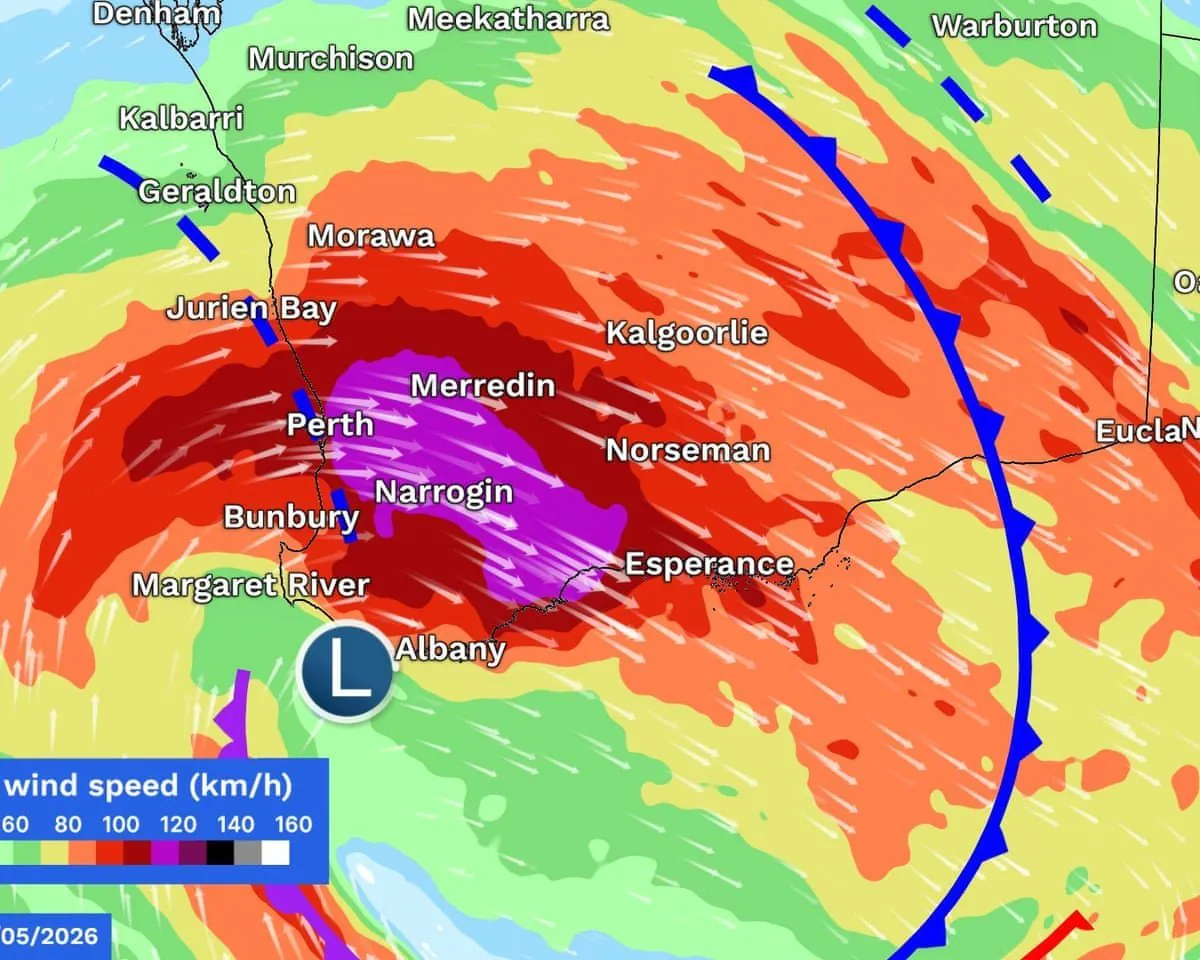
The strongest wind gusts are forecast around 10pm on Sunday, with damaging to locally destructive wind gusts in excess of 125 km/h possible.
But it’s not just the wind that’s a concern – heavy rainfall is also forecast, particularly through the Central West district from late Saturday afternoon into early Sunday morning, where rainfall totals of 40mm to 60mm in just three hours are possible.
Huge waves reaching up to 8m offshore are also expected, raising the risk of coastal erosion and flooding in low-lying areas, including along the Swan River.
This winter system is unusually strong, according to Bureau of Meteorology WA manager James Ashley, who described it as the type of system that’s only seen every four or five years.
“It’s likely to be the strongest winter system we see this year,” he said. “The type of system we don’t see very often in the south-west of WA.”
Forecasters have also warned parts of the state’s south face a risk of tornadoes, with meteorologist Sarah Scully saying that the danger zones would develop ahead of the trough line from Saturday afternoon into Sunday morning.
Localities in the state’s south were even at risk of being battered by tornadoes, with Ms Scully warning that any tornadoes that do form would be very short-lived and very difficult to track.
Locations which may be affected include Albany, Bunbury, Esperance, Geraldton, Kalbarri, Katanning, Mandurah, Manjimup, Margaret River, Merredin, Moora, Mount Barker, Narrogin, Norseman, Northam, and Perth. Residents in the warning zone are being told to “act now and stay safe” as the storm system approaches.
Emergency WA recommends those in locations set to be impacted do the following: stock up on food, water, and medication, unplug electronics, and stay indoors during the worst of the storm.
But for many, the real concern is the potential for widespread destruction and disruption to essential services.
Analysis: What This Means for Australia
The severity of this storm system has significant implications for Western Australia, with the potential for widespread damage to homes, businesses, and infrastructure. The risk of flash flooding and tornadoes also raises concerns about public safety, with emergency services on high alert to respond to any incidents.
Security analysts say that the storm system also highlights the need for robust disaster preparedness and response measures, particularly in regions prone to extreme weather events.
“This storm is a wake-up call for Western Australia,” said one analyst. “It’s a reminder that we need to be prepared for the worst and have systems in place to respond quickly and effectively.”
Law enforcement insiders warn that the storm system also poses a risk to public safety, particularly in areas with a high risk of flash flooding and tornadoes.
“We’re urging residents to take this storm seriously and take all necessary precautions to stay safe,” said one insider.
Industry observers believe that the storm system will also have significant economic implications, particularly for the agriculture and tourism sectors.
“This storm could have a devastating impact on crops and livestock, as well as the tourism industry, which is already struggling due to COVID-19,” said one observer.
As the storm system approaches, residents of Western Australia are bracing themselves for the worst.
With the potential for widespread destruction and disruption, it’s a stark reminder of the power of nature and the importance of being prepared for extreme weather events.