
‘Disgusting Animals’: Furore Erupts as Rowdy Partygoer Leaves Trail of Rubbish on Pristine Sunshine Coast Beach, Sparking Calls for Harsher Littering Laws
- A shocking display of disregard for the environment has left Sunshine Coast locals fuming after a woman left a trail of rubbish on Wurtulla Beach
- The mess included wine bottles, beer cans, and fast food wrappers, with some calling for the perpetrator to be fined and forced to clean up the beach
- The incident has sparked a heated debate about littering laws, with some arguing that current penalties are too lenient and do not deter offenders
- The Sunshine Coast Council has urged locals and visitors to be “mindful” of their rubbish, but some say more needs to be done to protect the region’s natural beauty
The usually serene Wurtulla Beach on the Sunshine Coast was left looking like a war zone after a rowdy partygoer abandoned a heap of rubbish on the sand.
The shocking display of disregard for the environment has sparked outrage among locals, with some calling for harsher littering laws to be introduced.
The mess, which included wine bottles, beer cans, beer boxes, and scraps of a popular Mexican food chain, was discovered by a frustrated local who took to social media to express his anger.
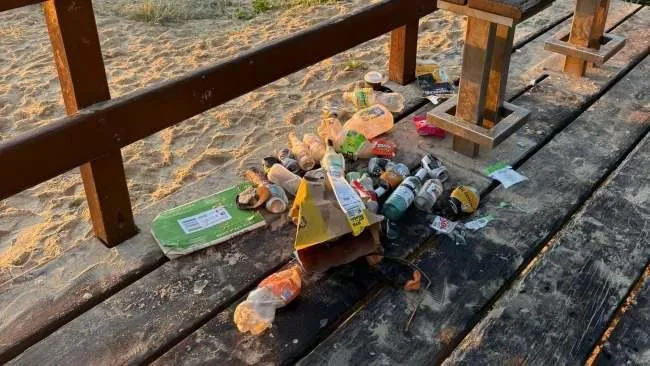
The local, who wishes to remain anonymous, posted photos of the rubbish on the Sunshine Coast SurfCheck Facebook group, along with a scathing message aimed at the perpetrator.
“To [redacted] (dumb enough to leave her name on a GYG receipt) and her friends that decided to have a party at Wurtulla lifeguard track,” he wrote.
“Forgot to clean up their mess, broken bottles out on the road, up the path and all over the boardwalk lookout. You and your friends need to learn some respect for our beaches and some discipline, obviously something your parents didn’t teach you.”
The post sparked a heated debate, with many locals calling for the woman to be fined and forced to clean up the beach.
Some even suggested that she should be named and shamed, with one person commenting, “Yes, name and shame its pathetic, no excuses.” Another suggested that she should be given hours of beach clean-up to learn a lesson.
The incident has highlighted the need for harsher littering laws in the region.
According to the Queensland Waste Reduction and Recycling Act 2011, general littering can result in an on-the-spot fine of $200 and a maximum court penalty of $3000.
However, some argue that these penalties are too lenient and do not deter offenders.
The Sunshine Coast Council has urged locals and visitors to be “mindful” of their rubbish, but some say more needs to be done to protect the region’s natural beauty.
“We all need to do our part to help keep our beaches, parks and open spaces litter-free on a regular basis,” a Sunshine Coast Council representative told news.com.au.
“It is imperative for not only the safety and health of our community to keep the Sunshine Coast litter-free, but also for our much-loved wildlife and beautiful natural areas.”
Analysis: What This Means for Australia
As the debate rages on about littering laws, it’s clear that something needs to be done to address the issue. Not only is littering a blight on our natural environment, but it also poses a risk to wildlife and human health.
In Australia, we pride ourselves on our stunning natural beauty, but incidents like this highlight the need for greater responsibility and accountability when it comes to waste management.
Law enforcement insiders warn that current littering laws are too lenient and do not provide a sufficient deterrent for offenders. “Littering is not just a minor offence, it’s a serious environmental crime that can have devastating consequences,” one insider said.
“We need to see tougher penalties and more effective enforcement to tackle this issue head-on.”
Industry observers believe that education and awareness campaigns can also play a crucial role in reducing littering. “We need to educate people about the impact of their actions and encourage them to take responsibility for their waste,” one observer said.
“By working together, we can create a cleaner, healthier environment for everyone.”