
Rebirth of a Melbourne Landmark: The Bittersweet Restoration of the Corkman Irish Pub
- A decade-long saga ends with the painstaking restoration of the 1857 pub’s exterior, but critics slam the result as a “disgrace” and an “empty shell”.
- Rogue developers Raman Shiqiri and Stefce Kutlesovski were slapped with a $1.1 million fine and orders to rebuild the original facade after demolishing the heritage building without permits.
- The University of Melbourne law students who led the charge against the demolition say the rebuild is a hollow victory, with no plans to revive the beloved gathering space.
- Shiqiri admits he made a “wrong decision” and has “learned a lot about heritage” after the debacle that sparked widespread outrage.
It’s a corner of Melbourne that will forever be etched in the city’s collective memory.
The Corkman Irish pub and the University of Melbourne Law School stood as sentinels on opposite corners of Leicester and Pelham streets, their proximity a testament to the symbiotic relationship between the city’s heritage and its people.
The pub’s destruction in 2016 sparked a firestorm of outrage, with law students leading the charge against the rogue developers who tore down the 159-year-old building without so much as a permit.
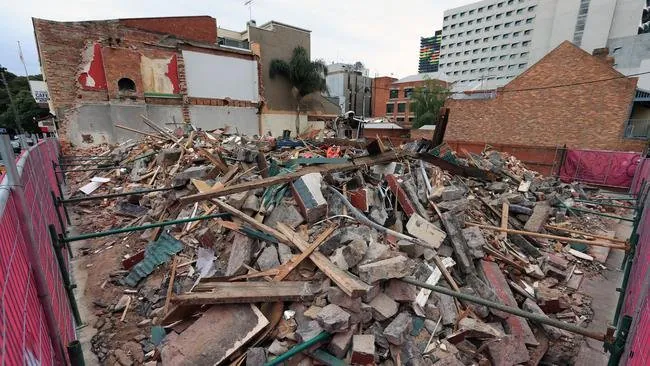
The events that unfolded were a masterclass in audacity and incompetence. A deliberately lit fire on October 8, 2016, was the catalyst for the demolition, which began without warning on October 15.
Council staff arrived to find 80% of the pub in ruins, with developer Stefce Kutlesovski brazenly declaring, “It’s my site, I can do whatever I want.” The fallout was swift and severe: month-long jail sentences for contempt of court, a $1.1 million fine, and orders to rebuild the original facade.
Fast-forward to the present, and the exterior of the Corkman Irish pub has been painstakingly restored, guided by the expertise of a heritage architect. But the result is bittersweet.
Critics, including University of Melbourne law students Tim Staindl and Duncan Wallace, have slammed the rebuild as a “disgrace” and an “empty shell”. The interior remains untouched, a hollow shell devoid of the laughter, camaraderie, and community that once thrived within its walls.
So, what went wrong? Security analysts point to a systemic failure of law enforcement and regulatory bodies, which allowed the developers to flout the rules with impunity.
“It’s a classic case of profit over people,” says one analyst.
“The fact that it took almost a decade to get to this point is a damning indictment of our system.” Law enforcement insiders warn that the case highlights the need for greater accountability and stricter penalties for those who would seek to exploit loopholes and disregard the law.
Analysis: What This Means for Australia
The Corkman Irish pub saga has significant implications for Australia’s approach to heritage preservation and the rule of law. Industry observers believe that the case sets a worrying precedent, where developers feel emboldened to disregard regulations and push the boundaries of what is acceptable.
The fact that the rebuild did not stipulate the restoration of the interior raises questions about the government’s commitment to preserving the cultural fabric of our cities.
As one expert notes, “This is not just about a pub – it’s about the very soul of our cities. We need to take a hard look at our priorities and our laws to ensure that this kind of destruction never happens again.”
For the people of Melbourne, the rebirth of the Corkman Irish pub is a bittersweet reminder of what was lost.
While the exterior may have been restored, the heart and soul of the pub remain absent, a testament to the enduring impact of destruction and neglect.
As the city moves forward, it must do so with a renewed commitment to preserving its heritage and upholding the rule of law.
**heritage preservation** and **law enforcement** are critical to ensuring that cases like the Corkman Irish pub do not become the norm. The government must take a proactive approach to protecting our cultural heritage and holding those who would seek to exploit it to account.
As the city looks to the future, it must do so with a deep respect for its past and a commitment to preserving the very fabric of its identity.