Typhoon Bavi Brings Destruction to Eastern China: 2 Million Take Shelter as Storm Makes Landfall with 144km/h Winds
- Typhoon Bavi slams into Zhejiang province, bringing catastrophic winds and torrential rain, with 2 million people seeking shelter
- The storm, measuring as big as France, prompts widespread evacuations, flight cancellations, and transportation disruptions
- Residents stock up on supplies as the government warns of flash flooding, rivers overflowing, and farmland inundation
- Death toll rises to at least 39 in southern and central China, with dozens of rivers overflowing and thousands displaced
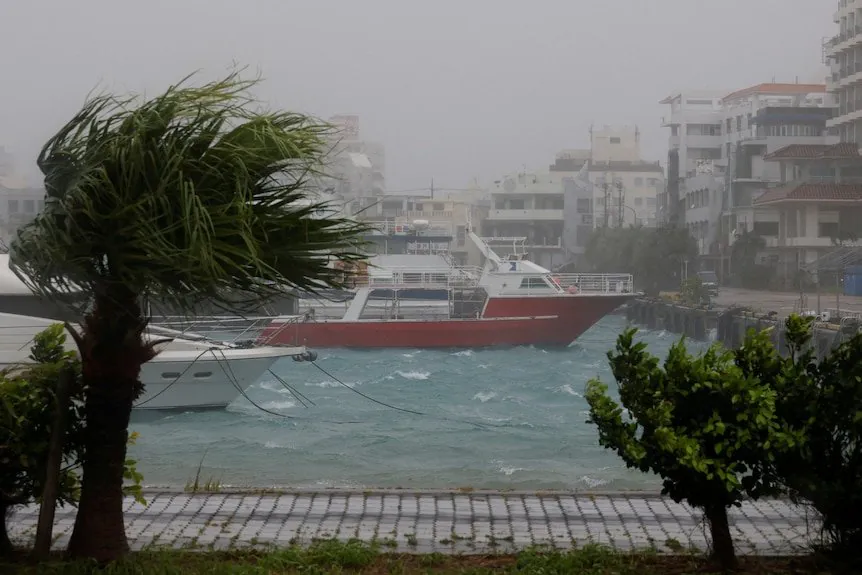
The eastern Chinese province of Zhejiang is reeling after Typhoon Bavi made landfall late Saturday, bringing with it powerful winds of up to 144 kilometres per hour and torrential rain.
The storm, which first roared ashore in Yuhuan city, has prompted widespread evacuations, with over 1.7 million people seeking shelter across the province.
Residents in the affected areas have been stockpiling essential supplies, including water and non-perishable food, as the government warns of the potential for flash flooding, rivers overflowing, and farmland inundation.
Huang Xinghuan, a resident of Wenzhou city, expressed his concerns but remained optimistic, saying, “I’m a little worried, but I think it’ll be OK. We’ve been through typhoons before.
We’ll get through it.”




Typhoon Bavi’s impact extends beyond China, with the storm having pummelled Japan’s southern Sakishima island chain and brushed past northern Taiwan earlier this week. In Taiwan, over 14,000 people were evacuated from mountainous areas, and hundreds of international and domestic flights were cancelled.
The storm also caused 113 injuries in Taiwan and left 18 dead in the Philippines, where nearly 11,000 people fled their homes.
The Chinese government has taken proactive measures to mitigate the damage, with officials stating that they are “spare[ing] no effort or cost” to guard against the worst-case scenario.
The government’s efforts include the suspension of school classes, work, public transport, and outdoor activities, as well as the cancellation of over 400 flights and dozens of train services.
Analysis: What This Means for Australia
While Typhoon Bavi’s impact on Australia is indirect, the storm serves as a stark reminder of the devastating effects of extreme weather events. As Australia faces its own challenges with climate change, it is crucial to examine the measures taken by the Chinese government to mitigate the damage.
Security analysts say that the proactive approach taken by China could be a valuable lesson for Australian authorities in preparing for and responding to natural disasters.
Law enforcement insiders warn that the widespread disruption caused by Typhoon Bavi also highlights the potential for looting and other crimes in the aftermath of a disaster.
Industry observers believe that the storm’s impact on global supply chains could also have significant economic implications for Australia, particularly in the agricultural and manufacturing sectors.
As the world grapples with the challenges of climate change, the impact of Typhoon Bavi serves as a sobering reminder of the need for cooperation and preparedness.
By examining the measures taken by the Chinese government and learning from their experiences, Australia can better prepare for the challenges that lie ahead.
climate change natural disasters Australian Bureau of Meteorology