
‘Police Will Respond Forcefully’: Twelve Gunmen Killed After Botched Store Robbery Ends in Rollover Crash and Bloody Shootout on Australia’s Doorstep in Papua New Guinea
- Twelve suspected armed robbers are dead after a getaway in a stolen vehicle ended in a rollover and a gun battle with police in the West New Britain capital of Kimbe
- The suspected ringleader is the only survivor and is now in custody, while officers recovered at least 10 firearms, most apparently homemade
- The gang allegedly took about 4,000 kina, roughly $1,500, along with a large haul of cigarettes
- The bloodshed capped days of gun violence in the town, including two near-misses in which bullets tore through police vehicles
Twelve men are dead. The haul was worth barely $1,500.
That grim arithmetic sits at the heart of one of the deadliest single policing incidents Papua New Guinea has seen in recent memory. It also lays bare a firearms and gang crisis festering less than 200 kilometres from Australia’s northern tip.
The carnage unfolded in Kimbe, the provincial capital of West New Britain, a palm oil hub on the north coast of New Britain island. A small coastal town has become, in a matter of days, a war zone.
According to police, an armed group stormed a local trade store this week and stripped it of cash and cigarettes. Reports put the cash at about 4,000 kina, roughly $1,500 in Australian money.
The gunmen then piled into a stolen vehicle and sped off, with police in pursuit.
They did not get far. The vehicle flipped during the chase, and several of the men inside were killed in the rollover.
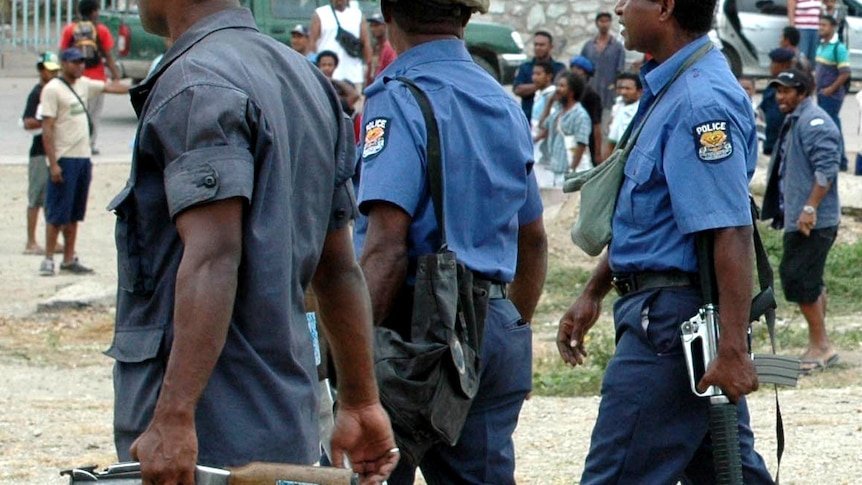
Those who walked away from the wreckage did not surrender. Royal Papua New Guinea Constabulary Commissioner David Manning said the men who escaped serious injury pulled out weapons and opened fire on officers.
Police cars were struck during the exchange.
When the shooting stopped, 12 of the robbers lay dead. Authorities have not revealed how many died in the crash and how many were killed by police bullets.
Just one man survived. Police believe he was the leader of the gang, and he is now behind bars.
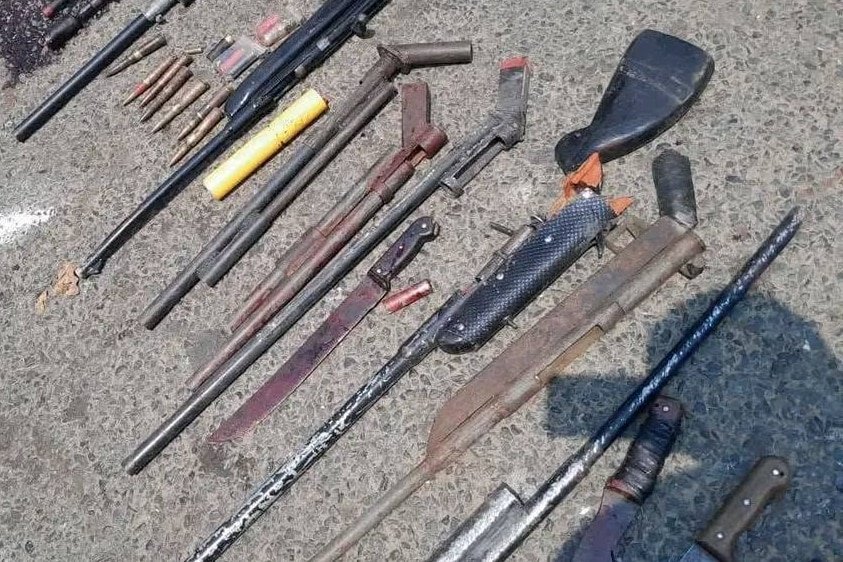
Inside the wrecked vehicle, officers discovered the stolen money along with what Commissioner Manning described as a “sizeable quantity” of guns and ammunition. Photographs released by police show at least 10 seized firearms, the majority appearing to be crude, improvised weapons.
The commissioner framed the outcome as a stark message to the criminal underworld, declaring that the constabulary would not shy away from enforcing the law.
Yet he paired the warning with an unusual plea.
Speaking directly to young men caught up in gangs, he said there was still a path out, urging them to abandon violence, return to their families and communities, and build a lawful, productive life.
The fatal robbery did not come out of nowhere. Kimbe had been on edge for days.
The violence began last Friday, when a gang allegedly held up a public motor vehicle, the minibuses known locally as PMVs that serve as the backbone of transport across the country, on the outskirts of town.
Police Minister John Pundari said a single officer traded fire with the attackers, killing one. The others vanished into the surrounding bush.
What followed was a chilling escalation. Police were reportedly targeted twice in under 24 hours.
On Sunday night, a bullet slammed into a police vehicle and narrowly missed a sergeant sitting inside. Then, on the morning of the store robbery, a high-calibre round punched through the driver’s side of another police car’s windscreen.
Miraculously, nobody was hit.
Investigators are still examining all four incidents and have not said whether they are connected. Mr Pundari nonetheless praised West New Britain officers for standing their ground, saying the clashes showed police would respond forcefully.
For years, PNG has wrestled with a surge in armed crime, driven by youth unemployment, rapid urban drift, tribal conflict and a steady flow of illegal firearms.
Homemade guns, cheap and easy to build, have become a fixture of so-called raskol gangs, and the country’s under-resourced police force is stretched thin across a nation of rugged terrain and scattered islands.
Analysis: What This Means for Australia
Canberra has every reason to pay close attention to Kimbe.
Australia is PNG’s largest security partner and aid donor, and in recent years has poured significant funding into strengthening the Royal PNG Constabulary through bilateral security arrangements.
Training, equipment and advisers have flowed north, much of it coordinated with the Australian Federal Police.
When gunmen can fire high-calibre rounds into police vehicles and a single robbery ends with a dozen bodies, it raises hard questions about whether that investment is keeping pace with the threat on the ground.
The national security stakes are real.
A destabilised PNG, where armed gangs test the authority of the state, creates openings for organised crime networks trafficking guns, drugs and people through the region.
Australia’s own fight against organised crime and illicit firearms does not stop at the Torres Strait.
There is a geopolitical dimension too. Australia has spent years competing for influence in the Pacific, and security cooperation is the centrepiece of that effort.
A partner that is seen to be losing ground to criminal gangs is a partner others may offer to help instead.
Closer to home, thousands of Australians live, work and travel in PNG, from mining and resources workers to aid staff and tourists. Escalating gun violence in provincial towns directly affects their safety, and the Smartraveller advisory for the country already urges a high degree of caution.
The economic links are also deep. Australian companies hold major stakes in PNG’s resources sector, and instability threatens investment, supply chains and the broader Pacific economy.
Security analysts say the incident illustrates a dangerous trend: criminal groups in PNG are increasingly willing to confront police head-on rather than flee. That shift, they warn, puts officers in an almost impossible position.
Law enforcement insiders caution that the prevalence of improvised firearms is a particular headache. Homemade weapons are difficult to trace, simple to replace, and largely sit outside any regulatory framework.
Regional observers believe Commissioner Manning’s appeal to young gang members reflects an uncomfortable reality. Force alone cannot fix the problem.
Without jobs, education and community investment, they argue, a new generation will keep picking up guns.
Human rights advocates are also likely to scrutinise the death toll closely, with calls for transparency over exactly how each man died expected to grow.
For now, Kimbe counts its dead, one suspected ringleader awaits his fate, and Australia is left watching a crisis on its doorstep that it cannot afford to ignore.