
‘Kilo Club’ Jackpot: Lone Prospector Nearly Walks Past $150,000 ‘Tibooburra Spud’ Buried In Outback NSW Dirt as Gold Fever Grips a Nation
- An anonymous amateur fossicker pulled a nugget weighing more than 1.2 kilograms from red outback earth near Tibooburra, and admits he almost missed it.
- Testing shows roughly 940 grams of pure gold inside the quartz-flecked lump, valued at $150,000 to $160,000 on spot price, and possibly $200,000 if sold to a collector.
- A veteran Broken Hill supplier says he has seen only one other kilo-plus find in more than two decades of trade.
- Soaring bullion prices are driving a surge of Australians into the hobby, while some of the region’s richest ground remains off-limits during Native Title negotiations.
He thought it might be a painted rock.
After days of scraping through baked red soil and turning up nothing but rusted junk, a weary prospector in the far north-west corner of New South Wales was ready to call it a day.
Then his metal detector began to scream.
What he lifted from the ground was no trick of the light. It was a gleaming slab of gold worth roughly $150,000, a life-changing haul from one of the loneliest stretches of the Australian outback.
The discovery, made in mid-October on Mount Stuart station outside the remote township of Tibooburra, has sent a jolt through the state’s prospecting community.
Experts say it is a reminder of the extraordinary wealth still hidden beneath the country’s surface, and of the frantic new gold rush that record prices have unleashed.
The finder, a Broken Hill local who has asked not to be named, has been chasing gold for years. Like most hobbyists, he is well acquainted with disappointment.
His detector, a Gold Monster 2000, typically leads him to the debris of the old days: spent lead bullets, horseshoes and nails left behind by the miners who swarmed the area well over a century ago.
On this occasion the signal was faint, surprisingly so for an object of such size. But as he dug down to about 100 millimetres, the machine began squealing.
Within a scrape or two, a bright yellow speck appeared in the centre of the hole.
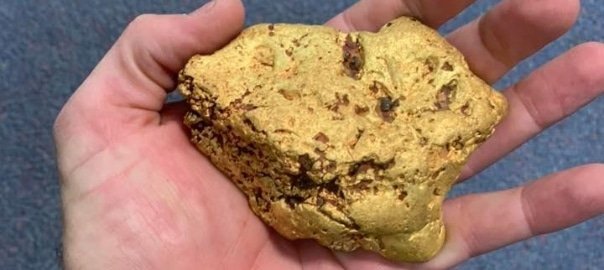
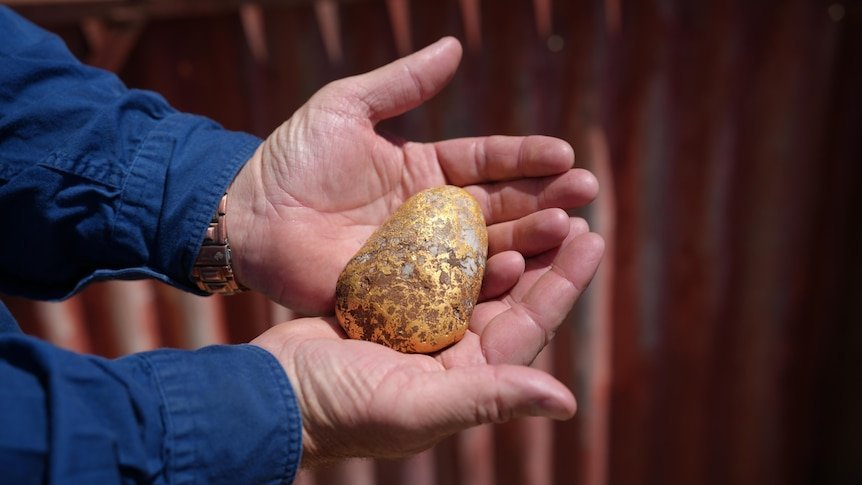
The nugget, studded with quartz, tips the scales at 1,218 grams. Analysis puts its gold content at around 940 grams.
He has christened it the ‘Tibooburra Spud’, a fitting nickname for a potato-sized lump of treasure. He intends to sell it to a private collector, a move he believes could lift its value as high as $200,000.
His secret to success? Persistence, he says.
Keep walking, keep swinging the detector, and dig every single target, no matter how unpromising it sounds.
Finds on this scale are vanishingly rare.
Greg Spangler, who has run Broken Hill Prospecting Supplies for about 20 years, says he has witnessed only one other customer unearth a nugget heavier than a kilogram in all that time.
Most fossickers count themselves lucky to pull out flakes or modest nuggets weighing a few ounces. Mr Spangler jokes about an informal ‘Ounce Club’ for those achievers, adding that membership of the ‘Kilo Club’ is far more exclusive.
The timing of the find is hardly coincidental. Gold has enjoyed a spectacular run, rocketing to almost $8,000 per troy ounce in January.
A troy ounce equals 31.1 grams. Although prices have since retreated, they remain historically strong at roughly $5,700 per ounce.
That boom, Mr Spangler says, has lured a wave of newcomers into the hobby.
Tibooburra has been synonymous with gold since the late 1880s, when prospectors first descended on the arid north-west. Today, that heritage remains one of the township’s biggest tourism drawcards.
But access is far from straightforward. Fossicking on the Tibooburra Common, the land surrounding the town, is currently prohibited while Native Title permissions are pursued.
Visitors instead rely on private properties such as Mount Stuart and Gumvale stations, which allow prospecting for a fee.
Analysis: What This Means for Australia
The Tibooburra Spud is more than a lucky break for one man.
It captures a broader economic story unfolding across regional Australia as households grapple with the cost of living crisis and look for alternative paths to financial security.
With gold prices elevated, a weekend hobby has started to look like a lottery ticket with better odds. For struggling outback communities, that shift could be significant.
Every visiting prospector spends money on fuel, accommodation, food, equipment and station access fees, injecting cash into towns that have long battled population decline.
Yet the boom raises hard questions. The ban on fossicking around Tibooburra Common highlights the tension between economic opportunity and the rights of Traditional Owners.
As more fortune-seekers arrive, governments and landholders will face mounting pressure to resolve Native Title arrangements fairly and to police where people can and cannot dig.
Safety is another concern.
The far west of NSW is unforgiving terrain, and an influx of inexperienced hobbyists chasing headlines like this one could stretch emergency services in areas where help may be hours away.
There are also implications for the national economy. Australia remains one of the world’s leading gold producers, and authorities such as Geoscience Australia have long mapped the mineral wealth beneath the continent.
Strong prices underpin royalties and exports, and the Reserve Bank of Australia watches commodity movements closely for their influence on the dollar and broader inflation.
Industry observers believe the fossicking surge mirrors investor behaviour globally, with gold seen as a safe haven during periods of uncertainty. When everyday Australians flock to the goldfields, analysts say, it often signals deeper anxiety about savings, housing and superannuation.
Regional tourism insiders warn that towns like Tibooburra must strike a careful balance, welcoming visitors without allowing heritage sites or sensitive cultural land to be damaged.
Prospecting veterans, meanwhile, say the hobby offers rewards beyond money.
Mr Spangler points to the exercise, the fresh air and the stillness of the bush, describing the peace of being first to see the sunrise over the plains.
He says it is a pastime the entire family can share.
And he insists the gold is far from exhausted. Each downpour shifts the earth, he notes, exposing fresh ground where others have previously walked straight past.
For the man behind the Tibooburra Spud, that is precisely the lesson. Fortune, it seems, belongs to those who refuse to stop digging.