
‘And Eh, We’re Okay Too’: Trump Lavishes Praise on ‘Tough’ Modi and Takaichi Before Delivering Awkward Back-Handed Swipe at Albanese as Quad Leaders Reunite in Manila Amid Iran War Fears
- Donald Trump hailed India’s Narendra Modi and Japan’s Sanae Takaichi as ‘tough’, then gave Anthony Albanese a lukewarm verdict: ‘we’re okay too’
- The awkward moment came as all four Quad leaders sat down together for the first time in more than two years
- Albanese’s plan to push for de-escalation in the US war with Iran was quickly dashed as Trump warned Tehran would ‘pay a price’ like no nation before it
- Within hours, the Prime Minister was preparing to fly to China for talks with Xi Jinping, a balancing act now under intense scrutiny
It took only a handful of words.
In a room meant to project unity among four of the most powerful democracies in the Indo-Pacific, Donald Trump handed out compliments like medals. Two leaders got gold.
Australia got a shrug.
And as Anthony Albanese laughed it off, many Australians watching back home were left asking an uncomfortable question: where exactly does this nation stand with its most important ally?
The exchange unfolded on Tuesday night in Manila, on the sidelines of the Association of Southeast Asian Nations summit, where the leaders of the Quad, the United States, Japan, India and Australia, gathered for a discussion ahead of the formal security talks.
After the four posed for the customary group photograph, the US President gave Albanese a pat on the back and declared the group to be his friends.
He told reporters Washington had enjoyed a strong relationship with all three nations from the outset, adding that he had known each leader for a long time and considered them ‘phenomenal people’.
Then came the rankings.
Gesturing towards Indian Prime Minister Narendra Modi, Trump described him as ‘a very tough man’. Turning to Japanese Prime Minister Sanae Takaichi, he suggested she ‘may be even tougher’.
Finally, he swung around to the Australian leader. ‘And eh, we’re okay too,’ he offered.
Albanese responded with a laugh. Whether it was genuine amusement or diplomatic damage control, only he knows.
The setting was significant.
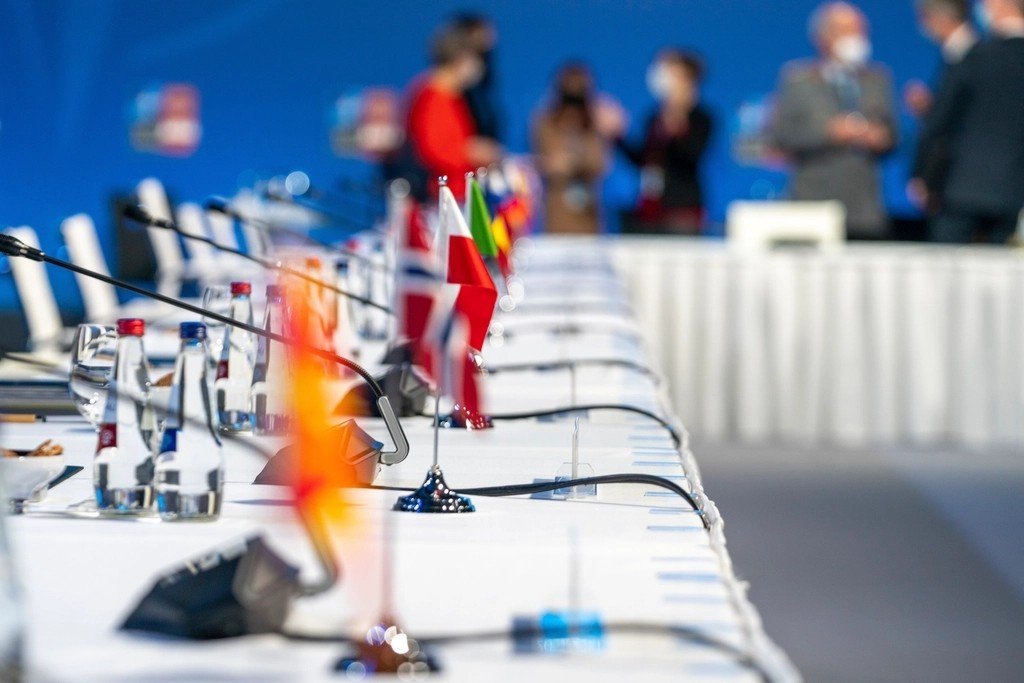
The four leaders sat around a square table, an arrangement experts said was designed to signal a shared commitment to peace and stability across the Asia-Pacific.
It was also the first time the full Quad leadership had met face to face in more than two years, a gap that had fuelled speculation about the grouping’s relevance in Trump’s second term.
Trump’s arrival only heightened the drama. Air Force One touched down in the Philippines a mere 45 minutes before the much-anticipated meeting was scheduled to begin.
The Quad, formally known as the Quadrilateral Security Dialogue, has long been viewed as a counterweight to China’s expanding military and economic reach across the region.
Revived in 2017 after an earlier stall, it was elevated to leader-level summits in 2021 and has since become a cornerstone of Canberra’s strategic thinking.
But the bloc now meets against a far darker backdrop.
The United States is at war with Iran, a conflict whose shockwaves are being felt at Australian petrol bowsers and supermarket checkouts.
Before the meeting, Albanese signalled he would urge a de-escalation, pointing directly to soaring prices for fuel and groceries that are squeezing households already battered by the cost of living crisis.
That appeal appeared to land with a thud.
Asked whether Iran represented an imminent threat to the US, Trump issued a chilling warning. If such a threat existed, he said, Iran would ‘pay a price the likes of which no country has ever paid before’.
He went further, claiming Washington took the danger seriously because the Iranian regime was ‘crazy’, and insisting that was precisely why Tehran could never be permitted to acquire a nuclear weapon.
There was no hint of retreat. No softening.
No olive branch.
Analysis: What This Means for Australia
On the surface, Trump’s quip was a throwaway line. Beneath it lies a far more serious problem for Canberra.
Australia’s national security architecture rests heavily on the American alliance, from intelligence sharing to the multibillion-dollar AUKUS submarine pact.
When a US president publicly places Australia a rung below its Quad partners, even in jest, it invites questions about Canberra’s leverage at the very moment it is trying to influence American war policy.
The Iran conflict is the sharpest test. Albanese went to Manila seeking restraint and came away with an escalation of rhetoric.
That failure carries a direct domestic price. Every spike in global oil markets flows through to fuel prices, freight costs and, ultimately, the weekly shop.
Families in outer suburbs and regional towns, who rely most on their cars, are the hardest hit.
There are also implications for defence planners. A prolonged Middle East war risks drawing American attention and resources away from the Indo-Pacific, the region the Quad was built to protect.
Should tensions escalate, pressure on Australia to contribute militarily could intensify, a prospect that would weigh heavily on the Australian Defence Force.
Then there is China.
Albanese is due in Shenzhen on Wednesday for the Asia-Pacific Economic Cooperation summit, where he is expected to meet President Xi Jinping and Premier Li Qiang in a bid to deepen trade ties.
The timing is striking.
In the space of 24 hours, the Prime Minister will move from a security forum designed to check Beijing’s influence to a summit where he will court Beijing’s leadership.
For an economy so dependent on Chinese demand for iron ore, coal and agricultural exports, that engagement is essential. But it also demands extraordinary diplomatic dexterity.
Security analysts say the juxtaposition captures Australia’s enduring dilemma: reliant on Washington for protection, reliant on Beijing for prosperity, and increasingly exposed when either relationship wobbles.
Foreign policy observers believe Trump’s remarks should not be overstated, noting the President frequently uses teasing banter with counterparts he regards as friendly. Some suggest a jibe of this kind may even reflect familiarity rather than contempt.
Others are less charitable.
Diplomatic insiders warn that perception matters enormously in the region, and that a public ranking of allies, however casual, can subtly shape how Australia is viewed by both partners and rivals.
Defence watchers point out that Japan and India each bring vast militaries and populations to the table, and that Australia must work harder than ever to demonstrate its value through capability, reliability and strategic clarity.
Economists, meanwhile, caution that the real story for ordinary Australians is not the awkward moment at the table, but what failed to happen there. With no sign of de-escalation in the Iran conflict, pressure on household budgets and inflation is unlikely to ease soon.
For Albanese, the laugh in Manila may have defused an uncomfortable moment. The harder task, keeping Australia secure, solvent and respected between two superpowers, begins the moment his plane lands in China.