
‘The House Just Started Shaking Crazily’: Magnitude-4.9 Earthquake Rocks South Australia as Hundreds of Terrified Residents Report Violent Tremors From Gawler to Beachport
- A magnitude-4.9 earthquake erupted beneath the ocean south of Adelaide at breakfast time, rattling homes, windows and nerves across an enormous stretch of South Australia
- Around 700 people lodged reports within an hour, with the shaking felt from the northern fringe of Adelaide all the way to the state’s south-east
- Seismologists warn aftershocks are possible, the latest in a string of tremors that has unsettled South Australia and Victoria in recent weeks
- The region carries a grim seismic memory: a magnitude-5.6 quake off Robe in 1948 caused serious damage
It began with a low growl that many mistook for a passing truck.
Within seconds, breakfast tables were trembling, glasses were chattering across benchtops and family dogs were bolting in panic. For thousands of South Australians starting their morning routine, the ground beneath them had suddenly come alive.
The culprit was a magnitude-4.9 earthquake, one of the most powerful to strike the state in recent memory. It is a sharp reminder that the so-called stable continent is anything but still.
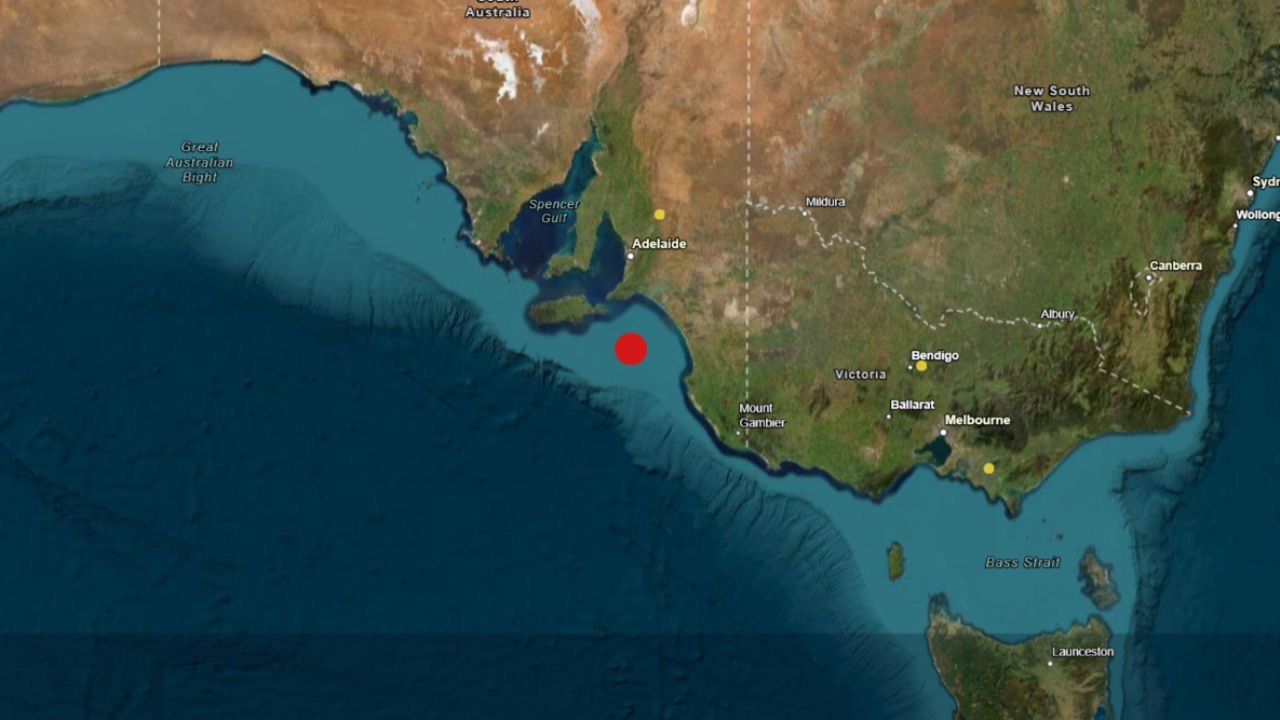
The quake hit at roughly 7:48am, according to Geoscience Australia, with its epicentre about 100 kilometres out to sea. It sat in the stretch of water between Kangaroo Island and South Australia’s south-east coastline, at a shallow depth of around 10 kilometres.
That shallowness helps explain why it travelled so far. The reach was extraordinary.
Reports flooded in from Gawler in Adelaide’s north, through the city’s suburbs, across Kangaroo Island and down the coast to Beachport and Kingston SE. In the south-east, tremors were noticed around Cape Jaffa and Blackford and well inland at Naracoorte and Hynam.
In the first hour alone, Geoscience Australia logged roughly 700 ‘felt reports’ from members of the public.
Senior seismologist Jonathan Bathgate described it as a significant event.
He noted that the vast area over which it was felt reflected its strength, and he confirmed that a quake of this size could well be followed by aftershocks.
Residents who phoned ABC Radio Adelaide painted a vivid picture of those few frightening seconds.
In Goolwa, a man named Brian watched his pot plants begin to quiver as a rumble rolled through. Another local, Heather, was seated for breakfast when the timber around her began to shake.
On nearby Hindmarsh Island, one resident likened the noise to a pack of motorbikes roaring to life at once, saying the very ground moved beneath them.
At Mount Barker, Josh heard his windows rattle as his dog went berserk. He estimated the shaking lasted about three seconds and said he had little doubt it was an earthquake.
In Willunga, a resident named Mark said his house began shaking wildly. His home already vibrates when the washing machine spins, so he leapt up to check the machine was off.
It was.
Third-floor apartment dweller Annie, in the inner suburb of Glenside, felt her building sway from north to south in four distinct movements. Her double glazing muffled any sound, but she could hear the walls flexing around her.
Down at Cape Jaffa, Mark Ireland and his wife were eating breakfast when the floor rumbled and glasses danced on the table. He first assumed heavy machinery was rolling past, until the intensity told him otherwise.
The couple simply stared at each other and asked whether it was an earthquake. Thankfully, nothing was damaged.
The jolt did not come out of nowhere.
Just over a week earlier, a magnitude-2.8 tremor shook Barossa Valley residents from their beds in the dead of night. Across the border, Victorians have also felt a run of noticeable quakes in recent weeks.
According to Mr Bathgate, the underlying cause is the relentless northward drift of the Australian continent, which creeps along at about seven centimetres a year. That slow grind builds stress within the crust, which is periodically released in sudden bursts like this one.
History shows how serious those bursts can become. In 1948, a magnitude-5.6 earthquake struck off Robe.
It sat much closer to the coast and caused considerable damage, an event Mr Bathgate pointed to as evidence of the area’s long record of offshore activity.
Nationally, Australia records only around five or six quakes of magnitude 5 or above each year, alongside more than 100 of magnitude 3. A near-5 event close to a capital city is far from routine.
Analysis: What This Means for Australia
For most Australians, earthquakes are something that happen elsewhere: in New Zealand, Japan or Indonesia. This morning’s tremor shatters that comfortable assumption.
The public safety implications are real. Much of Adelaide’s housing stock, particularly older brick and stone homes, was never designed with strong seismic forces in mind.
A shallow quake of greater magnitude, closer to shore, could inflict damage on homes, heritage buildings and critical infrastructure.
There is also the question of readiness. Emergency planning in South Australia has traditionally focused on bushfires, heatwaves and flooding.
Few households have an earthquake plan, and many residents this morning admitted they were unsure whether to stay put or run outside.
The offshore location raises another spectre. Undersea quakes always prompt fears of a tsunami.
On this occasion, Mr Bathgate said the event was far too small to generate one, explaining that offshore quakes generally need to be significantly larger before posing that kind of threat.
Still, the episode underlines why coastal communities must understand warning systems from the Bureau of Meteorology and the Joint Australian Tsunami Warning Centre.
Economically, even moderate quakes can trigger insurance inquiries, building inspections and anxiety in regional towns dependent on tourism and agriculture. The south-east’s coastal hamlets and the Fleurieu Peninsula are popular holiday destinations, and confidence matters.
Seismic observers say the cluster of recent tremors in South Australia and Victoria is a timely prompt for authorities to revisit building codes and public education campaigns.
Emergency management insiders warn that complacency is the greatest hazard. The rarity of damaging quakes, they argue, leaves communities unprepared when one finally arrives.
Disaster planning specialists believe simple steps, such as securing heavy furniture, knowing the ‘drop, cover and hold on’ technique and preparing an emergency kit, could dramatically reduce injuries in a stronger event.
Insurance industry observers suggest homeowners in seismically active pockets of the state should check whether their policies cover earthquake damage, rather than discovering gaps after the fact.
For now, South Australians are counting themselves lucky. Nobody was hurt and no damage was reported.
But with aftershocks still possible, and the continent continuing its slow, unstoppable march north, this morning’s rattle may not be the last word from the ground beneath their feet.