
Tragedy Strikes NRL: ‘Unstoppable Force’ Jai Arrow Forced into Retirement at 30 Due to Devastating Motor Neurone Disease Diagnosis
- Rabbitohs and Queensland Maroons star Jai Arrow announces retirement from rugby league due to motor neurone disease
- Arrow, 30, played 178 games and 12 Origin matches over his decade-long career, earning a reputation as an ‘unstoppable force’ on the field
- His diagnosis comes after a string of high-profile cases, including former Maroons Carl Webb and England rugby league halfback Rob Burrow, who both succumbed to the disease
- Arrow vows to ‘fight this with everything I’ve got’ as he embarks on a new battle for his health and wellbeing
The rugby league world is in shock after South Sydney and Queensland Maroons star Jai Arrow announced his retirement from the sport at just 30 years old, citing a devastating diagnosis of motor neurone disease (MND).
The news has sent a ripple effect through the NRL community, with fans, players, and coaches rallying around the beloved forward as he embarks on a new and daunting journey.
Arrow’s remarkable career, which spanned over a decade and saw him play 178 games for the Broncos, Titans, and South Sydney, as well as 12 Origin matches for Queensland, has been cut tragically short.
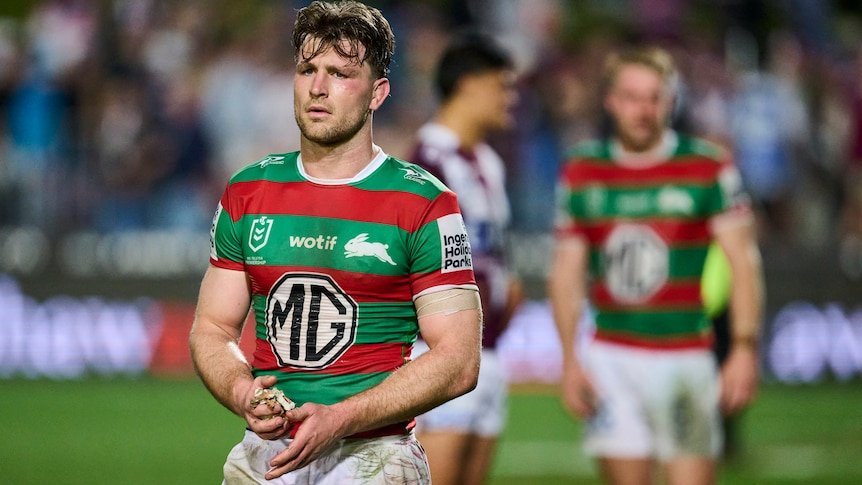
However, it’s clear that his fighting spirit and determination will serve him well in the face of this new challenge. “I’m competitive, stubborn, and ready to fight this with everything I’ve got,” Arrow declared, as he vowed to tackle his diagnosis head-on.
The road ahead will undoubtedly be tough, but Arrow is not alone.



His family, including wife Berina and daughter Ayla, will be by his side every step of the way, as will the South Sydney Rabbitohs, who have rallied around their star player with an outpouring of support.
“Jai and his family will always be Rabbitohs and they will be part of this club for many years to come,” said Rabbitohs chief executive Blake Solly.
As the NRL community comes to terms with Arrow’s diagnosis, attention is turning to the devastating impact of motor neurone disease on the sporting world. In recent years, high-profile cases such as Carl Webb and Rob Burrow have highlighted the cruel and unforgiving nature of the disease.
However, it’s also sparked a wave of awareness and fundraising efforts, with the likes of Australian Rules great Neale Daniher becoming a vocal advocate for research into the disease.
For Arrow, the diagnosis has brought a sudden and abrupt end to a career that was still in its prime. However, his determination to ‘fight this with everything I’ve got’ is a testament to the strength and resilience that defined him on the field.
As he embarks on this new chapter, the rugby league world will be watching with bated breath, eager to see how this ‘unstoppable force’ tackles his toughest challenge yet.
Analysis: What This Means for Australia
The news of Jai Arrow’s diagnosis has sent shockwaves through the Australian sporting community, highlighting the devastating impact of motor neurone disease on athletes and their families.
As the NRL and wider sporting world rallies around Arrow, attention is turning to the need for greater awareness and research into this cruel and debilitating disease.
According to experts, the risk of motor neurone disease is higher among athletes, particularly those involved in high-impact sports such as rugby league and Australian Rules.
This has significant implications for player welfare and safety, with clubs and governing bodies under pressure to provide greater support and resources for athletes affected by the disease.
Furthermore, the economic and social consequences of motor neurone disease are far-reaching, with families and carers often shouldering a significant burden.
As the Australian government continues to grapple with the challenges of healthcare funding and support, the case of Jai Arrow serves as a poignant reminder of the need for greater investment in research and care.
Security analysts say that the NRL and other sporting codes must take a proactive approach to addressing the risks associated with motor neurone disease, including providing education and support for players and staff.
This may involve working closely with medical experts and researchers to develop new treatments and therapies, as well as providing financial support for families affected by the disease.
Industry observers believe that the case of Jai Arrow will have a lasting impact on the Australian sporting landscape, highlighting the need for greater awareness and action on motor neurone disease.
As the rugby league world rallies around their fallen star, it’s clear that this is a challenge that will require a collective effort to overcome.