
Tragedy Strikes US Air Force Base as B-52 Bomber Crashes, Killing Eight on Board in Devastating Desert Disaster
- Eight crew members feared dead after a US Air Force B-52 bomber crashes at Edwards Air Force Base in California.
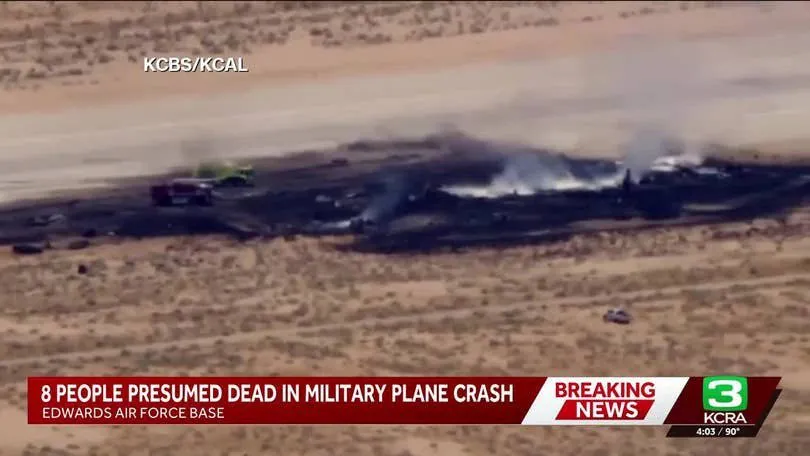
- Aerial footage shows a large charred patch of the desert floor, with virtually nothing left of the aircraft.
- The cause of the crash is still unknown, but aviation experts suspect a flight control malfunction or catastrophic engine problem.
- The airfield remains closed, and all inbound aircraft are being diverted as investigations continue.
The US Air Force base in California is reeling after a devastating crash involving a B-52 bomber, which is feared to have killed all eight crew members on board.
The tragedy occurred shortly after takeoff, sending shockwaves throughout the military community.
Aerial footage of the crash scene shows a large charred patch of the desert floor, about the size of a football field, with black smoke billowing into the air.
The Boeing B-52 Stratofortress, a long-range bomber that has been in service since 1955, was designed to carry conventional and nuclear weapons. The aircraft has been used in various conflicts, including Vietnam and Iran, and has been a cornerstone of the US Air Force’s strategic bomber force.
However, the bomber’s long history and proven track record did little to prevent this disaster.
According to the Edwards Air Force Base, “Initial indications are that the crash was not survivable.” The military has not disclosed any information about the crew or the cause of the crash, which is still under investigation.
The airfield remains closed, and all inbound aircraft are being diverted as a precautionary measure.
Aviation safety expert Jeff Guzzetti suspects that the crash may have been caused by a flight control malfunction or a catastrophic engine problem. “I think it was definitely a controllability issue,” he said.
“Now, whether that was tied to an engine failure, a flight control failure, or some new testing device failure, I’m not sure.” Guzzetti notes that testing new equipment on a plane can create new challenges, especially when it comes to flight safety.
Edwards Air Force Base is a critical facility for the US Air Force, serving as a testing ground for new aircraft, weapons systems, and software. The base is home to the 412th Test Wing, which conducts developmental testing of all Air Force aircraft and equipment.
The base’s vast desert landscape has also been the site of numerous historic achievements, including Chuck Yeager’s record-breaking speed of Mach 1.05 in 1947.
Analysis: What This Means for Australia
The crash of the B-52 bomber has significant implications for Australia’s national security and defense strategies. As a key ally of the United States, Australia relies on the US military for support and cooperation in the Asia-Pacific region.
The loss of a strategic bomber like the B-52 could impact the US military’s ability to project power and respond to regional threats.
Security analysts say that the crash highlights the risks associated with aging military equipment and the need for continued investment in modernization and maintenance.
“This incident serves as a stark reminder of the importance of prioritizing military modernization and ensuring that our equipment is safe and reliable,” said one security expert.
Law enforcement insiders warn that the crash could also have implications for counter-terrorism efforts, as the B-52 bomber has been used in various counter-terrorism operations around the world.
“The loss of this aircraft could impact the US military’s ability to conduct effective counter-terrorism operations, which could have far-reaching consequences for regional security,” said one counter-terrorism expert.
Industry observers believe that the crash will lead to a thorough investigation and potentially significant changes to the US Air Force’s testing and maintenance procedures. “This incident will likely lead to a major overhaul of the US Air Force’s safety protocols and testing procedures,” said one industry insider.