Chimpanzee Chaos: Newborn Cassie’s Miracle Recovery After Mum’s Tragic Drop
- Newborn chimpanzee Cassie’s life hangs in the balance after being dropped by her mother, Sile, at Rockhampton Zoo in central Queensland.
- The baby chimp’s femur was fractured in the fall, but thanks to a heroic donor, Cassie is receiving life-saving colostrum to aid in her recovery.
- As Cassie undergoes 24-hour care, zookeepers are working tirelessly to reunite the baby with her mother, but warn it may take time.
The joy of welcoming a new baby to the Rockhampton Zoo’s chimpanzee troop was short-lived, as the 19-year-old first-time mother, Sile, struggled to carry her newborn, Cassie.
In a shocking turn of events, Sile accidentally dropped the hours-old baby from a height, fracturing its femur.
Zoo curator and chimpanzee specialist, Blair Chapman, revealed that the team was overjoyed at the arrival of the baby, but their excitement was quickly replaced with concern as they rushed to provide medical attention.
“She’s doing overall well. She just has a lot to learn,” Mr Chapman said of Sile, who is still adjusting to motherhood.
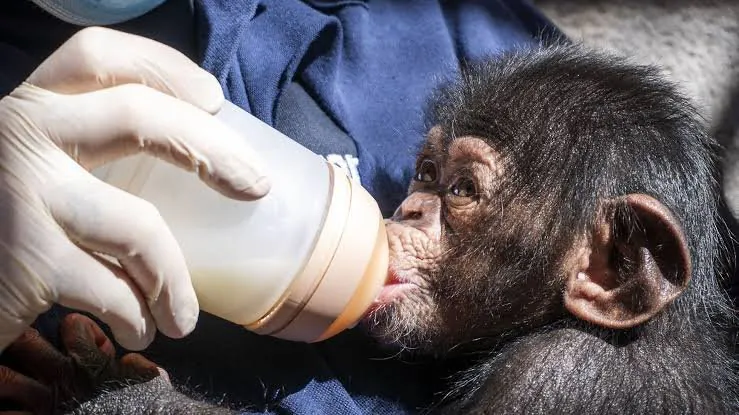
After a flurry of vet visits and x-rays, baby Cassie was fitted with a cast and is now being hand-reared by the zoo staff.


“Hand-raising is a very last resort with chimps,” Mr Chapman explained. “She is under our care at the moment while she recovers, but the ultimate goal is to get her back with mum.”
But there’s a glimmer of hope in this heart-wrenching story. A pregnant woman, also named Cassie, stepped forward to donate colostrum, a nutrient-dense first form of breastmilk, to help the baby chimpanzee recover.
“That gives her the best chance of having all the right antibodies,” said councillor Cherie Rutherford, who helped facilitate the donation.
Chimpanzees share 98 per cent of their DNA with humans, making the donated colostrum a lifeline for baby Cassie.
The new arrival was named Cassie, after both the woman who donated the colostrum and chimpanzee Cassius, who lived at the zoo for decades before his death last year.
Despite the rough start, baby Cassie is having positive interactions with mum, Sile, and the troop, through a barrier. “[Cassie] comes to visit each day with her mum and also with the rest of the troop,” Cr Rutherford said.
“Wraps that she uses are also brought up to Sile, so that she’s getting used to the baby’s smell.”
According to Mr Chapman, baby Cassie’s genetics are considered very valuable, given her mother’s German lineage and her father, Alon’s, Israeli heritage. “He is also unrelated to the rest of the chimpanzee groups in Australasia, so those two together, she is a very genetically valuable,” he said.
Analysis: What This Means for Australia
The arrival of baby Cassie is a significant event for the Rockhampton Zoo and the wider Australian community. With only a handful of chimpanzees born in Australian zoos in recent years, this new addition is a welcome boost to the species’ population.
However, the incident also highlights the risks and challenges associated with breeding endangered species in captivity.
“Our keepers, they feel that very deeply and they know there’s always a risk that could happen,” Cr Rutherford said, referencing the stillbirth of twins by another female chimp, Mary, just last month.
Security analysts say that the incident serves as a stark reminder of the need for stringent safety protocols and emergency response plans in place at zoos and wildlife parks.
Law enforcement insiders warn that the demand for exotic animals and their by-products, such as colostrum, can fuel the black market and pose a threat to animal welfare.
Industry observers believe that the successful donation of colostrum by a human mother highlights the importance of community engagement and education in supporting the conservation of endangered species.
As baby Cassie continues to recover and grow, her story serves as a poignant reminder of the complexities and challenges of caring for our closest living relatives in the animal kingdom.
The Rockhampton Zoo’s chimpanzee troop now numbers eight, with four males and four females. As the zoo staff work to reunite baby Cassie with her mother, they remain cautiously optimistic about the future of this fragile and fascinating species.