
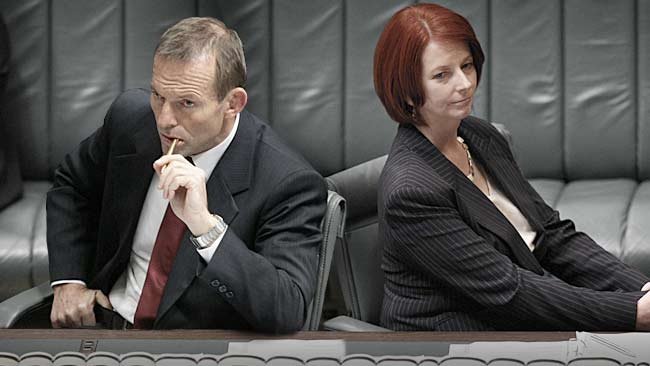
‘Pretty Over the Top’: Tony Abbott Breaks His Silence on the Misogyny Speech That Shook Parliament, as Julia Gillard Reveals She Has Never Watched It Back
- Fourteen years on, Tony Abbott says Julia Gillard’s famous misogyny speech was an “unjustified attack” and insists most of her accusations were exaggerated or unfair.
- The former Liberal leader claims he felt calm as the Prime Minister tore into him, believing he was “dominating” the chamber.
- Gillard admits she had staff compile a list of Abbott’s most sexist remarks before she rose to speak, but says the speech itself was unscripted.
- Remarkably, Australia’s first female prime minister says she has deliberately never watched the viral footage that has been seen by millions worldwide.
It lasted roughly 15 minutes. Its echoes have lasted more than a decade.
When Julia Gillard stood at the despatch box in October 2012 and declared she would not be lectured about sexism by Tony Abbott, few in Canberra’s press gallery believed they were witnessing history.
Many dismissed it as a clever deflection. Within days, it had circled the globe.
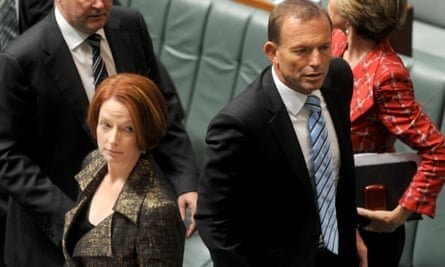
Now, for the first time in such candid terms, the man on the receiving end has spoken about what it felt like to sit across the chamber as the Prime Minister turned her fury on him.
His verdict is blunt. He thought she had gone “over the top”.
Mr Abbott made the remarks on the ABC iview series I Was Actually There, which revisits defining moments through the eyes of those who lived them.
Ms Gillard also appears in the episode, offering her own account of the day she says left her with a “cool anger”.
The former Coalition leader told the program he had known Ms Gillard for many years and considered her a “formidable politician”. The two, he said, had once shared a mutual respect.
But by late 2012, that respect was wearing thin.
He maintains he has never consciously treated women differently, or as lesser, because of their gender. As Ms Gillard reeled off a catalogue of his past comments, he said, his reaction was not alarm but composure.
He believed the chamber’s response showed he had the upper hand.
Mr Abbott conceded that some of the episodes she cited painted him as old-fashioned, clumsy or insensitive. Yet he insisted the bulk of the charges were either exaggerated or “slightly unfair”.
In his view, she was simply deploying the old political maxim that attack is the best form of defence.
Ms Gillard sees it very differently.
She told the program she knew she would be targeted in Question Time that day and asked her team to gather a list of her opponent’s most sexist quotes.
The words that followed, she says, came off the cuff.
She described Mr Abbott as something of a “rent-a-gaffe” on gender issues, likening the exchange to a hand of cards in which she could match every claim he made and then raise him.
The flashpoint was Peter Slipper. The Liberal MP had been coaxed into the Speaker’s chair by Labor, a move that shored up the numbers for Ms Gillard’s fragile minority government.
The arrangement unravelled when former staffer James Ashby accused Mr Slipper of sexual harassment, and crude, sexist text messages Mr Slipper had sent about female genitalia became public.
The government refused to dump him. Mr Abbott seized on what he called a double standard, moving a motion accusing Labor of sexism and misogyny.
In doing so, he said the government should “already have died of shame” — an unmistakable echo of radio broadcaster Alan Jones’s notorious comments following the death of Ms Gillard’s father.
Mr Abbott now calls that line “a bit of a niggle”, arguing it was fair to say the government should be ashamed of itself. For Ms Gillard, it was the spark.
She told the program she felt resentment and anger that, after enduring years of gendered attacks herself, she was now the one being skewered on sexism.
She also acknowledged a strategic shift. Her office had decided early on not to spotlight gender.
That day, ironically, handed her the moment.
Mr Abbott, for his part, points to the outcome. By evening, Mr Slipper had resigned — which he regards as total vindication.
Analysis: What This Means for Australia
The renewed clash is not merely a nostalgic replay of an old political brawl. It goes to the heart of how Australia confronts sexism in its institutions — and how slowly that conversation has moved.
The speech arrived years before the national reckoning over Parliament House culture triggered by the Brittany Higgins allegations in 2021, the March 4 Justice rallies, and the Jenkins review that found widespread bullying and harassment across Commonwealth parliamentary workplaces.
In hindsight, many see Ms Gillard’s words as an early alarm that went largely unheeded inside the building.
The social consequences are tangible.
Research tracked by the Australian Human Rights Commission has repeatedly found workplace sexual harassment remains pervasive, while the Workplace Gender Equality Agency continues to report a persistent gender pay gap.
Mr Abbott’s insistence that the accusations were unfair, set against Ms Gillard’s account of years of gendered critique, mirrors a divide many Australian workplaces still struggle to bridge.
There is also a question of democratic health.
Women weighing a career in federal politics watched how Australia’s first female prime minister was treated — and how her defence was initially written off as tactics.
That perception shapes who chooses to run.
Political observers say the gulf between the two accounts is revealing. Where Mr Abbott still frames the day as a parliamentary contest he effectively won, Ms Gillard frames it as a personal and cultural breaking point.
Both, analysts argue, can be true at once — and that tension is precisely why the speech endures.
Gender equality advocates believe the speech’s afterlife owes more to ordinary women than to Canberra insiders. The gallery’s early verdict, they note, was overtaken by millions of viewers who recognised their own experiences in it.
Parliamentary veterans warn that recognising a moment is not the same as changing a culture, and that the reforms promised after 2021 will be judged on enforcement, not rhetoric.
Mr Abbott concedes he had no inkling the speech would become an “iconic feminist moment”. He saw it as an effective tactic on the day, nothing more.
Ms Gillard, still asked about it at home and abroad, has made a striking choice. She has never watched it.
She wants to remember the day as she felt it, untouched by the footage — a memory, she says, she intends to keep exactly as it is.