
Cat Owners Beware: Your Feline Friend May Be Unleashing a Parasite That’s Spreading to Almost Half of the World’s Human Population
- Millions of Australians may be harbouring a deadly parasite spread by domestic cats, with serious health consequences for unborn babies and vision impairment for adults.
- A team of Australian researchers is calling on the World Health Organisation to add toxoplasmosis to its list of neglected tropical diseases, citing alarming exposure rates and devastating effects.
- The parasite, Toxoplasma gondii, can cause miscarriage, life-long eye and neurological issues in babies, and retinal scarring in adults, with one in 150 Australians affected.
- Experts warn that the disease is often avoidable in developed countries, but is a significant issue in undeveloped nations where it can spread through untreated water and unsanitary conditions.
The next time you snuggle up with your feline friend, you may want to think twice.
While owning a pet cat usually comes with the risk of the odd scratch or bite, or the pain of a costly vet visit, there’s a more sinister threat lurking in the shadows.
Toxoplasma gondii, a single-celled parasite known to infect birds and mammals across the globe, is likely responsible for spreading to almost half of the world’s human population.
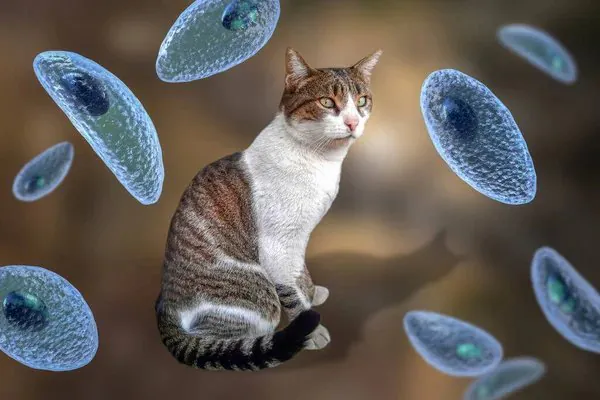
And the primary host of this parasite? Your domestic cat.
According to a team of Australian researchers, the parasite can have serious health consequences for humans, particularly unborn babies and adults with weakened immune systems. The bacteria’s primary host are species in the felidae family, including domestic cats and wild relatives such as lions.
It’s usually spread to other animals through cat faeces, even trace elements in soil or water. Humans can also become infected through those trace elements, or by ingesting the uncooked meat of an infected animal.
While the exposure rate is alarming, in most cases, it will go unnoticed as the body’s immune system causes the infection to become dormant. However, research led by Flinders University Professor Justine Smith has now revealed the more serious potential consequences for humans.
“When it infects a human, it goes to certain parts of the body and it really likes the eye, particularly the nerve tissue lining the back of the eye — important for building vision — called the retina,” Smith explained.
“So it eats a little piece of the retina and it incites a lot of inflammation and in some cases scarring.”
A study of 5,000 Australians living in Busselton, WA, found one in 150 people on average had retinal scarring due to toxoplasmosis, with varying severities depending on how central the scarring was on the retina.
Major issues can arise with people who are immunocompromised, as the disease can wake from its dormant state and continue to cause scarring on the retina.
Potentially fatal effects can be caused if a woman first becomes infected with toxoplasma while pregnant, when it can be passed onto the unborn child.
Without a proper immune system, the parasite can flood to the retina of the baby and cause life-long eye and neurological issues or, in some cases, cause a miscarriage.
Women are routinely warned not to go near cat litter trays while pregnant.
Smith says the worst-case scenarios for toxoplasmosis are often avoidable in developed countries such as Australia, but they are particularly an issue in undeveloped countries where it can spread through untreated water and unsanitary conditions, and where minimal medical infrastructure is insufficient to treat it.
Smith has now joined a group of researchers around the world calling for the World Health Organisation to add toxoplasmosis to its list of neglected tropical diseases (NTD).
“That recognition is really important because it gives it visibility,” she said. “It means that governments are aware of it and they build it into their public health programs.
It unlocks the opportunity to obtain funding for better prevention, treatment and also research.”
Analysis: What This Means for Australia
The implications of toxoplasmosis for Australia are significant. With millions of Australians potentially harbouring the parasite, the risk of vision impairment and miscarriage is a serious concern.
Furthermore, the disease’s ability to spread through untreated water and unsanitary conditions highlights the need for improved public health infrastructure and awareness campaigns.
Security analysts say that the lack of attention given to toxoplasmosis is a ticking time bomb, particularly in rural and remote areas where access to healthcare is limited.
Law enforcement insiders warn that the black market for infected meat and contaminated water sources is a significant concern, and industry observers believe that the economic consequences of toxoplasmosis could be substantial.
As the world grapples with the COVID-19 pandemic, it’s easy to overlook other health threats lurking in the shadows. But toxoplasmosis is a wake-up call for Australia to take action and address this neglected disease.
By adding it to the list of neglected tropical diseases, the World Health Organisation can help raise awareness and unlock funding for research, prevention, and treatment.
It’s time for Australia to take toxoplasmosis seriously and protect its citizens from this deadly parasite.