
Exclusive: The Mastermind Behind Pauline Hanson’s Dramatic Protest Banned from Canberra’s Elite National Press Club
- A daring protest at the National Press Club has left Senator Pauline Hanson reeling, with a senior campaigner from activist group GetUp! at the centre of the storm.
- David Sharaz, a former journalist, has been banned from the exclusive club and his organisation faces a hefty bill for damages.
- The dramatic stunt, which involved a remote-activated banner, has sparked a federal police investigation and raised questions about the limits of free speech.
- As the fallout continues, the National Press Club is considering taking legal action against GetUp! for the damage caused to its premises.
The National Press Club, a revered institution in Canberra’s media landscape, has taken a hard line against the mastermind behind a dramatic protest that upstaged Senator Pauline Hanson’s address last month.
David Sharaz, the campaign chief of progressive activist group GetUp!, has been banned from the club and his organisation faces a hefty bill for damages caused by the stunt.
The protest, which involved a remote-activated banner that unfurled as Senator Hanson took the stage, was a brazen attempt to discredit the One Nation leader.
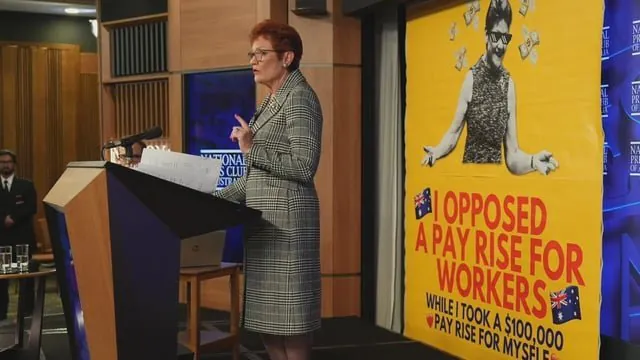
The banner read: “I opposed a pay rise for workers while I took a $100,000 pay rise for myself.” GetUp! claimed responsibility for the stunt, which sparked both Australian Federal Police and ACT Policing investigations.
According to National Press Club chief executive Maurice Reilly, Mr Sharaz’s membership application has been declined, and he is “not welcome at the club in the future.” Mr Reilly confirmed that the club is considering taking legal action against GetUp!
for the damage caused to the media wall and light box. “We will consider our legal position when the outcome of the AFP investigation is completed,” he said.
So, why did GetUp! choose such a dramatic and provocative method to make their point?
The answer lies in the group’s history of using unconventional tactics to capture the public’s attention. As a former journalist, Mr Sharaz knows how to craft a compelling narrative and create a media spectacle.
But as the leader of a prominent activist group, he also knows the risks of pushing the boundaries of free speech.
Analysis: What This Means for Australia
The fallout from the National Press Club protest has significant implications for Australia’s national security and law enforcement.
The fact that a senior campaigner from a prominent activist group was able to orchestrate such a daring stunt raises questions about the effectiveness of the country’s counter-terrorism measures.
Security analysts say that the incident highlights the need for increased vigilance in the face of growing extremist activity.
Law enforcement insiders warn that the incident could set a dangerous precedent, emboldening other activist groups to use similar tactics to disrupt public events. “The National Press Club protest shows that anyone can be a target, regardless of their position or influence,” said one insider.
As the investigation into the incident continues, Australians are left to ponder the limits of free speech and the role of activism in a democratic society.
While some may view the protest as a legitimate form of expression, others see it as a reckless attempt to undermine the authority of public figures.
Industry observers believe that the incident will have far-reaching consequences for the National Press Club and the wider media landscape. “The National Press Club is a symbol of journalism’s commitment to truth and fairness,” said one observer.
“This incident will raise questions about the club’s ability to maintain its neutrality in the face of growing activism.”