
From Toppled Statue to ‘Ring of Truth-Telling’: Hobart Unveils Australia-First Replacement for Colonial Surgeon Accused of Stealing an Aboriginal Man’s Skull, Igniting Fresh Battle Over Who Owns the Nation’s History
- The empty plinth where William Crowther once stood, before vandals sawed him off at the ankles in 2024, is now ringed by bronze and filled with native plants
- Crowther, a 19th-century surgeon and politician, is widely believed by historians to have broken into a morgue and taken the skull of Aboriginal man William Lanne for pseudoscience
- Hobart’s response is thought to be the first time an Australian council has removed a colonial statue through a democratic process, and other cities may follow
- A councillor joined protesters at the unveiling, warning against the “erasure of history”, while a Palawa writer accused critics of denying her people’s humanity
For more than a century, a bronze surgeon gazed across one of Hobart’s most cherished public squares. Today, there is no figure at all.
In its place sits something quieter and, its creators argue, far more honest: a bed of native plants enclosed by a gleaming bronze circle, etched with stories that the old monument never told.
The question now haunting town halls across the country is simple. Is this the future of Australia’s contested colonial monuments?
On Tuesday morning, the City of Hobart pulled back the curtain on its permanent answer to the statue of William Crowther in Franklin Square.
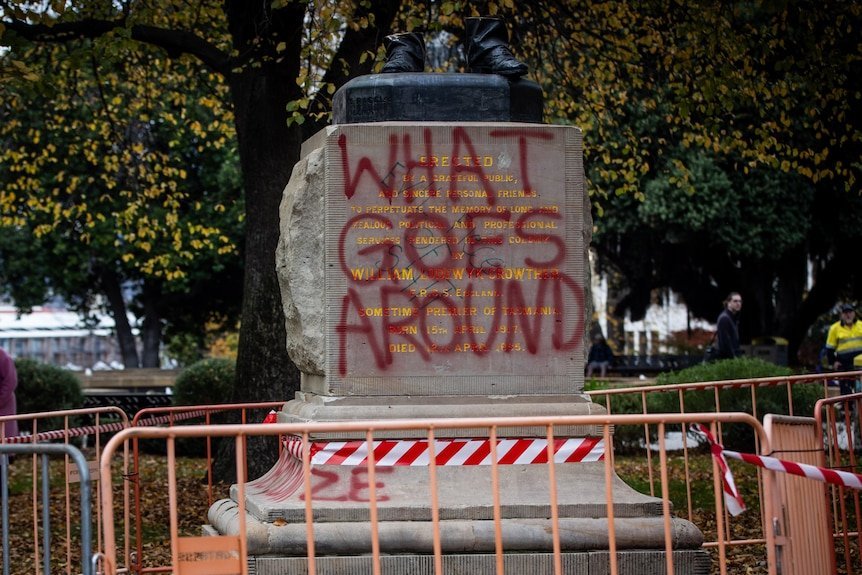
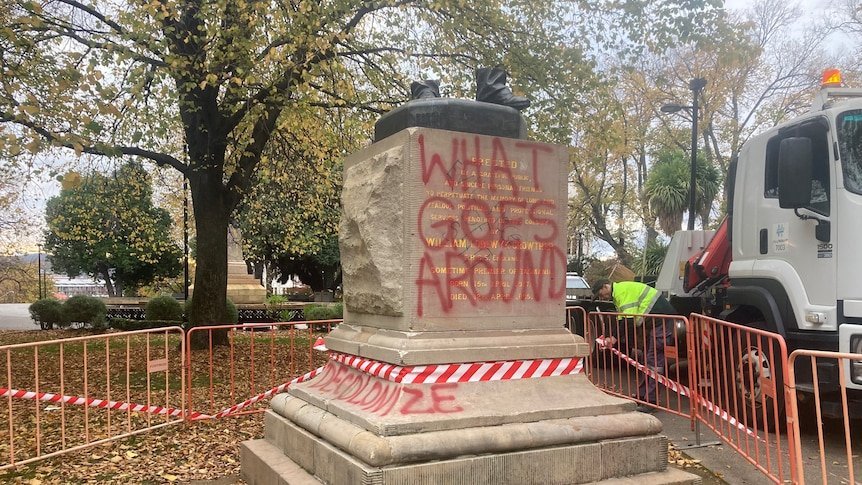
The bronze likeness was hacked down by vandals in mid-2024, cut through at the feet only hours before the Tasmanian Civil and Administrative Tribunal backed the council’s decision to remove it lawfully.
The plinth has been deliberately left standing.
Around it runs a bronze band carrying three separate texts, each capped at 250 words, with longer versions accessible through a QR code linked to the council’s website.
History writer Dr Alison Alexander tackled Crowther and colonial Tasmania. Palawa and Warlpiri woman Nunami Sculthorpe-Green wrote about William Lanne and the experience of Aboriginal Tasmanians in the 1800s.
Arts writer Andrew Harper reflected on the long global history of statues being torn down.
Dozens gathered for the ceremony. So did four protesters clutching signs.
Architect Mat Hinds, who was commissioned to reimagine the site, said the garden recalls the open, flowering field that existed before colonisation.
The choice of bronze was layered with meaning: it nods to the metal of the original statue, and to Lanne’s working life aboard whaling ships, where bronze was indispensable.
Mr Hinds described the band as a “ring of truth-telling”, a kind of halo, designed to draw visitors into a slow, almost meditative walk around the garden as they read.
Keeping the empty plinth, he said, serves as an echo of the decision to take the statue away.
He was blunt about traditional monuments, calling them a “really dumb way” for communities to hold memory, arguing they conceal as much as they reveal and frequently inflate the people they depict.
To understand why a patch of native garden has become a flashpoint, you have to go back to the darkest chapter of Crowther’s story.
Crowther was a prominent surgeon and politician in colonial Tasmania.
But most historians agree that after Lanne’s death he broke into a morgue and removed the Aboriginal man’s skull, part of the grim 19th-century trade in Indigenous remains used to prop up racist pseudoscience.
That act has shadowed his legacy for generations, and in recent years it collided with a broader national reckoning over who deserves to be honoured in public spaces.
The Crowther reinterpretation capped a multi-year public arts project that included temporary works by Palawa artists and extensive consultation.
Lord Mayor Anna Reynolds said the process stretched beyond five years and delivered a “fuller picture” of the city’s past, arguing the site now tells more history, not less, including stories that were once suppressed or dismissed as unimportant.
Hobart is far from alone. In 2020, Black Lives Matter protesters in Bristol dragged down a statue of slave trader Edward Colston and dumped it in the harbour.
On the eve of Australia Day in 2024, vandals sawed a statue of James Cook off at the ankles in Melbourne’s St Kilda. Monuments to Melbourne founder John Batman and NSW governor Lachlan Macquarie have also triggered bitter disputes.
Analysis: What This Means for Australia
Hobart has effectively handed the nation a blueprint, and it arrives at a combustible moment.
For law enforcement, the pattern is troubling.
In both Hobart and St Kilda, monuments were attacked with power tools under cover of darkness, timed to coincide with politically charged dates or legal rulings.
Each incident drains police resources and leaves councils footing repair and security bills, while emboldening those who believe vigilante action delivers faster results than democratic process.
Hobart’s approach offers a counterweight. By running its decision through community consultation and a tribunal challenge, the council can argue the outcome carries legitimacy that a midnight hacksaw never could.
That distinction matters for social cohesion as the broader debate over Indigenous recognition continues to divide communities.
There are economic dimensions too. Councils managing hundreds of colonial-era monuments face mounting costs for security, restoration and legal disputes.
A model that reinterprets rather than simply removes may prove cheaper and less inflammatory over time, and it could feed into growing visitor interest in cultural tourism.
But the risk of backlash is real.
Hobart councillor Louise Elliot, who opposed the project, said she could not support the erasure of history, describing Crowther as a good man loved by thousands of Tasmanians and arguing his memory had become a lightning rod for anger.
Ms Sculthorpe-Green hit back, saying those exploiting the project for political division were trying to deny Aboriginal people the right to be offended, and to deny their humanity.
She said the work was about widening, not rewriting, history, and centring Lanne as a human being.
Heritage observers say the Hobart model could become a reference point for local governments wrestling with similar monuments, particularly where legal bodies such as the Tasmanian Civil and Administrative Tribunal have already weighed in.
Law enforcement insiders warn that unless councils move transparently, frustrated activists may keep taking matters into their own hands, with copycat attacks on statues remaining a persistent threat around Australia Day each year.
Cultural sector analysts believe the project’s real significance lies in its inclusion of Aboriginal voices alongside a colonial historian.
Mr Harper said he searched for another city-led project in which Aboriginal artists responded to a colonial statue with a troubled past, and found none, calling it a huge achievement for everyone involved, even those who objected.
Dr Alexander said the city could not pretend the story never happened, and that acknowledging the statue’s removal was part of moving forward.
As for Crowther himself, he has not been melted down. The statue has been repaired, its ankles welded back on, and it now sits in council storage.
The Lord Mayor said there were no plans for it yet, though members of the public can ask to see it.
For now, the surgeon waits in the dark, while the square he once dominated blooms without him.