
Billion-Dollar Battleships Put AUKUS Submarine Plans at Risk: US Congress Warns of ‘Unrealistic’ Trump Project
- Donald Trump’s ‘Golden Fleet’ of battleships could delay the delivery of nuclear-powered submarines to Australia under the AUKUS pact
- The US House Armed Services Committee wants the Navy to provide reassurances that the battleship plan won’t interfere with existing shipbuilding projects
- Experts warn that the massive project could further strain the US Navy’s already struggling shipbuilding program
- Australia’s hopes of buying at least three Virginia-class submarines from the US could be jeopardized by the delays
The US Congress has sounded the alarm over Donald Trump’s ambitious plan to build a ‘Golden Fleet’ of battleships, warning that the project could put a strain on the US Navy’s shipbuilding program and jeopardize the delivery of nuclear-powered submarines to Australia under the AUKUS pact.
The House Armed Services Committee has expressed concerns that the construction of at least 15 ‘Trump-class’ battleships, also known as BBG(X), could interfere with the production of other nuclear-powered vessels, including the Virginia-class submarines that Australia hopes to acquire.
The committee has requested that the Navy provide a report on its strategy to design and construct the battleships without disrupting existing shipbuilding plans.
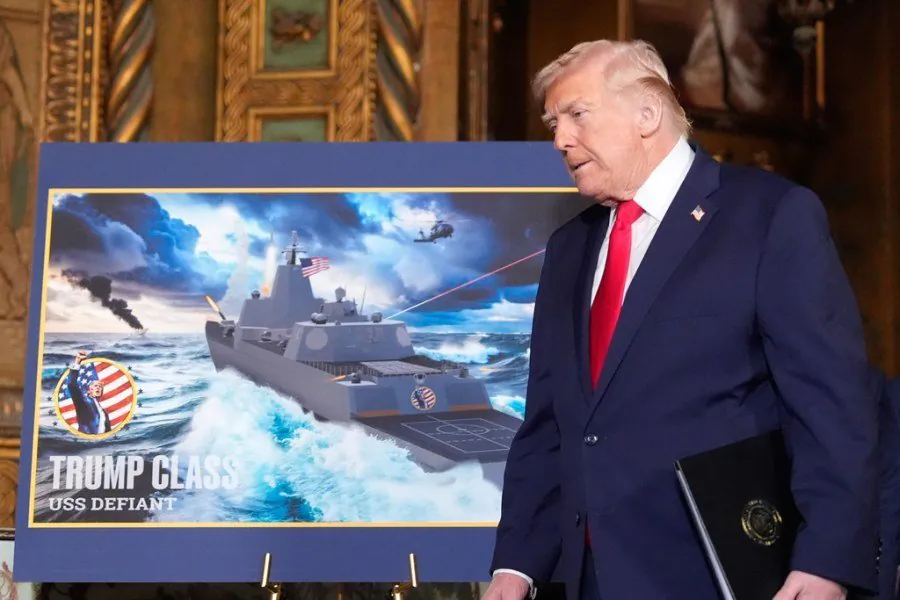
The US Navy’s shipbuilding program is already plagued by construction delays, which pose a significant threat to Australia’s hopes of buying at least three Virginia-class submarines under the AUKUS pact.
The committee’s concerns were echoed by Democrat Joe Courtney, one of Congress’s key AUKUS champions, who warned that the battleship plan would “encroach on previous industrial base capacity” and “violates every lesson we’ve learned on shipbuilding”.
The ‘Trump-class’ battleships, announced by the former President in December, are expected to be nuclear-powered and would require the use of the same supplier of nuclear reactors used for all US Navy boats.
However, the procurement of these reactors typically occurs 2-3 years ahead of procurement of the vessel, and production timelines range from 6-8 years. The committee fears that the accelerated procurement timeline for the BBG(X) program could result in a negative impact on this supply chain.
Analysis: What This Means for Australia
The potential delays to the US Navy’s shipbuilding program could have significant implications for Australia’s national security. The AUKUS pact relies on the US Navy’s ability to deliver nuclear-powered submarines to Australia, which is already facing significant delays.
If the construction of the ‘Trump-class’ battleships further strains the US Navy’s shipbuilding program, it could jeopardize Australia’s hopes of acquiring the submarines it needs to maintain its naval capabilities.
Security analysts warn that the delays could also have broader implications for regional security, as Australia’s ability to deter potential threats is closely tied to its naval capabilities.
“The AUKUS pact is a critical component of Australia’s national security strategy, and any delays to the delivery of nuclear-powered submarines could have significant implications for the country’s ability to defend itself,” said one analyst.
Law enforcement insiders also warn that the delays could have significant economic implications for Australia, as the country’s shipbuilding industry is closely tied to the US Navy’s program.
“The AUKUS pact is not just a security agreement, it’s also a significant economic opportunity for Australia,” said one insider. “Any delays to the delivery of nuclear-powered submarines could have significant implications for the country’s economy.”
Expert Commentary
Defence expert Mark Cancian, from the Center for Strategic and International Studies, has described the ‘Trump-class’ battleships as an “unrealistic vanity project” that is unlikely to survive beyond Trump’s term.
“The battleships will take years to design, cost $9 billion each to build, and contravene the Navy’s new concept of operations, which envisions distributed firepower,” Cancian wrote.
Other experts have also expressed concerns about the feasibility of the project, citing the significant technical and logistical challenges involved in building such a large number of nuclear-powered battleships.
“The US Navy’s shipbuilding program is already struggling to meet its existing commitments,” said one expert. “Adding a new project of this scale to the mix is just unrealistic.”