
‘Mum of Terror’: How One Woman’s Descent into ISIS Indoctrination Put Her Children in the Firing Line
- A Melbourne mother of three is accused of exposing her young children to shocking ISIS propaganda, encouraging them to mimic fighters and watch graphic videos of violence.
- Rayann El Houli, 34, allegedly posed an ‘unacceptable risk’ to the community and her own children, with prosecutors claiming she had not moved on from her radical ideology.
- El Houli’s bail application has been delayed, with a magistrate reserving his decision until next week amid concerns over her potential threat to national security.
- As the case raises questions about the dangers of extremist ideology in Australia, experts warn that the country’s counter-terrorism efforts must adapt to the evolving threat of ISIS-inspired radicalisation.
Raised in Melbourne, Rayann El Houli’s transformation from a suburban mother to an alleged ISIS supporter is a disturbing example of the insidious nature of extremist ideology.
In 2014, El Houli voluntarily travelled to Syria, leaving behind her ordinary life in Australia to live under the brutal rule of the Islamic State.
For five years, El Houli and her family were immersed in the brutal world of ISIS, with her children exposed to shocking propaganda and encouraged to mimic the actions of fighters.
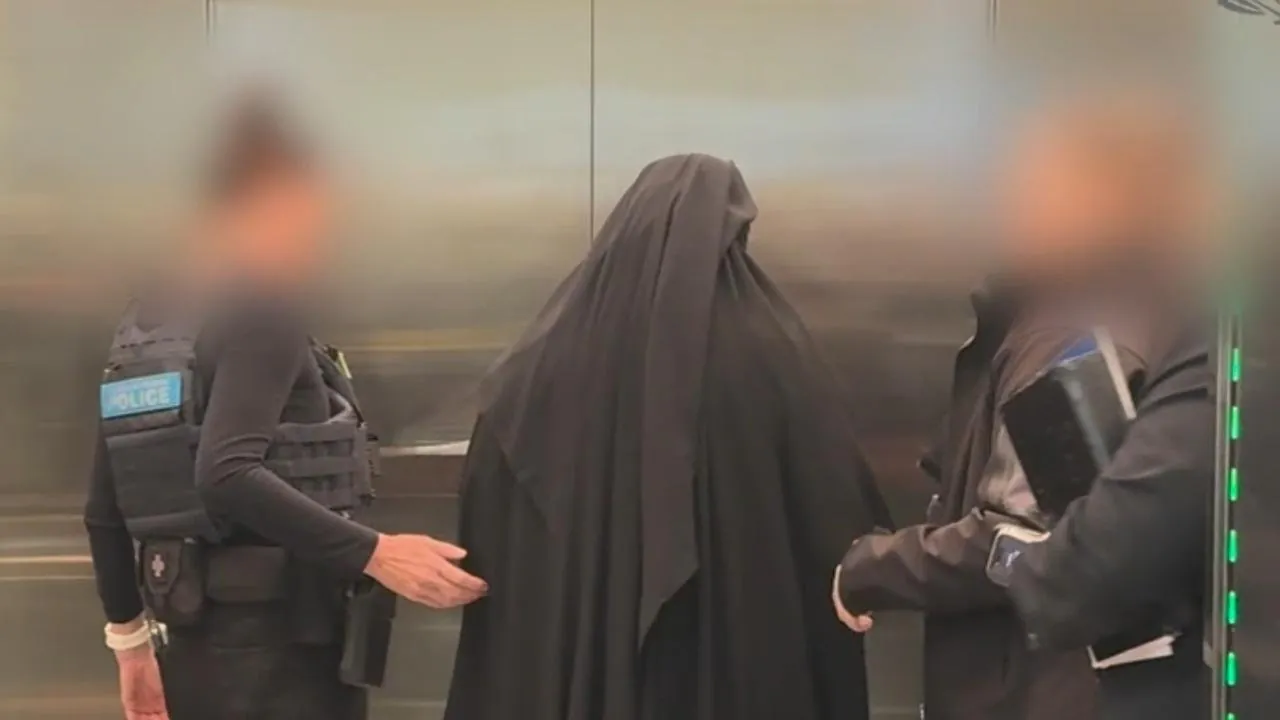
Videos allegedly filmed by El Houli show her young children watching graphic footage of violence and being asked to repeat extremist slogans.
In one disturbing clip, a toddler is seen mimicking the actions of a fighter, holding a toy rifle and repeating the phrase ‘in the hellfire’ when asked where Allah puts disbelievers.
Senior Constable Paul Sherlock, the lead investigator, described the videos as ‘disturbing’ and claimed that El Houli’s actions posed an ‘unacceptable risk’ to the community and her own children.
‘The protective factor is that if she does something wrong, she will be arrested and separated from her children,’ Sherlock said.
But El Houli’s lawyer, Peter Morrissey SC, argued that his client had experienced significant PTSD since returning to Australia and was focused on being a good mother.
Morrissey claimed that El Houli’s activities in Syria were ‘very old’ and that she had not engaged in any extremist behaviour since her return to Australia.
However, prosecutor Andrew Sprague countered that El Houli’s alleged engagement and enthusiasm for ISIS when she travelled to Syria and supported the regime ‘undermined’ her assertions about her initial ideology and motivations.
Sprague pointed to the videos of El Houli allegedly showing her children propaganda, asking if she was ‘seeking to indoctrinate them.’
As the case continues, it raises serious questions about the dangers of extremist ideology in Australia and the country’s counter-terrorism efforts.
Security analysts warn that the threat of ISIS-inspired radicalisation is evolving, with social media and online platforms providing a fertile ground for extremist groups to spread their ideology.
‘The threat of extremist ideology is not limited to Syria or the Middle East,’ said one security expert. ‘It’s a global problem that requires a global response.
Australia must continue to adapt and evolve its counter-terrorism efforts to address this threat.’
As the nation grapples with the complexities of counter-terrorism, the case of Rayann El Houli serves as a stark reminder of the devastating consequences of extremist ideology.
With her bail decision pending, the community remains on high alert, wondering if this ‘mum of terror’ will be released back into society.
Analysis: What This Means for Australia
The case of Rayann El Houli highlights the ongoing threat of extremist ideology in Australia and the need for continued vigilance in the face of evolving threats.
The fact that El Houli was able to travel to Syria and engage with ISIS without detection raises serious questions about the effectiveness of Australia’s border security and intelligence gathering.
Law enforcement insiders warn that the threat of ISIS-inspired radicalisation is not limited to Syria or the Middle East, but is a global problem that requires a global response.
Australia must continue to adapt and evolve its counter-terrorism efforts to address this threat, including investing in social media monitoring and online counter-narrative programs.
The community impact of extremist ideology cannot be overstated.
The fact that El Houli’s children were exposed to shocking propaganda and encouraged to mimic the actions of fighters is a stark reminder of the devastating consequences of extremist ideology.
As the nation grapples with the complexities of counter-terrorism, it is essential that we prioritize the safety and well-being of our children and communities.