
‘Knocked Unconscious With a Brain Bleed’: Police Reject Political Motive in Brutal Surf Coast Bashing of One Nation Volunteer, as Accused Was Allegedly Breath-Tested Hours Before and Fundraiser Rockets Past $250,000
- A 60-year-old One Nation volunteer was allegedly struck with a blunt weapon outside his Surf Coast home, leaving him unconscious with bleeding on the brain.
- Victoria Police say detectives are not treating the attack as politically motivated, contradicting claims from One Nation leaders that his campaign signs made him a target.
- The 37-year-old man charged was allegedly intercepted by police in Torquay about three hours earlier, returned a positive breath test and had his car impounded.
- An online fundraiser promoted by the party has raised more than $250,000, weeks out from Victoria’s November 28 state election.
A quiet Sunday evening on Victoria’s Surf Coast ended with a 60-year-old man lying unconscious, blood pooling on his brain, and a state election campaign suddenly forced to confront an uncomfortable question.
Was he attacked because of the political signs on his property? Or was something else entirely at play?
Victoria Police have now delivered their answer, and it is not the one One Nation wanted to hear.
“Detectives are not treating the incident as politically motivated,” the force said in a statement, pouring cold water on claims that the volunteer was singled out for his support of Pauline Hanson’s party.
The alleged assault unfolded on Scorpio Street at around 7.45pm on Sunday.
Within a short time, officers had arrested two people: a 37-year-old man from Hampton Park, in Melbourne’s south-east, and a 14-year-old boy.
The man has been charged with intentionally causing injury along with other assault-related offences. The teenager was let off with a caution.
But it is what police revealed about the hours before the bashing that has raised the most eyebrows.
At about 4.20pm the same day, officers stopped the 37-year-old on Blackgate Road in Torquay. He allegedly returned a positive breath test, and his vehicle was impounded on the spot.
Roughly three and a half hours later, the man was allegedly involved in the violent confrontation that left a grandfather-aged volunteer fighting for his recovery in hospital.
Police also moved to correct early reports about the weapon used. The victim was not struck with a baseball bat, as had been widely circulated, but with what investigators described only as “a blunt weapon”.
One Nation’s federal leader, Senator Pauline Hanson, travelled to University Hospital Geelong on Monday to visit the injured man. She said afterwards that he had been knocked unconscious and suffered a brain bleed.
By then, the party’s Victorian leader, Warren Pickering, had already framed the attack as an act of political intimidation, alleging the volunteer was targeted because One Nation signage was on display at his home.
Mr Pickering urged every candidate and party contesting the looming poll to commit to “peaceful debate”, a plea that has been echoed across the political divide.
Premier Ben Carroll and Liberal leader Jess Wilson both expressed shock and concern at the incident, a rare moment of unity in an increasingly heated campaign.
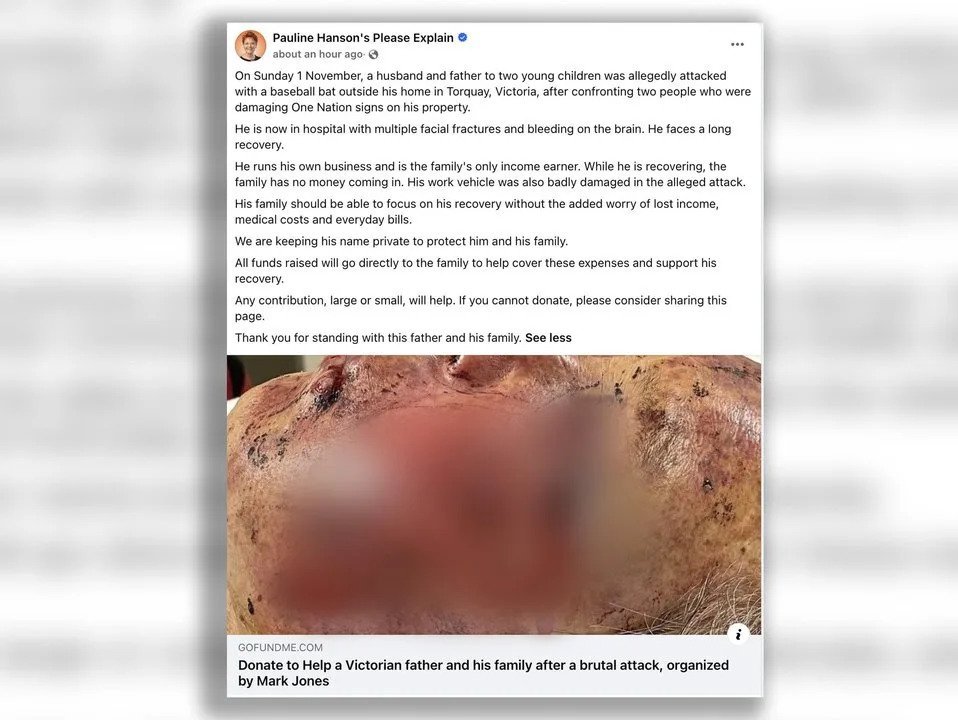
Meanwhile, an online fundraiser promoted across One Nation’s social media channels has surged past $250,000, a staggering sum that speaks to how deeply the story has struck a nerve with the party’s supporters.
The attack lands at a volatile moment.
Victorians head to the polls on November 28, and campaign season has always brought with it a rash of defaced corflutes, torn-down banners and heated doorstep exchanges.
Yet the broader climate has darkened in recent years.
Electorate offices around the country have been vandalised and targeted with protest activity, and Australia’s domestic spy agency, Australian Security Intelligence Organisation, has repeatedly warned that politically motivated violence has become a growing concern, contributing to its decision in 2024 to lift the national terrorism threat level to “probable”.
Against that backdrop, it is unsurprising that One Nation’s supporters instinctively read the attack as an assault on political expression itself.
Police, however, appear to be pointing towards a different explanation, though they have not publicly detailed what they believe the motive to be.
Analysis: What This Means for Australia
Regardless of motive, the case exposes a raw nerve in Australian civic life. Displaying a sign for a political party on your front fence is one of the most basic forms of democratic participation.
If ordinary volunteers begin to fear that doing so could make them a target, the chilling effect on community engagement could be profound.
From a national security perspective, the episode illustrates how quickly a local crime can be absorbed into a national narrative. Within hours, claims of political targeting were circulating widely online, long before investigators had established the facts.
In a polarised environment, that gap between allegation and evidence is precisely where misinformation thrives.
For law enforcement, the revelation that the accused had already been dealt with by police that afternoon will inevitably prompt scrutiny.
Questions are likely to be asked about what happened in the hours between the roadside interception and the alleged assault, and whether anything more could have been done.
Those questions go to the heart of drink driving enforcement and the limits of what police can do once a vehicle has been impounded.
For the Surf Coast community, a region better known for its beaches and holidaymakers than for street violence, the attack has delivered a jolt. Residents are left grappling with the reality that serious crime can erupt on an ordinary suburban street on an ordinary Sunday night.
And politically, the enormous fundraising response shows how incidents like this can galvanise support, mobilise voters and reshape campaign dynamics in the final weeks before a Victorian state election.
Security analysts say the case is a textbook example of why authorities must be cautious about attributing motive too quickly, in either direction. Labelling an attack political when it is not risks inflaming tensions, while dismissing a genuine political motive could embolden would-be offenders.
Law enforcement insiders warn that election periods place extra strain on police, who must balance the protection of candidates and volunteers with routine policing demands across the state.
Political observers believe the major parties’ swift condemnation was a deliberate effort to lower the temperature, recognising that any perception of tolerance for intimidation could backfire badly with voters.
Community safety advocates argue that, whatever the court ultimately finds, the image of a 60-year-old man left unconscious outside his own home should alarm every Victorian.
The 37-year-old is expected to face court at a later date. None of the allegations against him have been tested.
One Nation was approached for comment on the police statement.
For now, a volunteer remains in hospital, a community is shaken, and a state election campaign has been reminded just how fragile the line between passionate debate and violence can be.