
Australia’s Defence Strategy in Shambles: Expert Warns of US Dominance in Northern Territory
- The Australian Strategic Policy Institute has slammed the government’s defence infrastructure delivery in the Northern Territory, warning of US dominance in the region.
- The report claims Australia’s defence planning has been “incoherent” and has not kept pace with US expansion in the Northern Territory.
- Experts warn that Australia’s reliance on the US could undermine its sovereignty and weaken its deterrent capabilities.
- The report calls for a more focused approach to defence infrastructure development in the Northern Territory to ensure Australia’s national security.
The Australian government’s defence strategy in the Northern Territory has been labelled “incoherent” and “fragmented” by a damning report from the Australian Strategic Policy Institute (ASPI).
The report warns that Australia’s defence planning has not kept pace with the rapid expansion of US military presence in the region, risking dependence on the US and undermining Australia’s sovereignty.
In 2023, the federal government announced a $3.8 billion investment over four years to upgrade military installations across Australia’s north.
However, the ASPI report claims that the delivery of this investment has been “thin, fragmented, or misaligned”, with the Northern Territory’s defence infrastructure “hollowed out” by the redeployment of personnel and equipment interstate.
The report’s authors, John Coyne and Raelene Lockhurst, argue that Australia’s defence planning has been inconsistent and has failed to match the US’s expansion in the Northern Territory.




“If left uncorrected, that trajectory undermines sovereign resilience, weakens deterrence credibility, and risks turning alliance integration into dependence rather than partnership,” they warn.
Australia’s 2024 National Defence Strategy identified bases in the NT, Western Australia, and Queensland as key to a “strategy of denial”, where Australia defends itself in the seas to its north using long-range missiles and deployment of troops from sea and air onto land.
However, the ASPI report claims that the delivery of this strategy has been hindered by the lack of investment in defence infrastructure in the Northern Territory.
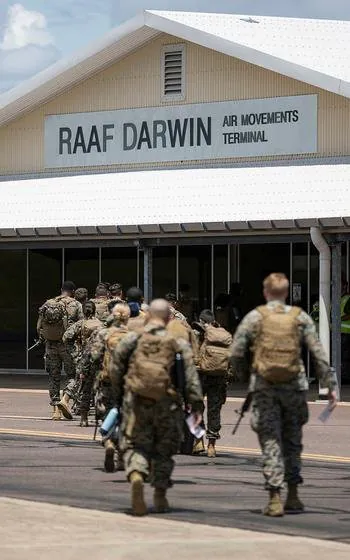
Since 2012, tens of thousands of US marines have been stationed in Darwin on six-month deployments, with 2,500 marines and sailors in last year’s rotational force.
The ASPI report notes that this expansion has not been matched by Australia’s own defence presence in the region, with the Northern Territory having around 500 fewer permanent Australian Defence Force personnel in 2025 than in 2015.
Experts warn that Australia’s reliance on the US could have serious consequences for national security.
“That shift stands in sharp contrast to the trajectory of the US, which is rapidly expanding its posture, operational tempo, and sustainment depth in northern Australia,” the report says.
Analysis: What This Means for Australia
The ASPI report’s findings have significant implications for Australia’s national security and defence strategy. If Australia continues to rely on the US for its defence in the Northern Territory, it risks undermining its sovereignty and weakening its deterrent capabilities.
This could have serious consequences for Australia’s ability to defend itself in the region.
Security analysts say that Australia needs to take a more focused approach to defence infrastructure development in the Northern Territory to ensure its national security.
This includes investing in road and rail lines between Darwin and Adelaide, which would drive economic growth and productivity, as well as providing critical infrastructure for defence.
Dr Coyne, one of the report’s authors, says that the federal government needs to take a more holistic approach to defence planning, considering how different infrastructure projects interact with each other to create economic opportunity and support the ADF in times of conflict.
As Australia’s closest Asian neighbours grow wary of the increasing US military presence in the region, it is more important than ever that Australia takes control of its own defence strategy and invests in the infrastructure necessary to support it.