
Australian Women and Children Flee Syrian Refugee Camp: The High-Stakes Journey Home
- A group of Australian women and children have left the notorious al-Roj refugee camp in north-eastern Syria, sparking concerns about national security and community safety.
- Their departure comes on the heels of a previous group of four women and nine children who returned to Australia earlier this month, only to have three of the women arrested and charged by federal police.
- As the latest group makes its way to Damascus, then on to Australia, experts warn of the potential risks and consequences of their return, citing links to the Islamic State and possible radicalization.
The bus carrying the group of Australian women and children had barely left the dusty confines of the al-Roj refugee camp in north-eastern Syria when the questions began.
Where were they headed? What would happen to them when they arrived in Australia?
And, most pressing of all, what kind of threat did they pose to the Australian public?
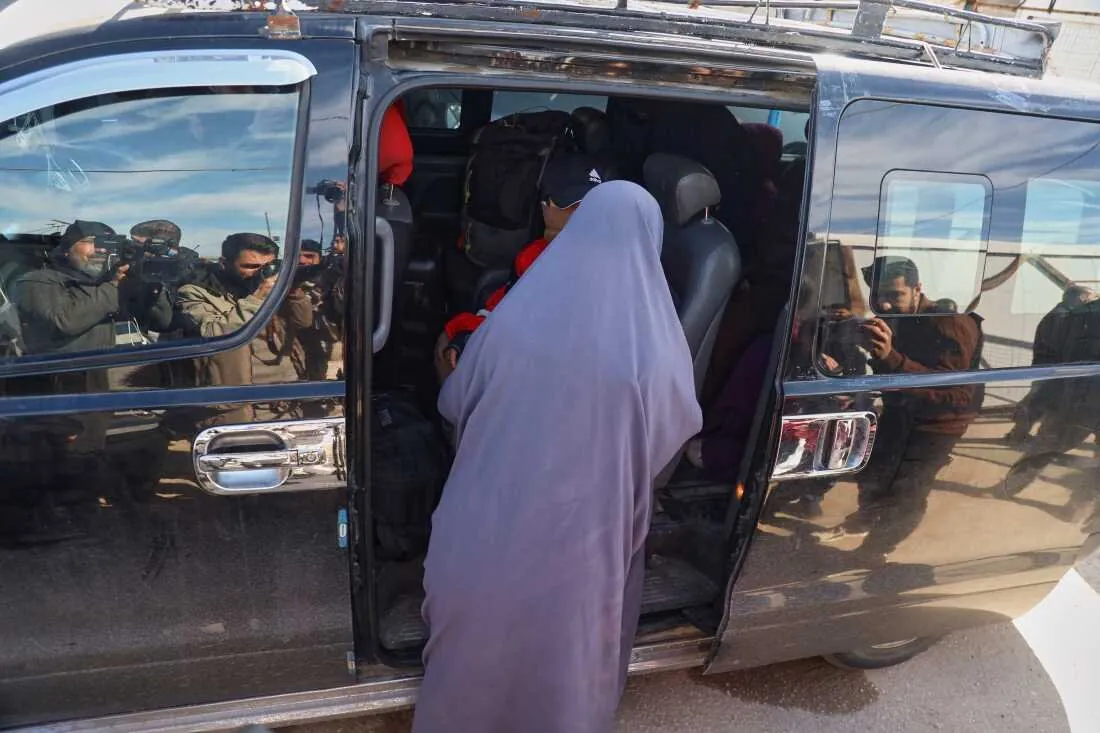
The facts are these: the group, believed to comprise all remaining Australians at the camp, departed on Thursday afternoon, local time, accompanied by Syrian government officials acting as escorts.
Their destination is Damascus, from where they will embark on the long journey to Australia. But as they make their way back to their home country, the Australian government finds itself in a precarious position.
Earlier this month, a group of four women and nine children returned to Australia after years in the squalid camp. But their homecoming was short-lived, as three of the women were arrested and charged by federal police upon arrival in Melbourne and Sydney.
Two were charged with slavery offences, while the third was charged with joining a terrorist organisation and travelling to a declared terrorist area.
The Australian government has repeatedly insisted it is not helping to bring the women and children home, yet it is under an obligation to provide them with travel documents, which it did earlier this year.
The Prime Minister, Anthony Albanese, has made his feelings on the matter clear, saying he holds the women in contempt for travelling to Syria at the height of the so-called Islamic State’s efforts to establish a caliphate.
However, some of the women claim they were coerced or tricked into making the journey.
As the latest group makes its way back to Australia, security analysts warn of the potential risks and consequences of their return. “These women and children have been living in close proximity to some of the most hardened and radicalized individuals in the world,” one expert notes.
“The risk of radicalization, whether through coercion or influence, is very real, and the Australian government needs to be prepared to deal with the consequences.”
But what exactly does that mean for Australia? The reality is that the country’s laws and policies are not equipped to deal with the complexities of this situation.
Legal experts insist there is no legal basis or power to block the group from making the trip, given they are Australian citizens.
This leaves the government with a difficult decision: to provide support and rehabilitation to those who may have been coerced or tricked into joining the Islamic State, or to take a hardline stance and risk further alienating an already vulnerable group.
Analysis: What This Means for Australia
The return of these women and children raises serious questions about national security and community safety.
With the threat of terrorism still very real, the Australian government needs to be prepared to deal with the consequences of their return.
This includes providing support and rehabilitation to those who may have been coerced or tricked into joining the Islamic State, as well as taking steps to mitigate the risk of radicalization.
Law enforcement insiders warn that the task ahead will be daunting. “We’re dealing with a group of individuals who have been living in a war zone, surrounded by extreme ideology,” one source notes.
“The risk of radicalization is very real, and we need to be prepared to deal with the consequences.”
As the Australian government grapples with the complexities of this situation, one thing is clear: the return of these women and children will have far-reaching consequences for the country.
Whether it’s the risk of radicalization, the need for rehabilitation and support, or the potential for further alienation, this is a story that will continue to unfold in the months and years to come.
Industry observers believe that the Australian government needs to take a more proactive approach to dealing with the return of these women and children.
“We need to be prepared to provide support and rehabilitation to those who may have been coerced or tricked into joining the Islamic State,” one expert notes.
“This includes providing access to counseling, education, and job training, as well as working to reintegrate them into society.”
But as the debate rages on, one thing is clear: the return of these women and children will be a defining moment for Australia. Will the country be able to provide the support and rehabilitation they need, or will they be left to fend for themselves?
Only time will tell.
The bus carrying the group of Australian women and children had barely left the dusty confines of the al-Roj refugee camp in north-eastern Syria when the questions began. Where were they headed? What would happen to them when they arrived in Australia? And, most pressing of all, what kind of threat did they pose to the Australian public?
The facts are these: the group, believed to comprise all remaining Australians at the camp, departed on Thursday afternoon, local time, accompanied by Syrian government officials acting as escorts. Their destination is Damascus, from where they will embark on the long journey to Australia. But as they make their way back to their home country, the Australian government finds itself in a precarious position.
Earlier this month, a group of four women and nine children returned to Australia after years in the squalid camp. But their homecoming was short-lived, as three of the women were arrested and charged by federal police upon arrival in Melbourne and Sydney. Two were charged with slavery offences, while the third was charged with joining a terrorist organisation and travelling to a declared terrorist area.