
Australia Sounds Alarm as Middle East Conflict Threatens to Unleash a Perfect Storm on the Global Economy
- Australia urges diplomatic end to the conflict as fuel prices soar and cost-of-living pressures escalate
- Foreign Minister Penny Wong warns of devastating consequences for households and the global economy
- US President Donald Trump threatens further action against Iran, sparking fears of all-out war
- Prime Minister Anthony Albanese voices concern over the prospect of renewed escalation and its impact on financial markets
The Middle East conflict is on the brink of spiraling out of control, and Australia is sounding the alarm, warning that a return to all-out war could unleash a perfect storm on the global economy.
As tensions between the US and Iran continue to escalate, Foreign Minister Penny Wong is urging a diplomatic end to the conflict, warning that the consequences are already being felt by Australian households through higher fuel prices and broader cost-of-living pressures.
Speaking from London, where she is attending high-level talks with key European and British counterparts, Senator Wong stressed that Australia has been working closely with allies to support efforts to bring the fighting to an end.
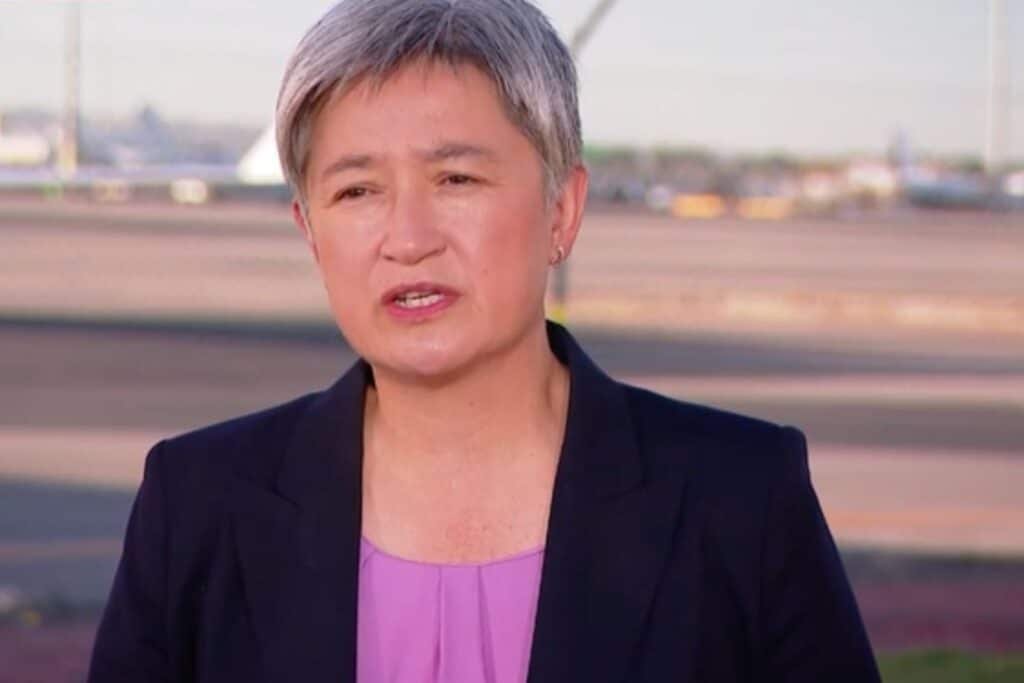
“We want a negotiated solution. We want a negotiated end to the conflict.
That’s what we’ve called for; that’s what we’re pressing for,” Wong said. Her comments come as US President Donald Trump threatened further action against Iran, warning Tehran would “pay the price” if negotiations drag on.
The conflict has already had far-reaching consequences, with the US launching fresh strikes that Washington described as a “proportional response to unjustified Iranian aggression” after an American helicopter was downed near the Strait of Hormuz.
The incident has sparked fears of a wider conflict, with Prime Minister Anthony Albanese voicing concern about the prospect of renewed escalation and its impact on financial markets.
“We’re very worried both about the human impact, of course that comes with war, but also the economic impact that is having a massive impact on the global economy will get worse rather than better,” Albanese told the ABC.
The conflict has been simmering for months, with tensions between the US and Iran escalating in recent weeks. The situation has been further complicated by the presence of other regional players, including Saudi Arabia and the United Arab Emirates.
Security analysts say the conflict has the potential to draw in other countries, sparking a wider regional war. “The situation is highly volatile, and the risk of miscalculation is high,” one analyst warned.
“The consequences of a wider conflict would be catastrophic, not just for the region but for the global economy as a whole.”
Analysis: What This Means for Australia
The conflict in the Middle East has significant implications for Australia’s national security and economic interests. The country’s reliance on imported oil makes it vulnerable to price shocks, which could have a devastating impact on the economy.
Furthermore, the conflict has the potential to disrupt global supply chains, which could lead to shortages and price increases for essential goods.
Law enforcement insiders warn that the conflict could also have a profound impact on Australia’s counter-terrorism efforts, as extremist groups seek to exploit the chaos and instability.
“The conflict has the potential to create a perfect storm of instability, which could have far-reaching consequences for Australia’s national security,” one insider said.
Industry observers believe that the conflict could also have a profound impact on Australia’s trade relationships, particularly with countries in the Middle East. The conflict has already led to a decline in trade volumes, and further escalation could lead to a complete collapse of trade relationships.
“The conflict is having a devastating impact on trade, and further escalation could lead to a complete collapse of trade relationships,” one observer said. “This could have a profound impact on Australia’s economy, particularly in industries such as agriculture and resources.”