
‘Shocking’ Conditions in Cairns Watch House Breach Human Rights of Children as Young as 13, Tribunal Finds
- Three teenage boys, aged 13-17, had their human rights breached while being held on remand in the Cairns watch house in 2021 and 2022.
- Conditions in the watch house were found to be unsanitary, with no windows or natural light, and children were forced to use the toilet in full view of others.
- Advocates warn that children’s mental health declines rapidly in watch houses, leading to a higher risk of reoffending.
The Queensland Civil and Administrative Tribunal (QCAT) has delivered a scathing verdict on the conditions in the Cairns watch house, finding that the human rights of three teenage boys were breached during their detention in 2021 and 2022.
The tribunal’s findings have sparked outrage among advocates, who warn that the conditions in the watch house are not only inhumane but also counterproductive in reducing youth crime.
The three boys, aged between 13 and 17 at the time, were held on remand in the Cairns watch house for periods of several days. During their detention, they were subjected to conditions that were deemed “not compatible” with their human rights.
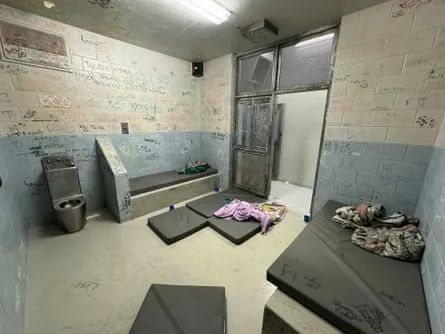
The watch house cells were found to be unsanitary, with no windows or natural light, and the children were forced to use the toilet in full view of others.
One child was even detained in a padded cell for over an hour, a decision that was deemed “not compatible” with his human rights.
The tribunal’s findings are a damning indictment of the Queensland government’s handling of youth justice. Advocates say that the conditions in the watch house are not only a breach of human rights but also a recipe for disaster.
“Children’s mental health declines quite quickly after spending days in watch houses,” said Katherine Hayes, chief executive of the Youth Advocacy Centre. “They do go on to commit more crimes after they’re mistreated like this.”
The situation in the Cairns watch house is not an isolated incident. Advocates say that the conditions in watch houses across Queensland are similarly dire, with children being held in cells with limited privacy and inadequate facilities.
The state’s proposed new youth bail laws are likely to exacerbate the problem, with more children being detained in a system that is already struggling to cope.
Security analysts say that the situation highlights the need for a more holistic approach to youth justice, one that addresses the underlying causes of crime rather than simply locking children up.
“These kids who are committing these crimes tend to have a lack of impulse control, a lack of emotional regulation,” said Hayes. “They need help, not punishment.”
Analysis: What This Means for Australia
The findings of the QCAT tribunal have serious implications for Australia’s youth justice system. The fact that children as young as 13 are being detained in conditions that breach their human rights is a national shame.
The situation highlights the need for urgent reform, including increased investment in youth detention facilities and a more holistic approach to addressing the underlying causes of crime.
Law enforcement insiders warn that the situation in the Cairns watch house is not an isolated incident, but rather a symptom of a broader problem. “Police haven’t created these unpleasant conditions,” said Shane Prior, president of the Queensland Police Union.
“But we need significant government investment to address overcrowding in our watch houses.”
As the Queensland government considers the tribunal’s findings, it must also consider the long-term consequences of its actions.
The fact that children’s mental health declines rapidly in watch houses, leading to a higher risk of reoffending, is a stark reminder that the current system is not working.
It is time for a new approach, one that prioritizes rehabilitation and support over punishment and detention.