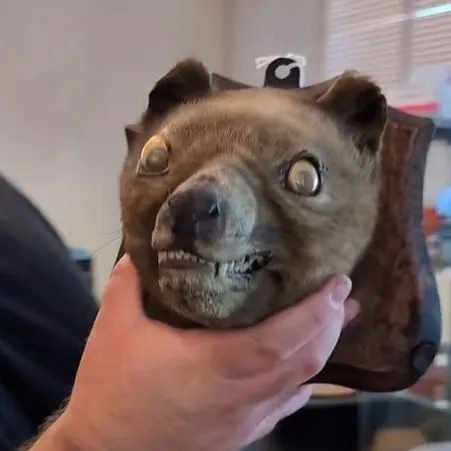
Shocking Discovery in UK Auction House: ‘Holy Grail’ of Taxidermy Specimens Uncovered as Rare Tasmanian Tiger Head
- A British collector has purchased a mounted head at an auction in the UK, later discovered to be the extremely rare and valuable skull of a Tasmanian tiger, a species thought to be extinct since 1936.
- The buyer, James Cranfield, paid over 60,000 British pounds for the specimen, which was initially listed as a fox’s head and had an estimated price of just 40 pounds.
- Experts say the discovery is a significant find, with only one other known mounted head of a Tasmanian tiger in existence, and could provide valuable insights into the biology and history of the species.
- The head’s origins are unknown, but it is believed to have been brought to the UK during the 19th or early 20th centuries, possibly as part of a bounty hunting program in Tasmania.
The discovery of the Tasmanian tiger head has sent shockwaves through the scientific community, with many experts hailing it as a significant find.
The species, also known as the thylacine, was thought to be extinct since 1936, when the last known captive individual died at Beaumaris Zoo in Hobart, Tasmania.
James Cranfield, the collector who purchased the head, said he had a “battle” with another bidder after they both realized the true identity of the specimen.
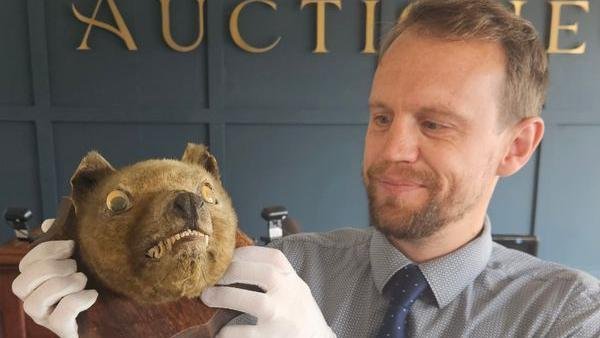
“Because it has plastic googly eyes, everyone overlooked it as a tatty fox head, but I spotted the teeth and spent days and sleepless nights comparing and contrasting,” he said.
Cranfield’s hypothesis is that the head originated from when hunters in Tasmania were offered bounties for killing thylacines and presenting the skulls as evidence, between 1888 and 1909.




He believes it was then brought to the UK, possibly by a private animal dealer.
The remains of the last-known thylacine were thought to be lost for over 85 years, but were recently rediscovered in a cupboard at a Tasmanian museum.
The significance of this discovery is only now being realized, and the find of the mounted head in the UK has added to the excitement.
Senior zoology curator at the Tasmanian Museum and Art Gallery, Kathryn Medlock, said specimens from thylacines were uncommon, although they did occasionally pop up.
“Any thylacine material is quite rare, but specimens do turn up from time to time having been kept in a family home or on a farm for many years,” she said.
Medlock is not surprised by the discovery, given the history of specimen trading between Tasmania and the UK during the 19th and early 20th centuries. “Private animal dealers also traded in thylacines, and often listed thylacine material as being available — the prices asked were high,” she said.
Analysis: What This Means for Australia
The discovery of the Tasmanian tiger head has significant implications for Australia, particularly in terms of the country’s conservation efforts and its relationship with its indigenous people.
The thylacine was a unique and fascinating species that was native to Tasmania and mainland Australia, and its extinction is a reminder of the importance of protecting the country’s biodiversity.
The find also highlights the need for greater awareness and education about Australia’s natural history and the importance of preserving its cultural heritage.
The fact that the head was discovered in a UK auction house, rather than in an Australian museum or collection, raises questions about the country’s ability to protect and preserve its own natural history specimens.
Law enforcement and border control agencies may also need to take a closer look at the trade in rare and endangered species, to prevent the illegal export of valuable specimens and to ensure that those involved in the trade are held accountable.
Industry observers believe that the discovery of the Tasmanian tiger head could also have significant economic implications for Australia, particularly in terms of tourism and the promotion of the country’s natural history.
“This find is a game-changer for Tasmania and Australia,” said one expert. “It highlights the importance of preserving our natural history and promoting it to the world.”
As for James Cranfield, he plans to enjoy his purchase and make it available to scientific institutions for study.
“As this is a significant discovery, I hope that some museums will be interested in having it on loan so more people can see this incredible specimen,” he said.
Cranfield will undergo X-rays and CT scans of the head to prove its authenticity, and then send the results to experts for validation.
The discovery of the Tasmanian tiger head is a reminder of the importance of preserving our natural history and the need for continued conservation efforts to protect Australia’s unique and fascinating wildlife.
The discovery of the Tasmanian tiger head has sent shockwaves through the scientific community, with many experts hailing it as a significant find. The species, also known as the thylacine, was thought to be extinct since 1936, when the last known captive individual died at Beaumaris Zoo in Hobart, Tasmania.
James Cranfield, the collector who purchased the head, said he had a “battle” with another bidder after they both realized the true identity of the specimen. “Because it has plastic googly eyes, everyone overlooked it as a tatty fox head, but I spotted the teeth and spent days and sleepless nights comparing and contrasting,” he said.
Cranfield’s hypothesis is that the head originated from when hunters in Tasmania were offered bounties for killing thylacines and presenting the skulls as evidence, between 1888 and 1909. He believes it was then brought to the UK, possibly by a private animal dealer.