
Armed AFP Officers Storm Sydney Arrivals as Wave of ‘Malicious’ Bomb Threats Spreads From Europe, Leaving Tokyo Passengers Trapped for Hours and Exposing Australia’s Aviation Vulnerability
- Passengers on an ANA flight from Tokyo were held on a grounded jet for 90 minutes, then ordered off by AFP officers carrying semi-automatic rifles
- The Sydney scare came hours after nearly 30 European flights were hit by bomb threats, triggering fighter jet escorts and emergency diversions
- A British aviation expert claims emails tied to the threats have been attributed to a Russian splinter group, though no link has been confirmed
- Travellers caught up in the chaos may find their insurance refuses to pay a cent
They thought they were nearly home.
After two weeks abroad, the passengers aboard a Tokyo service were ready for familiar beds, not a tarmac standoff that would stretch deep into the night.
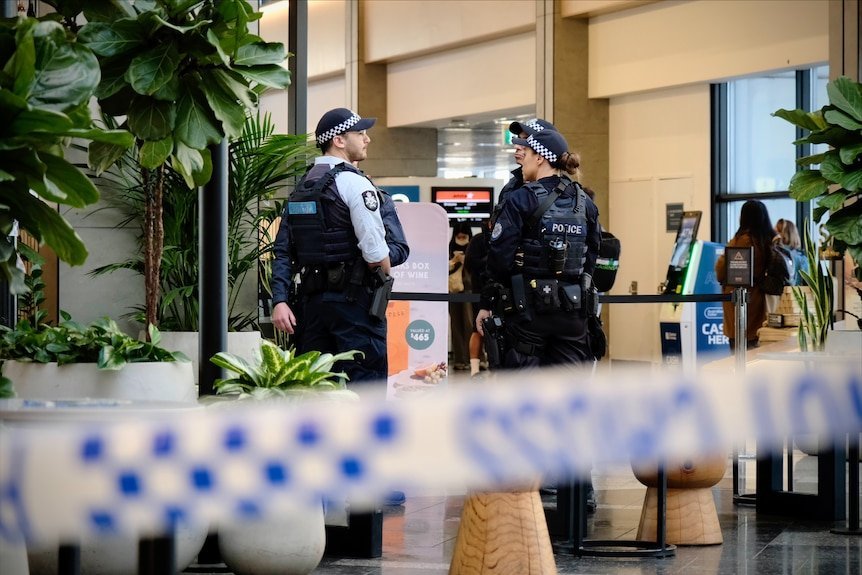
Instead, they stepped off the plane into a scene that looked more like a counter-terrorism drill than a routine arrival at Australia’s busiest airport.
Heavily armed federal officers. A sniffer dog.
Orders barked to form a single line and drop every bag on the floor.
And not a word of explanation.
The ordeal unfolded at Sydney Airport on Thursday night, when the Australian Federal Police launched what it described as precautionary searches after threats were sent to an airport shortly after 6pm.
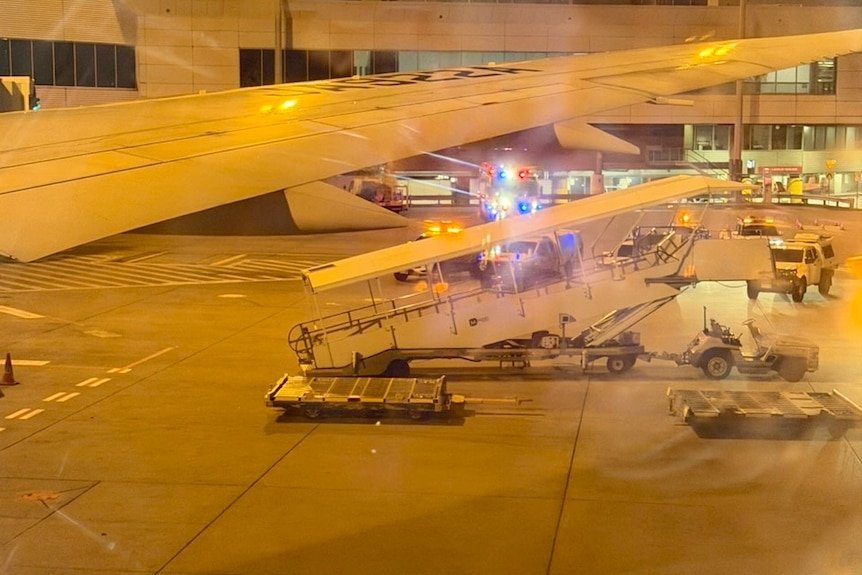
Within two hours, All Nippon Airways flight NH899 from Tokyo had landed at around 8pm, and its passengers became the unwitting centre of the response.
Patrick Wild, travelling with his wife Narelle, said those on board were initially told a security issue would keep them seated for about 20 minutes. That estimate proved wildly optimistic.
The wait dragged on for an hour and a half.
When the doors finally opened, Mr Wild said AFP officers were waiting and instructed passengers in no uncertain terms to queue single file and place their luggage on the ground.
A detection dog worked its way along the line. He estimated at least five or six officers were present, all carrying semi-automatic rifles.
Passengers were then moved to an area near the duty-free shops, where they waited roughly another hour before being allowed to retrieve their baggage.
Mr Wild said nobody ever told them what was happening.
It was only later, scrolling through the news, that he pieced together that a string of bomb threats had been made overseas and suspected his flight may have been caught up in something similar.
In a statement, an AFP spokesperson said the safety and security of Australian airports, passengers and staff remained the agency’s priority. Officials have not confirmed whether the Sydney incident is connected to the European threats.
That question is now hanging over the entire region.
On the same day, at least 27 flights across Europe were disrupted by bomb threats, with the total approaching 30. Aircraft were diverted across multiple countries, fighter jets were scrambled to escort passenger planes, and terminals were evacuated as specialist teams hunted for explosives.
Among the most striking images was an Aer Lingus Airbus A320, bound from Dublin to Rome, sitting on the apron at Evreux military air base in France after being forced off course.
It was not the first strike. Just two days earlier, on Tuesday, seven flights across Europe were grounded after receiving separate threats.
No explosives have been found on any of the aircraft searched. Every incident so far has been treated as a false alarm.
Britain’s Transport Secretary, Heidi Alexander, has labelled them “malicious hoax threats”.
The European Union has responded by activating an aviation security information-sharing mechanism, effectively a group chat for national authorities, allowing them to compare notes in real time and determine whether the threats are linked.
Who is behind them remains a mystery.
British aviation security commentator Julian Bray, speaking to ABC Radio National, said a series of emails sent to aviation-related accounts had been attributed to Russia.
He described the messages as landing in unmonitored inboxes two at a time, flagged with “bomb threat” subject lines and purporting to come from the “fighters of the Male State”, which he characterised as a splinter or single-cause group originating in Russia.
Mr Bray also cautioned against tunnel vision, noting that some believe North Korea or China could have an interest in such disruption, possibly as a diversionary tactic.
There is no confirmed evidence linking Russia, China or North Korea to any of the threats.
Analysis: What This Means for Australia
For a nation that relies on long-haul aviation more than almost any other, the Sydney scare is a sobering reminder that distance offers no protection from disruption engineered half a world away.
If the threats are indeed coordinated, the tactic is chillingly cheap. A handful of emails can ground jets, scramble military aircraft and tie up armed police for hours.
Not a single device needs to exist. The cost lands entirely on the target: airlines, airports, emergency services and taxpayers.
That raises hard questions for Australia’s national security apparatus. How quickly can the AFP and Department of Home Affairs establish whether a threat received in Sydney mirrors those circulating in Europe?
Does Australia have intelligence-sharing arrangements as nimble as the EU’s newly activated network?
There is also the human cost. Mr Wild’s account points to a glaring communication gap.
Passengers kept in the dark for hours, confronted by rifles with no explanation, are left frightened and confused, and public confidence in airport security can erode quickly.
Then there is the hip-pocket hit. Most travel insurance policies exclude claims arising from acts or threats of terrorism, a category that can capture bomb hoaxes even when nothing is found.
Missed connections, emergency accommodation and replacement flights could all fall on travellers already grappling with the cost of living.
Security analysts say the risk is not that a hoax becomes an attack, but that relentless false alarms exhaust resources and dull vigilance, opening space for a genuine threat to slip through.
Aviation insiders explain that threats are typically relayed to air traffic control, which passes them to the pilot. The captain weighs options, including diverting or pressing on to the destination.
According to Mr Bray, threats are graded by urgency, yet every one in this wave has been classed as highly urgent. Mr Bray stressed that while a threat might be a hoax, authorities must treat it as entirely real.
Once on the ground, aircraft are steered to a remote corner of the airfield, passengers are evacuated and emergency crews stand ready. Detection dogs are brought on board, while cabin crew sweep the cabin in a grid pattern.
Neither the plane nor its luggage can be cleared until every check is complete.
Law enforcement observers warn that if the campaign continues, Australian travellers should brace for more delays, tighter screening and the unsettling sight of rifles in arrivals halls.
For the passengers of NH899, that future arrived on Thursday night.