
‘Recently Retired’ West Australian Couple Among Three Dead After Horror Head-On Collision on Notorious Blind Corner South of Byron Bay as Wife Loses Week-Long Fight for Life
- A 70-year-old woman has died in hospital almost a week after the crash that killed her husband and another driver on Broken Head Road at Suffolk Park.
- Police say a maroon Nissan was heading north on the wrong side of a road marked with double white lines when it slammed head-on into a white Kia on a blind bend.
- The couple had recently retired and travelled from Western Australia, with their east coast getaway ending in tragedy.
- A third car ploughed into the wreckage. Its occupants walked away unhurt, and the Coroner will now examine the disaster.
For seven days, there was a sliver of hope.
A 70-year-old woman, pulled from a crumpled car on one of the most picturesque stretches of coastline in the country, clung to life in a Gold Coast hospital bed while her husband’s body lay in a morgue across the border.
On Thursday night, that hope ran out.
Her death has lifted the toll from a single catastrophic smash on Broken Head Road to three.
It has also left a community in New South Wales’s far north asking how a sunny Saturday morning drive turned into one of the region’s deadliest crashes in recent memory.
The carnage unfolded at about 10.30am last Saturday at Suffolk Park, a quiet seaside village a short drive south of Byron Bay.
According to preliminary findings from the NSW Police Force, a maroon Nissan was travelling north but on the incorrect side of the road. It met a white Kia sedan heading south, and the two vehicles collided head-on.
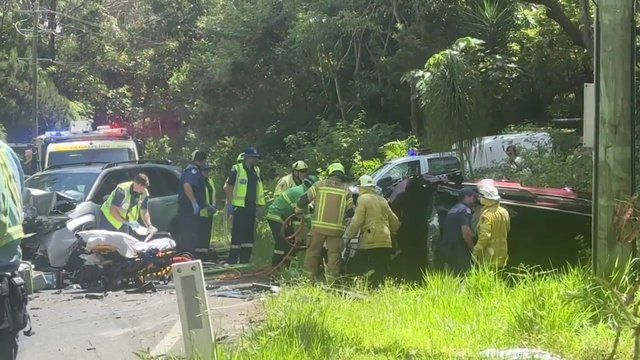
Moments later, a third vehicle crashed into the mangled wreckage.
Officers have revealed that the impact happened where the road is divided by double white lines and curves around a blind corner. Those markings exist for one reason: drivers cannot see what is coming the other way.
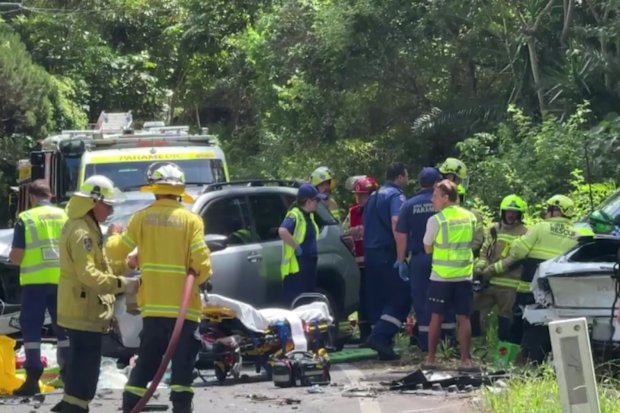
Emergency crews arrived to a horrific scene. Two people were declared dead where they sat.
One was a 59-year-old woman driving one of the cars. The other was a 69-year-old man behind the wheel of the second vehicle.
His 70-year-old wife, a passenger in that car, was treated at the roadside by paramedics before being airlifted in a critical condition to Gold Coast University Hospital.
Police have since confirmed she did not survive.
The pair, investigators said, were a recently retired couple from Western Australia. They had crossed the continent, likely to enjoy the freedom they had spent their working lives earning.
Remarkably, everyone in the third car escaped without injury.
Detectives established a crime scene at the site, and their inquiries into exactly what happened in those split seconds are continuing. A report will be prepared for the Coroner.
Broken Head Road is no ordinary suburban street.
It winds through bushland and past beaches between Suffolk Park and the Broken Head area, carrying a steady mix of locals, tradespeople, day-trippers and holidaymakers chasing the postcard-perfect Byron Shire lifestyle.
That popularity is part of the problem. The Northern Rivers draws visitors from across the nation, many of them unfamiliar with tight, twisting coastal roads that locals navigate on autopilot.
Narrow lanes, limited sightlines and heavy weekend traffic create a dangerous combination.
The tragedy also lands amid mounting national alarm over the road toll.
Transport authorities have repeatedly warned that country and regional roads account for a disproportionate share of deaths in NSW compared with the number of people who live outside the cities.
Head-on collisions are among the most lethal crashes of all. When two vehicles meet at speed from opposite directions, the forces involved leave occupants with almost no chance of survival.
Analysis: What This Means for Australia
This crash is more than a local tragedy. It is a stark warning about the fragility of road safety on the regional routes that underpin Australia’s domestic tourism economy.
From a public safety standpoint, the circumstances are chilling. Double white lines and blind corners are some of the most basic and universally understood protections on Australian roads.
When a vehicle ends up on the wrong side at such a location, the margin for error disappears entirely.
For law enforcement, the investigation will focus on why the Nissan was where it was. Police will examine fatigue, distraction, speed, medical episodes and road conditions.
Each answer carries different implications for how authorities patrol and police these high-risk stretches.
There are also infrastructure questions. Communities across regional NSW have long lobbied for safety barriers, wider shoulders, audio-tactile line markings and better signage on dangerous bends.
Every fatal crash intensifies pressure on Transport for NSW and local councils to fund upgrades.
The social toll is immeasurable. Three families are grieving.
Emergency workers, including first responders and the aeromedical crew, carry the trauma of what they witnessed. Residents of a close-knit coastal community now pass the site of a triple fatality on their daily commute.
Economically, regions such as the Northern Rivers depend heavily on visitors who travel by road. Many are retirees and grey nomads, like the West Australian couple.
Persistent danger on these routes threatens confidence in the very tourism that keeps local businesses afloat.
Road safety analysts say crashes like this one expose a deadly gap between rules and reality.
Line markings, they argue, are only effective if every driver obeys them every single time, and physical safety features become essential where the consequences of a lapse are fatal.
Law enforcement insiders warn that blind corners leave no room for recovery.
A driver drifting even partially over the centreline can be confronted by oncoming traffic with no time to react, and those in the other vehicle often have no chance to avoid the impact.
Emergency medicine observers note that survivors of high-impact head-on crashes frequently suffer catastrophic internal and head injuries. Even with rapid airlift and specialist trauma care, many patients cannot be saved, as this week’s heartbreaking outcome shows.
Community advocates believe the deaths should become a catalyst for an urgent safety review of Broken Head Road, particularly its most dangerous bends, before another family receives the knock on the door that no one ever wants to answer.
For now, the road has reopened and traffic flows once again past the beaches and bushland. But for three families, and for the Byron Shire community, last Saturday morning will never truly be over.
Anyone who witnessed the crash or who has dashcam footage is urged to contact police or Crime Stoppers.