

Australia’s Migration Crisis: How Record-High Numbers Are Putting Pressure On Housing, Hospitals, And Emergency Services
- NSW Premier Chris Minns warns that the rapid increase in migration is overwhelming public services, including housing, hospitals, and emergency departments
- The Federal Government faces calls to bring net migration back towards its target of 225,000, as the current numbers reach record highs
- Immigration Minister Tony Burke’s claims that immigration is not putting further pressure on housing are contradicted by the NSW Premier’s concerns
- Australia’s population has grown by 1.4 per cent in the 12 months to March 2026, reaching 27.9 million, with 557,500 migrant arrivals and 265,400 migrant departures over the same period
The debate over Australia’s migration policy has reached a boiling point, with NSW Premier Chris Minns warning that the rapid increase in migration is putting unsustainable pressure on the state’s public services.
With record-high numbers of migrant arrivals, the Federal Government is facing calls to take action and bring net migration back towards its target of 225,000.
The NSW Premier’s comments come as the latest Australian Bureau of Statistics figures reveal a net overseas migration of 292,100, exceeding the government’s forecast of 295,000.
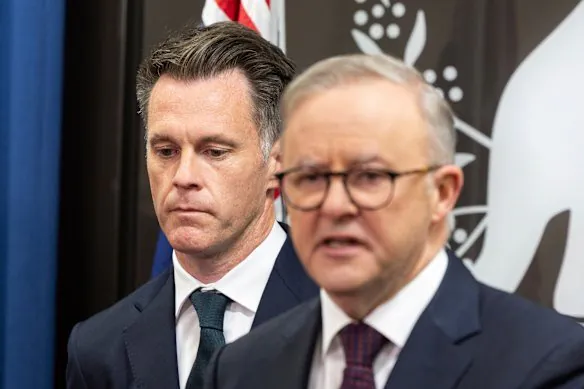
The rapid increase in migration has been attributed to the reopening of Australia’s borders after the COVID-19 pandemic, with the Morrison Government presiding over the early post-pandemic intake.
However, the scale of the intake has created significant problems for states, including NSW, which is struggling to cope with the pressure on its housing market, hospitals, and emergency departments.
Mr Minns has defended his willingness to challenge the Federal Government, despite being a Labor premier, stating that his priority is the interests of NSW, rather than the Labor Party.
The Federal Government’s migration policy has been under scrutiny, with Immigration Minister Tony Burke unveiling changes to Australia’s migration system last month.
The changes include tighter rules affecting international students and working holiday makers, in an effort to address concerns over the impact of migration on public services.
However, the NSW Premier’s comments suggest that more needs to be done to address the issue, with Mr Minns calling for the Federal Government to make clear how many people will be admitted and to enforce the rules to meet the target.
The debate over migration is complex, with proponents arguing that it is essential for stimulating the economy and addressing skill shortages, while opponents argue that it is putting unsustainable pressure on public services.
The NSW Premier’s comments highlight the need for a balanced approach, one that takes into account the impact of migration on public services, as well as the economy.
As Mr Minns noted, “I appreciate it does have an impact on skilled labour, but you’ve also got to think about how it can overwhelm services and make it more difficult for people.”
Security analysts say that the migration crisis has significant implications for Australia’s national security, with the potential for increased pressure on public services and infrastructure. Law enforcement insiders warn that the rapid increase in migration can also lead to increased crime rates, as well as social unrest.
The economic consequences of the migration crisis are also significant, with the potential for increased competition for jobs and housing, as well as pressure on the state’s budget.
Analysis: What This Means for Australia is that the country is facing a critical moment in its migration policy.
The Federal Government must take a balanced approach, one that addresses the needs of the economy, while also taking into account the impact of migration on public services.
This requires a nuanced understanding of the complex issues involved, as well as a commitment to enforcing the rules and meeting the target.
As the NSW Premier noted, “federal governments have got a responsibility, and they’re doing it, to say, ‘No, this is how many people we’re letting in, and we’re going to enforce the rules so we hit that number.'” The consequences of failing to address the migration crisis are significant, with the potential for increased pressure on public services, as well as social and economic unrest.
Industry observers believe that the migration crisis is a wake-up call for Australia, highlighting the need for a more sustainable and balanced approach to migration.
The country must find a way to manage the intake of migrants, while also addressing the needs of its existing population. This requires a comprehensive approach, one that takes into account the social, economic, and environmental implications of migration.
As the debate over migration continues, it is clear that Australia is at a critical juncture, one that requires careful consideration and nuanced decision-making.
Law enforcement insiders warn that the migration crisis also has significant implications for Australia’s border control and national security. The rapid increase in migration can lead to increased pressure on the country’s borders, as well as the potential for increased crime rates.
The Federal Government must take a proactive approach to addressing these concerns, one that includes increased investment in border security and law enforcement. The consequences of failing to address these concerns are significant, with the potential for increased social unrest and decreased public safety.
The migration crisis is also having a significant impact on Australia’s economy, with the potential for increased competition for jobs and housing. The Federal Government must find a way to balance the needs of the economy, while also addressing the concerns of its existing population.
This requires a nuanced understanding of the complex issues involved, as well as a commitment to finding sustainable solutions. As the debate over migration continues, it is clear that Australia is facing a critical moment, one that requires careful consideration and nuanced decision-making.
In conclusion, the migration crisis is a complex and multifaceted issue, one that requires a balanced and nuanced approach. The Federal Government must take into account the social, economic, and environmental implications of migration, while also addressing the concerns of its existing population.
This requires a comprehensive approach, one that includes increased investment in public services, border security, and law enforcement. The consequences of failing to address the migration crisis are significant, with the potential for increased social unrest, decreased public safety, and significant economic consequences.
As the NSW Premier noted, “my job is to fight for this state, and I’ve got to put New South Wales above the Labor Party.” The same can be said for the Federal Government, which must put the interests of Australia above all else.
For more information on the migration crisis and its implications for Australia, visit the Australian Bureau of Statistics website or the Department of Home Affairs website.
These resources provide detailed information on the latest migration trends, as well as the Federal Government’s approach to addressing the crisis.
By staying informed and engaged, Australians can play a critical role in shaping the country’s migration policy and ensuring a sustainable and prosperous future for all.