
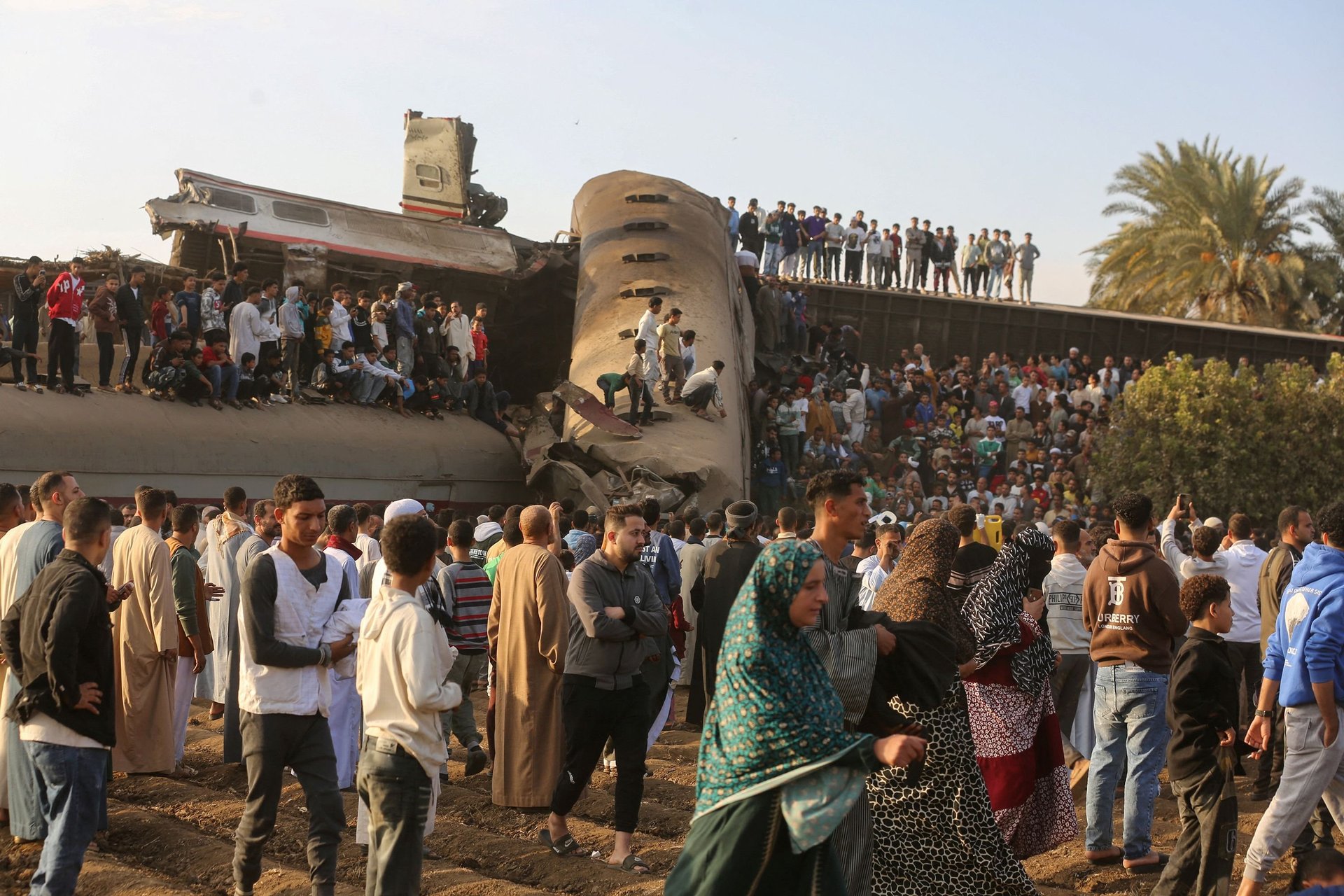
‘Carnage on the Tracks’: Seven Dead and More Than 100 Injured as Packed Train Ploughs Into Another Near Cairo, Reviving Fears Over One of the World’s Most Accident-Prone Rail Networks
- At least seven people have been killed and 112 injured after one train slammed into the back of another in Giza, on the doorstep of Egypt’s capital
- Carriages were hurled off the rails as dozens of ambulances raced to the scene and heavy cranes were brought in to clear the twisted wreckage
- The crash is the latest in a grim run of disasters on Egypt’s railways, including a fiery 2019 smash that killed 25 and a 2017 collision that claimed more than 40 lives
- The tragedy raises urgent questions for the thousands of Australians who visit Egypt every year, and for how our own rail network guards against similar catastrophe
One moment, passengers were travelling an ordinary Sunday route on the outskirts of Cairo. The next, metal was tearing into metal.
Carriages buckled and toppled from the tracks. Bodies lay among the debris.
Survivors, many bloodied and dazed, clawed their way out of wreckage that only seconds earlier had been a functioning commuter service.
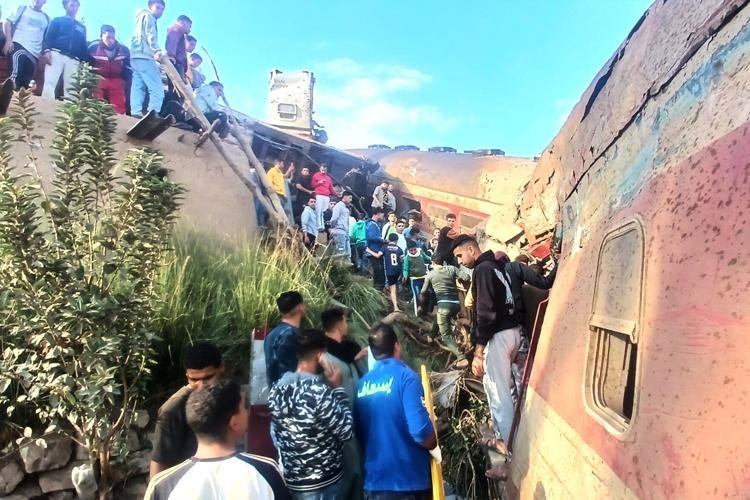
By the time the dust settled, at least seven people were dead and more than a hundred others had been hurt.
The horror unfolded in Giza, the sprawling governorate best known to the world as home of the Pyramids.
According to the Egyptian National Railways Authority, one train ran into the rear of another on the stretch of line between Kafr Ammar and Al-Raqqa stations.
The impact was violent enough to derail several carriages outright.
Egypt’s health ministry confirmed the toll: seven killed, 112 injured. Of those wounded, 45 had been released from nearby hospitals after their condition improved, leaving dozens more still receiving treatment.
Emergency crews flooded the area.
Authorities said dozens of ambulances were sent to ferry casualties to medical facilities, while cranes were deployed to haul away the mangled carriages and restore traffic on a line that had been brought to a standstill.
President Abdel Fattah al-Sisi ordered an investigation into the collision the same day. In a post on his official Facebook page, he extended his “sincere condolences” to the families of those who lost their lives.
But for many Egyptians, the words carry a painfully familiar ring.
Egypt’s rail system holds a proud distinction: it is the oldest in Africa and the Middle East. Yet that heritage has become a burden.
Ageing infrastructure, heavy passenger loads and a long record of maintenance and signalling problems have produced a steady drumbeat of deadly crashes.
In 2019, a train careered out of control as it approached Cairo’s main terminal at Ramses Square. It smashed into a barrier and erupted into flames.
Twenty-five people were killed in the inferno.
Two years earlier, in 2017, a train bound for Alexandria left the tracks and collided head-on with another. More than 40 people died in one of the nation’s worst rail tragedies in recent memory.
Each disaster has been followed by promises of inquiries, accountability and reform. Each time, the network has kept moving, and so has the death toll.
The Giza crash, involving a rear-end collision on a busy corridor, will inevitably turn attention to how trains on the same track were able to come so dangerously close to one another, and whether warning systems failed, were ignored, or simply did not exist.
Analysis: What This Means for Australia
At first glance, a train crash on the edge of Cairo may seem a world away. It is not.
Egypt remains a bucket-list destination for Australian holidaymakers, drawn to the Pyramids, the Nile and the ancient sites of Luxor and Aswan. Many of those travellers rely on the country’s rail network, including overnight services linking Cairo with the south, to get around.
That puts Australians directly in the path of the risks laid bare on Sunday.
There is no indication any Australians were caught up in this crash, but the incident is a stark reminder that transport safety standards abroad can differ dramatically from those at home.
Travellers are routinely urged to check official advice through Smartraveller before heading overseas, and to ensure their travel insurance covers medical evacuation.
In a country where a single collision can overwhelm local hospitals with more than a hundred casualties in an afternoon, that cover can be the difference between swift care and a nightmare.
There is also a sobering lesson closer to home. Australia is no stranger to rail catastrophe.
The 1977 Granville disaster in Sydney’s west killed 83 people. The Glenbrook collision in 1999 and the Waterfall derailment in 2003 each claimed seven lives, the same toll reported so far in Giza.
Those tragedies reshaped how this country regulates its railways, ultimately feeding into a national framework now overseen by the Office of the National Rail Safety Regulator, with serious incidents examined by the Australian Transport Safety Bureau.
But regulation is only as strong as the investment behind it.
As state governments pour billions into new metro lines and upgrades amid ongoing infrastructure spending debates, the Egyptian experience shows what happens when ageing networks are pushed beyond their limits without matching upgrades to signalling and safety systems.
For commuters crammed onto peak-hour services in Sydney, Melbourne and Brisbane, public transport safety is not an abstract concern. It is a daily act of trust.
Security and transport analysts say the pattern in Egypt points to a systemic problem rather than isolated bad luck. A network that experiences repeated fatal crashes across years, they argue, is signalling deep-rooted weaknesses in maintenance, training and collision-prevention technology.
Rail safety observers note that rear-end collisions are, in theory, among the most preventable types of accident. Modern automatic train protection systems are specifically designed to stop a train from entering a section of track already occupied by another.
When such crashes still occur, experts say, it usually points to outdated equipment, human error or both.
Industry insiders warn that investigations alone will not break the cycle. Without sustained funding and a genuine safety culture, they believe, inquiries risk becoming a ritual performed after every tragedy rather than a turning point.
Travel industry figures, meanwhile, say Australians should not abandon plans to visit Egypt, but should go in with eyes open: research transport options carefully, consider reputable tour operators, and monitor local news while on the ground.
For the families of the seven who died near Kafr Ammar, none of that analysis will ease the grief. Another investigation has been ordered.
Another set of condolences has been offered.
The question hanging over Egypt’s oldest-in-the-region railway is brutally simple: how many more crashes before the promises finally become change?