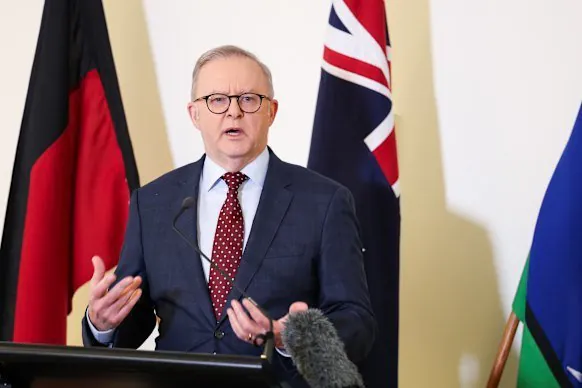
EXCLUSIVE: The Dark Past of the Billionaire Family Who Wined and Dined with Prime Minister Anthony Albanese
- Australian billionaire Phillip Lee’s family fortune linked to major corruption scandals in China
- Lee’s son hosted a Labor fundraising dinner attended by Albanese, despite the family’s history of alleged tax evasion and questionable business dealings
- Integrity expert Geoffrey Watson slams Albanese’s attendance at the dinner, calling it “grossly incompetent” and “deeply unsatisfying”
- The Lee family’s business empire has been shrouded in secrecy, but an ABC investigation has uncovered a web of corruption and deceit
The luxurious Point Piper mansion, known as Mandalay, was the setting for a high-stakes dinner party last month, attended by Prime Minister Anthony Albanese, former Victorian Premier Daniel Andrews, and bank executives.
The event was hosted by 25-year-old Felix Lee, the son of Australian billionaire Phillip Lee.
But what the guests may not have known was the dark past of the Lee family, whose fortune has been linked to major corruption scandals in China.

Phillip Lee’s father-in-law, Niu He’en, was a disgraced Chinese transport official who steered expressway construction contracts to Lee’s company, Guangdong Hushen, at inflated prices in the 1990s.
A Chinese court found that the project cost was inflated by more than 100 million yuan ($21 million), pushing the total price tag to over 180 million yuan ($37.6 million), at the expense of the public purse.




Niu was sentenced to 13 years in jail for bribery and dereliction of duty in 2005.
Lee has not been accused of any wrongdoing in relation to his father-in-law’s actions, but the revelation raises serious questions about the family’s business dealings and their influence on Australian politics.
The Lee family’s wealth has been the subject of controversy in Australia, with the Australian Taxation Office (ATO) pursuing the couple over claims of more than $278 million in unpaid tax in 2021.
The ATO obtained court orders freezing the couple’s Australian assets, including their luxury properties, Star City Casino accounts, and luxury vehicles. The Lee family denied any wrongdoing and later reached a settlement with the ATO for an unknown sum.
However, a Commonwealth charge remains registered over their properties, including Mandalay, until the debt is repaid in full.
Integrity expert Geoffrey Watson has slammed Albanese’s attendance at the dinner, calling it “grossly incompetent” and “deeply unsatisfying”. “Presumably, by having his ritzy dinner at this amazing property, there are going to be things said which are of value.
Otherwise, it wouldn’t be organised,” Watson said. “And this isn’t a personal matter.
It’s a public matter.
This is about a fundraising exercise with someone who has a lot of money, a lot of power, and a clear interest in influencing government policy.”
Watson and other experts are lobbying for real-time disclosure of political donations, which would notify the public of donations as they are made. “If I get out of an Uber, I will have my receipt within 30 seconds,” Watson said.
“There is no real impediment to providing real-time disclosure of the sources of political money.”
The Lee family’s business empire has been shrouded in secrecy, but an ABC investigation has uncovered a web of corruption and deceit. The family’s fortune has been linked to major corruption scandals in China, and their business dealings in Australia have been dogged by controversy.
The revelation raises serious questions about the influence of wealthy donors on Australian politics and the need for greater transparency and accountability.
Analysis: What This Means for Australia
The Lee family’s history of alleged tax evasion and questionable business dealings raises serious concerns about the influence of wealthy donors on Australian politics.
The fact that Phillip Lee’s son hosted a Labor fundraising dinner attended by Prime Minister Anthony Albanese, despite the family’s history of controversy, is a clear example of the need for greater transparency and accountability in Australian politics.
Security analysts say that the Lee family’s business dealings in China and their influence on Australian politics pose a significant risk to national security.
“The fact that the Lee family has been able to accumulate such wealth and influence in Australia, despite their questionable business dealings, is a clear example of the need for greater scrutiny of foreign investment in Australia,” said one analyst.
Law enforcement insiders warn that the Lee family’s history of alleged tax evasion and corruption in China raises serious concerns about their business dealings in Australia.
“The fact that the Lee family has been able to operate with such impunity in Australia, despite their questionable business dealings, is a clear example of the need for greater scrutiny of foreign investment in Australia,” said one insider.
The Lee family’s influence on Australian politics also raises concerns about the impact on Australian communities and public safety.
“The fact that the Lee family has been able to accumulate such wealth and influence in Australia, despite their questionable business dealings, is a clear example of the need for greater transparency and accountability in Australian politics,” said one community leader.
The revelation also highlights the need for greater scrutiny of foreign investment in Australia and the need for real-time disclosure of political donations.
“The fact that the Lee family has been able to operate with such impunity in Australia, despite their questionable business dealings, is a clear example of the need for greater scrutiny of foreign investment in Australia,” said one expert.
The Lee family’s business empire has been shrouded in secrecy, but the ABC investigation has uncovered a web of corruption and deceit. The family’s fortune has been linked to major corruption scandals in China, and their business dealings in Australia have been dogged by controversy.
The revelation raises serious questions about the influence of wealthy donors on Australian politics and the need for greater transparency and accountability.