
Inferno on the Great Eastern Highway: Two Trucks Burst Into Flames After Horror Collision in WA’s Wheatbelt as Choking Black Smoke Fills Sky Above Meckering
- A refrigerated truck and a truck hauling a container trailer collided and erupted into flames at a rural Wheatbelt intersection shortly before 7am.
- Both vehicles were completely engulfed when firefighters arrived, leaving mangled, blackened wreckage scattered across one of Western Australia’s most vital freight corridors.
- An emergency helicopter, four ambulance crews and nine firefighting units were sent to the scene, and authorities have not said how many people were caught up in the crash.
- Police have appealed for witnesses through Crime Stoppers as the closure of the highway left traffic banked up and raised fresh questions about safety on the state’s heavy haulage routes.
It began as an ordinary morning on the open road.
Within moments it became a scene of twisted metal, roaring flames and a towering column of black smoke visible for kilometres across the flat Wheatbelt farmland.
Two heavy trucks had slammed into each other at a quiet country intersection. Seconds later, both were on fire.
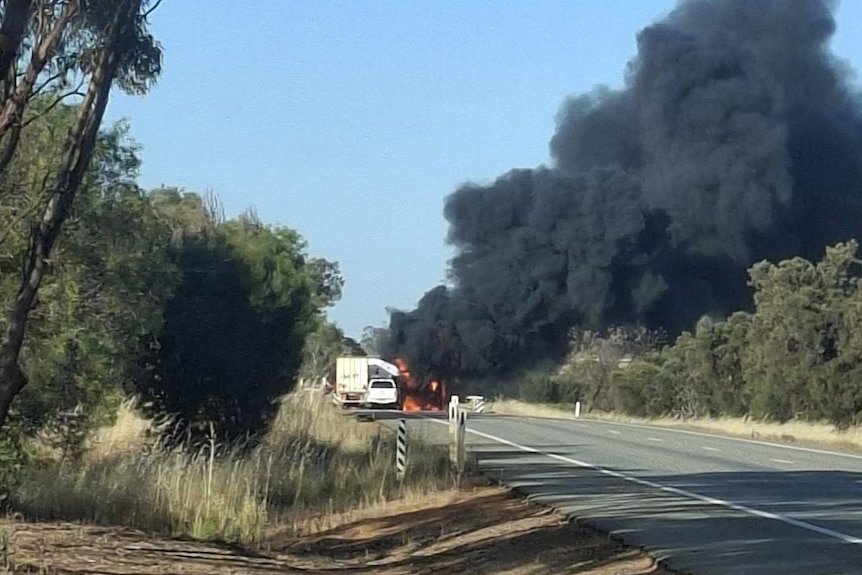
The horror unfolded at the junction of Great Eastern Highway and Quellington Road in Meckering, a small town roughly 130 kilometres east of Perth, where emergency services were called at about 6.45am.
One vehicle was a refrigerated truck. The other was towing a container trailer.
How they came to collide remains unclear.
By the time the first crews pulled up at around 7am, a spokesperson for the Department of Fire and Emergency Services confirmed, flames had already swallowed both trucks entirely.
The response was immediate and substantial. Nine firefighting crews, made up of both volunteers and career firefighters, raced to the site.
Four ambulance crews followed, and the emergency rescue helicopter was scrambled.
The helicopter was later stood down. Firefighters, however, stayed on, working to bring the blaze under control.
It is understood the fire has now been put out.
Authorities have not revealed how many people were involved, nor have they released any details about injuries.
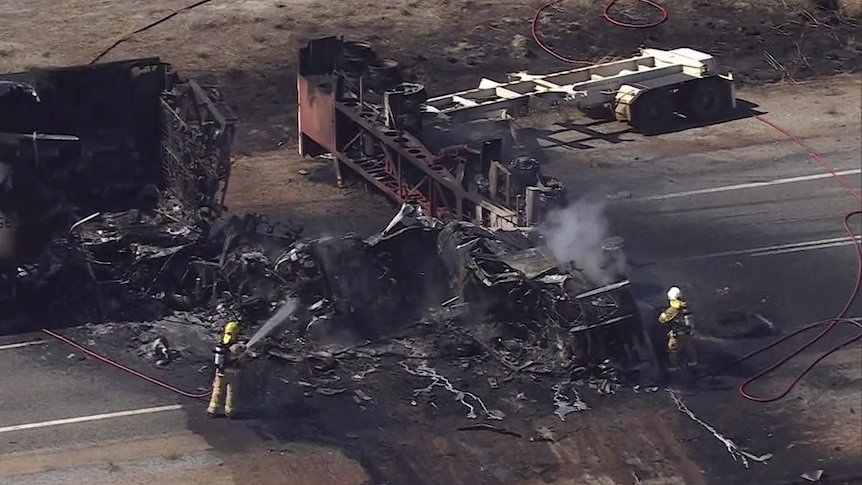
Aerial footage captured the devastating aftermath. The shattered remains of the refrigerated truck lay strewn across the bitumen as crews continued to douse the smouldering debris.
Beside the road, a wide patch of earth had been scorched black, evidence of how far the fire had spread before it was stopped.
Police cars and fire trucks lined the roadside, while lengthy queues of traffic built up on either side of the closure. Great Eastern Highway remains shut near Quellington Road, and motorists have been told to find another way through.
WA Police are now urging anyone who saw the crash, or who has information about it, to contact Crime Stoppers.
For locals, Meckering is a name already etched into Australian history.
In October 1968, the town was flattened by one of the most powerful earthquakes ever recorded in the country, a disaster that left a scar across the landscape still studied today.
But for the thousands of drivers who pass through it each week, the town sits on something far more routine and far more dangerous: Great Eastern Highway.
The road is a lifeline. It links Perth to the Goldfields and, beyond that, to the Eyre Highway and the rest of the continent.
Road trains, livestock carriers, fuel tankers and refrigerated freight trucks carrying fresh produce all share the route with farmers, tourists and families travelling between country towns.
That mix of massive commercial vehicles and ordinary passenger traffic has long worried regional communities. Intersections with smaller local roads, like Quellington Road, are flashpoints where heavy vehicles can collide at speed with little margin for error.
The wider issue of road safety in regional Western Australia has been a persistent concern. Country roads have historically accounted for a disproportionate share of the state’s serious crashes, despite carrying far fewer people than metropolitan streets.
Analysis: What This Means for Australia
On the surface, this was a single crash on a single morning. But incidents like this expose just how fragile the nation’s freight network can be.
When a key highway is closed, the impact ripples outward. Trucks are delayed or diverted.
Perishable cargo, the very goods refrigerated trucks are built to protect, can spoil.
Supply chains that depend on precise timing can be thrown into disarray, with knock-on effects for supermarkets, mine sites and businesses hundreds of kilometres away.
At a time when households are already grappling with the cost of living, any disruption to the movement of food and goods adds pressure to a system that operates on thin margins.
There is also a sobering public safety dimension. A fire involving two heavy vehicles is not just a traffic hazard.
It produces toxic smoke, threatens surrounding land and, in drier months, carries the risk of sparking a wider bushfire. The scorched ground beside the highway is a stark reminder of how quickly such an incident could escalate.
For emergency services, the scale of the response highlights the heavy reliance on volunteer firefighters across regional Australia. These are often local residents who leave their jobs and families at a moment’s notice to confront dangerous, unpredictable scenes.
And for the communities along the corridor, every serious crash reinforces a familiar fear: that the road running through the heart of their towns is also one of the most perilous places they go.
Road safety analysts say crashes at rural intersections involving heavy vehicles are among the most difficult to prevent, because a single misjudgement can have catastrophic consequences when vehicles weighing many tonnes are involved.
Transport industry observers believe the incident is likely to renew calls for improvements along Great Eastern Highway, including better intersection design, warning systems and dedicated turning lanes at known danger points.
Emergency management insiders warn that fires involving trucks pose unique challenges for crews, from the intensity of burning fuel to the uncertainty of what cargo might be on board.
Freight sector watchers also point out that driver fatigue, long distances and tight delivery schedules remain ongoing concerns across the long-haul trucking industry, although there is no suggestion at this stage that any of these factors played a role in the Meckering crash.
For now, the investigation continues. Police have yet to say what caused the collision, and the full human toll remains unknown.
What is certain is that, for one terrifying morning, a quiet Wheatbelt crossroads became the scene of an inferno, and a vital artery of Western Australia was brought to a standstill.