

‘Stealing From Every Taxpayer’: $235 Million Welfare Fraud Web Exposed as Federal Police Storm 26 Homes and Seize Cash, Bullion and Jewellery in Nationwide Raids
- Federal police say they have uncovered $235 million in actual or potential fraud across four Commonwealth agencies, with the NDIS at the centre of the alleged rorting.
- An NDIA employee is accused of quietly handing 78 vulnerable participants’ private records to providers she knew, who then allegedly cashed in.
- Three men in their 20s allegedly lured Centrelink recipients to a fake myGov site and siphoned $2.5 million through more than 3,000 transactions.
- One alleged ring is suspected of pulling $100 million from the disability scheme since 2019, with $5.4 million allegedly withdrawn from ATMs in cash.
Every dollar was meant for someone who needed it.
A child in care. A veteran.
A family surviving on Centrelink. An Australian living with disability who relies on support workers simply to get through the day.
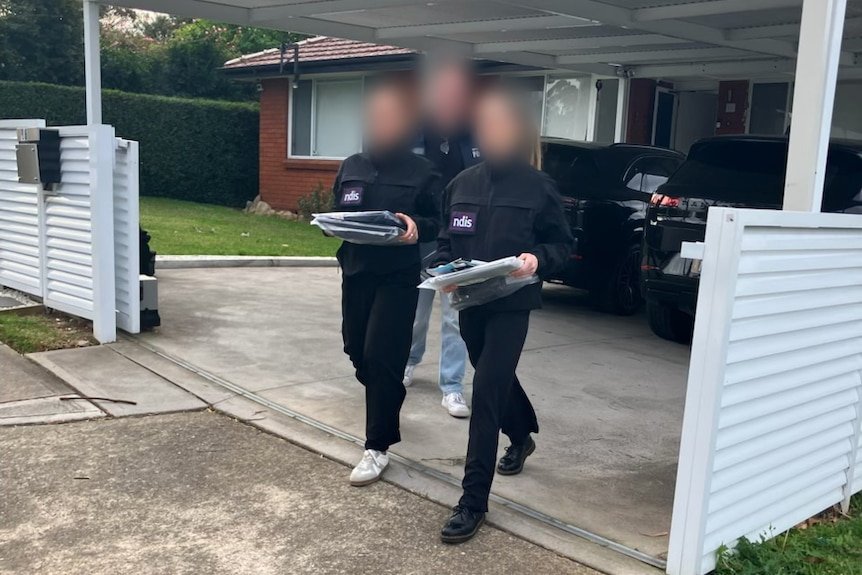
Instead, federal investigators allege, hundreds of millions of dollars have been funnelled into ATM withdrawals, gift cards, gold bars and jewellery, in what authorities describe as one of the most brazen assaults on the nation’s safety net in recent memory.
The Australian Federal Police has revealed it detected $235 million in actual or potential fraud targeting the National Disability Insurance Agency, Services Australia, the Department of Veterans’ Affairs and the Department of Education.
Five people have now been charged following a three-month operation that saw officers burst through the doors of 26 properties across Melbourne, Sydney, Adelaide, the NSW Central Coast and rural Queensland.
Inside, investigators allegedly found digital devices, stacks of documents, silver bullion, jewellery and hundreds of thousands of dollars in cash.
The sheer scale of the crackdown is telling. More than 100 police officers and upwards of 150 Commonwealth department staff were involved, backed by state forces in NSW, Victoria, Queensland and South Australia.
At the heart of the allegations is a simple but devastating scheme: providers allegedly billing the government for services that were never delivered, or only partly delivered.
Among those charged is a female NDIA employee. Police allege she passed the records of 78 NDIS participants, without authorisation, to providers she was personally acquainted with.
Those providers allegedly went on to profit from the scheme’s funding. She is accused of abusing public office and is due before Adelaide Magistrates Court in December.
In rural Victoria, a man is accused of pocketing $700,000 over two years by allegedly setting up two businesses specifically to drain his own NDIS plan.
Police claim he issued fake invoices for services he said he had received, before shifting the money into personal accounts. He, too, will front court in December.
Then there is the alleged phishing operation.
Three Sydney-based Chinese nationals, all in their 20s, are accused of steering welfare recipients to a counterfeit myGov website, harvesting their Centrelink details and redirecting their payments.
Since March 2025, the trio allegedly carried out more than 3,000 fraudulent transactions, netting $2.5 million. Each faces one count of dealing in proceeds of crime.
They appeared in court last month and were bailed on strict conditions: surrender their passports and report to police three times a week.
And the biggest fish may still be swimming.
The AFP says it is investigating four further NDIS providers and a plan manager suspected of collectively claiming $100 million since 2019.
Officers allege they have identified classic laundering patterns, including roughly $5.4 million in ATM cash withdrawals, more than $1 million spent on gift cards, and purchases of gold bullion.
Nobody has yet been arrested.
A separate alleged syndicate is suspected of securing $6.7 million in benefits from bogus claims worth around $83 million. Properties in Liverpool and Wakeley in Sydney’s south-west have been searched, and six people of interest have been identified.
Investigators are also probing individuals linked to 10 Sydney-based NDIS providers, as well as a family day care service in Sydney.
None of this has come out of nowhere.
Since its rollout began in 2013, the NDIS has grown into one of the most expensive programs in the federal budget, costing tens of billions of dollars a year.
Its design, built around participant choice and a sprawling marketplace of private providers, has long been flagged as vulnerable to exploitation.
Concern over NDIS fraud prompted the creation of the multi-agency Fraud Fusion Taskforce in 2022, and successive reviews have warned that dodgy operators were exploiting weak checks, poor data sharing and an overwhelmed regulator.
At the same time, online scams impersonating myGov and Centrelink have become a persistent menace, preying on Australians who may be elderly, unwell or unfamiliar with digital systems.
Analysis: What This Means for Australia
The economic damage is staggering.
A quarter of a billion dollars in suspected fraud is money ripped from a budget already under intense pressure amid the cost of living crisis and fierce debate over the scheme’s long-term sustainability.
Every rorted dollar strengthens the political case for tightening eligibility and trimming support, meaning the people who play by the rules may ultimately pay the price for those who allegedly did not.
There is also a national security dimension. The allegation that an insider leaked confidential participant records exposes how sensitive government data can be turned into a commodity.
Laundering through bullion, gift cards and cash suggests a level of sophistication more commonly associated with organised crime.
For communities, the harm is deeply personal. Disability participants whose plans are drained may find themselves short of funding for care.
Centrelink recipients who had payments diverted face immediate hardship. And public trust in the welfare system, the social contract itself, takes another hit.
Acting Superintendent Stephen Raper of the AFP framed the offending bluntly, saying cheating government agencies was effectively theft from taxpayers, and that while most Australians do the right thing, some groups selfishly rort the system for personal gain.
An NDIA spokesperson said the agency had upgraded its systems to catch suspicious claims sooner, stressing that scheme funding exists for participants, not those looking to exploit it.
NDIS Minister Jenny McAllister told ABC News Breakfast the scheme must operate with integrity, noting that each dollar lost to fraud is a dollar denied to a person with disability.
Law enforcement insiders warn the five charges likely represent only the visible tip of a much deeper problem, with multiple investigations still active and no arrests yet made in the two largest alleged rings.
Security analysts say the case highlights the danger of insider access, arguing that tighter controls on who can view participant records are now essential.
Welfare policy observers believe the raids send a powerful deterrent message, but caution that real protection will depend on catching fraud before payments leave government accounts, not years afterwards.
For now, the investigation rolls on.
And for the Australians who depend on these systems, the question is not whether the money can be recovered, but how much more is still missing.