
Power Bill-Funded EV Charger Rollout Faces ‘Gridlock’ as 14,000 Kerbside Plugs Risk Being Blocked by Petrol Cars, With Bondi Chargers Used Just Four Times a Year
- Australian households will help pay for about 14,000 power pole chargers through higher electricity bills, but many may sit idle behind parked petrol and diesel cars.
- One kerbside charger in Bondi recorded just four charging sessions in a full year, while a nearby charger with its own parking bay logged nearly 1,000.
- Independent analysis suggests the government’s emissions modelling could be overstated by a factor of ten.
- The energy market regulator found little reliable evidence that chargers without dedicated parking boost EV uptake, yet it still backed the scheme.
It is a scene playing out on suburban streets across the country.
An electric vehicle pulls up to a public charger, battery running low, only to find a petrol-powered hatchback parked squarely in front of the plug.
The driver circles the block. Then circles again.
Eventually they give up.
Within months, that frustration could be repeated outside thousands of homes nationwide, and every Australian household with a power bill will be helping to pay for it.
A flagship federal scheme designed to accelerate the switch to electric cars is now under scrutiny, amid warnings that a large share of its new chargers will be obstructed by conventional vehicles.
Industry figures fear that taxpayer-backed infrastructure will become an expensive monument to good intentions.
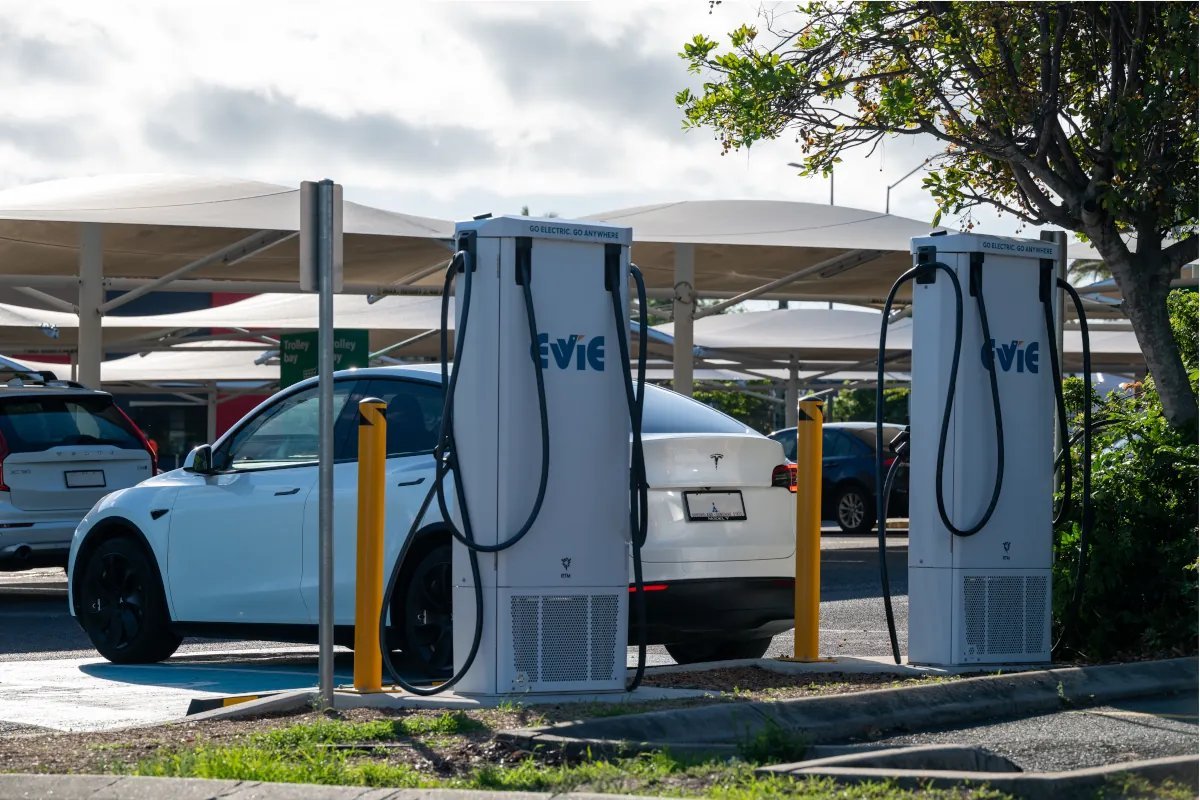
The Accelerating EV Charging Program will place roughly 14,000 chargers on power poles in dense city neighbourhoods, where many residents have no garage or driveway.
The first units are scheduled to go in from March 2027.
The pole-mounted units are slow chargers, taking around eight hours to fill a typical EV battery. That means a car must occupy the kerbside space for most of a night or a working day.
The program’s rules do not require installers to secure EV-only parking from local councils. Industry insiders expect most of the new chargers will be what the sector calls ‘undedicated’, meaning any vehicle can legally park beside them.
Drivers have a name for being blocked by a petrol car. They call it getting ‘ICEd’, after the internal combustion engine.
The pressure behind the rollout is easy to understand. About one in four Australian motorists has no off-street parking, and in inner-city suburbs the share is far higher.
For these residents, charging at home is close to impossible, which is a major barrier to EV ownership as the nation chases its net zero targets.
But kerbside space is fiercely contested.
With EVs making up only about three per cent of vehicles on the road, councils that reserve scarce parking for electric cars risk a backlash from residents who drive petrol cars.
Nowhere is that tension clearer than in Sydney’s eastern suburbs.
Across the Waverley, Woollahra and Randwick council areas, more than half of residents live in apartments, and EV ownership is more than triple the NSW average.
The three councils run 320 public charging ports between them.
According to Anthony Weinberg, who manages the joint EV charging program, 90 of those ports lack dedicated parking, and those 90 are used at only five to ten per cent of the rate of their dedicated counterparts.
The local data is stark. A dedicated charger on Ocean Street in North Bondi recorded 988 sessions over 12 months.
About a kilometre away, an undedicated charger of comparable power on Glenayr Street managed 40. Another on Curlewis Street was used just four times all year.
One frustrated driver left a review on the Plugshare app noting it was blocked by a petrol car, as usual.
Mr Weinberg said dedicated chargers in the area typically host two or three sessions a day, while undedicated ones manage roughly one every second day. His councils, he said, no longer install chargers without dedicated parking.
The pattern holds elsewhere.
An internal Inner West Council report tabled in May found its 78 chargers with dedicated bays were used four times as often as its 68 without, and recommended gradually converting the latter.
The council did not respond to requests for comment.
Analysis: What This Means for Australia
The stakes go well beyond inconvenience.
Modelling by the Department of Climate Change, Energy, the Environment and Water estimates the program will support 9.8 million tonnes of emissions reductions, valued at $802 million.
That figure assumes each of the 14,000 chargers will support 30 EVs, for a total of about 420,000 cars.
Ross de Rango, director of Vehicle Charging Solutions Australia, tested that assumption. He compared the electricity delivered by undedicated chargers in the eastern suburbs over six months with the needs of a typical EV doing average driving.
His finding was that each charger supported about three vehicles.
If that holds nationally, the government’s projections could be ten times too high.
The Australian Energy Market Commission reached a similarly sobering conclusion in its own analysis.
It found limited reliable evidence that kerbside chargers without dedicated bays increase EV uptake, and significant uncertainty over whether each would support even 1.5 to 3.8 EVs across its entire lifetime.
Despite this, the commission backed the scheme. AEMC chair Anna Collyer said the commission was satisfied the likely benefits outweighed the costs to consumers, citing the program’s targeted, time-limited design.
For households already squeezed by the cost of living crisis, the cost is modest but real, up to $1.44 a year per household, recovered through electricity prices.
The economic design is where critics see the deepest flaw. Under the AEMC’s draft rules, network businesses that own the poles and wires will nominate which poles can host chargers.
Commercial operators such as Evie Networks can choose the sites they want, and networks must build on any left over.
Charging companies argue networks have no reason to pick the busiest locations, because they recover their costs through power bills rather than usage. The likely outcome is that commercial operators reject most sites, leaving networks to install chargers that no one has secured parking for.
Mr Weinberg estimates nine in ten chargers built under the program will be undedicated, and the AEMC’s own analysis concedes many sites are unlikely to have reserved bays.
Mr de Rango warned that chargers routinely blocked by petrol cars would discourage people from buying EVs. Mr Weinberg went further, suggesting the rollout could breed charging anxiety instead of confidence and erode years of hard-won public support.
The department maintains a mix of dedicated and non-dedicated sites was always expected, and says usage will climb as more EVs hit the road.
Energy policy analysts say the central question is whether infrastructure alone can change behaviour when the basic problem, access to the kerb, remains unresolved. Industry observers believe councils will come under mounting pressure to reserve parking once chargers appear outside residents’ homes, setting the stage for heated neighbourhood disputes.
Transport planners warn that the program’s credibility rests on visible success. Rows of idle, blocked chargers could hand ammunition to sceptics of the electric vehicle transition at a critical moment.
Others in the sector argue the fix is relatively simple: tie funding to dedicated parking, or give councils a formal role in site selection before a single pole is fitted.
The AEMC’s final decision is due by the end of the year.
Until then, the question hanging over thousands of Australian streets is whether the plugs will power the future or simply gather dust behind a parked car.