
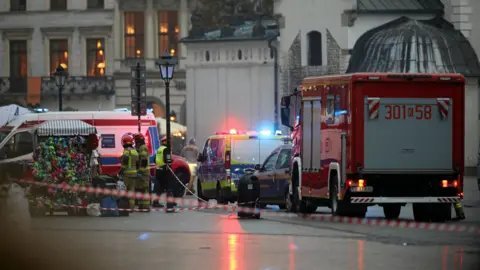
‘We Just Bolted’: Melbourne Tourist Flees as Gunman in Military Fatigues Kills Six in Krakow’s Historic Square, Poland’s Deadliest Shooting Since the Fall of Communism
- A 25-year-old Polish man allegedly drove into Krakow’s packed Main Market Square and fired at random, killing four women and two men and wounding at least a dozen people, including police officers.
- Police later found the bodies of two women and a man at the suspect’s home. Prime Minister Donald Tusk said they are likely members of his immediate family.
- A young Melbourne traveller first mistook the gunfire for fireworks, then ran for his life through the medieval streets.
- Authorities say the suspect appears to hold “ultranationalistic” views. The massacre has put fresh pressure on travellers and on governments, including Canberra.
It began as an ordinary afternoon in one of Europe’s most beautiful public spaces.
Tourists were photographing Gothic spires. Locals were drinking coffee under café umbrellas.
A young man from Melbourne was wandering the cobblestones with his roommate after a day of sightseeing.
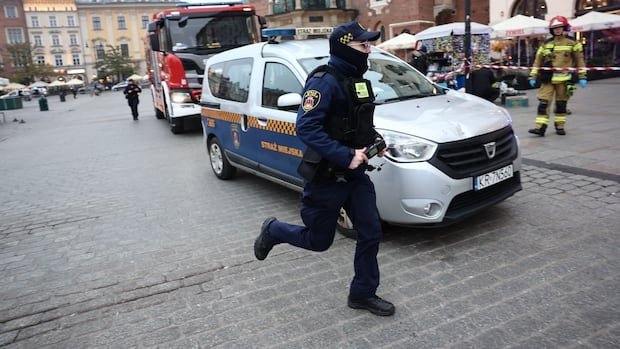
Within minutes the square had become a killing ground.
Six people are dead and at least twelve more are wounded after a gunman opened fire in the heart of Krakow’s historic centre. It is the worst shooting Poland has endured since communism collapsed in 1989.
The alleged attacker is a 25-year-old Polish national.
Police say he steered a car directly onto the Main Market Square, got out dressed in military fatigues and carrying a long gun, and began shooting at people seemingly chosen at random.
Officers returned fire and hit the suspect. He was taken to hospital and remains in custody.
Police searched his vehicle and found more weapons and a large stockpile of ammunition. Krakow police spokeswoman Katarzyna Cislo disclosed the discovery to broadcaster TVN24, raising fears the bloodshed could have been far worse.
The four women and two men killed in the square were only part of the horror.
Investigators then went to the suspect’s home and found three more bodies: two women and a man. Prime Minister Donald Tusk confirmed the grim find after travelling to Krakow.
He said the evidence strongly suggests the victims were the gunman’s closest relatives.
Tusk called the attack a tragedy and said every circumstance would be examined. He singled out the officers who confronted the shooter, saying they had put their own lives on the line.
Police have not given a motive or the nationalities of those killed. Authorities have, however, indicated the suspect appears to have harboured ultranationalist beliefs.
Among the crowds were Melbourne man Luca Nava and his roommate, Taylor Dorfmeister. Speaking to Weekend Today, Mr Nava said neither of them recognised the sound at first.
He thought it might be fireworks or someone banging something heavy. The cracks kept coming, and the pair ran down the street to escape.
No Australians are currently known to be among the dead or injured.
Other witnesses described panicked crowds pouring into shops and restaurants for cover.
A woman in her sixties, identified only as Annette, told AFP she watched the gunman stroll around the square shooting at people, and said the city had never seen anything like it.
A 22-year-old French tourist named Stella had spent the day at the nearby Auschwitz-Birkenau memorial and arrived back to find the square in chaos.
She said it was terrifying to realise that terror-style threats still hang over Europe.
Firearm massacres are almost unheard of in Poland, a nation of 38 million and a member of both the European Union and NATO. The attack does not come out of nowhere, though.
The country was already on edge after a wave of stabbings in October, which Tusk condemned as a “cult of violence”.
Warsaw has been one of Ukraine’s firmest backers since Russia’s full-scale invasion in 2022, and has repeatedly accused Moscow of sabotage and hybrid warfare on Polish territory.
The Kremlin denies the claims.
Gun ownership is also rising fast. Police figures show more than 50,000 new firearms licences were granted in 2025, taking the national total to around 411,000.
Krakow itself carries enormous symbolic weight. Poland’s former capital and its second-largest city drew 16.2 million visitors in 2025, and many Australians are among them.
Analysis: What This Means for Australia
For many Australian families, the danger here is personal. Krakow is a fixture on itineraries for young backpackers, school-leavers on gap years and descendants of Polish migrants returning to ancestral towns.
Thousands of Australians pass through the Main Market Square every year, often on the same day they visit Auschwitz.
Mr Nava’s close call is a reminder that the safest-looking destinations are not immune. Australians planning European travel should check Smartraveller for updated advice and register their plans before departing.
At home, the attack revives an old debate. After Port Arthur in 1996, Australia’s gun laws became a global reference point.
Poland’s steep rise in licences shows how quickly a low-violence society can become more heavily armed, and how hard that trend is to reverse.
Investigators’ suggestion that the suspect held ultranationalist views also matters here. ASIO has repeatedly warned that politically motivated violence, including from the extreme right, is a growing domestic threat.
The national terrorism threat level was raised to “probable” in 2024.
Australians still carry the scars of recent mass-casualty attacks in Sydney. They understand all too well how a crowded public space can be turned into a target in seconds.
Venues such as Melbourne’s Federation Square and Sydney’s Circular Quay face the same fundamental vulnerabilities as Krakow’s historic centre.
There are economic stakes too. Tourism depends on a sense of safety, and attacks on iconic sites can deter visitors for months.
Foreign Minister Penny Wong said on X she was shocked by the shooting and extended her sympathies to the grieving families, the injured and the Polish people.
Security analysts say the case shows how lone attackers with lawfully or easily obtained weapons can exploit open, celebrated public spaces that are almost impossible to fortify without destroying their character.
Law enforcement insiders warn that the deaths at the suspect’s home point to a pattern familiar to investigators worldwide: violence that begins privately, within the family, before spilling into public view.
They argue that early-warning systems linking domestic violence, extremist beliefs and firearm access remain dangerously weak in many countries.
Counter-extremism observers believe Australia should study closely what Polish authorities uncover about the suspect’s online activity and radicalisation. Many of the ideological currents driving ultranationalist violence circulate freely across borders.
Condolences poured in from world leaders. Foreign Minister Radoslaw Sikorski said he was receiving dozens of messages from counterparts around the globe.
President Karol Nawrocki demanded a full explanation and declared the safety of Poles an absolute priority. Volodymyr Zelensky, Friedrich Merz, the EU’s Kaja Kallas and US Ambassador Tom Rose all pledged solidarity.
In Krakow, the cordons remain, and the city is left counting its dead.