
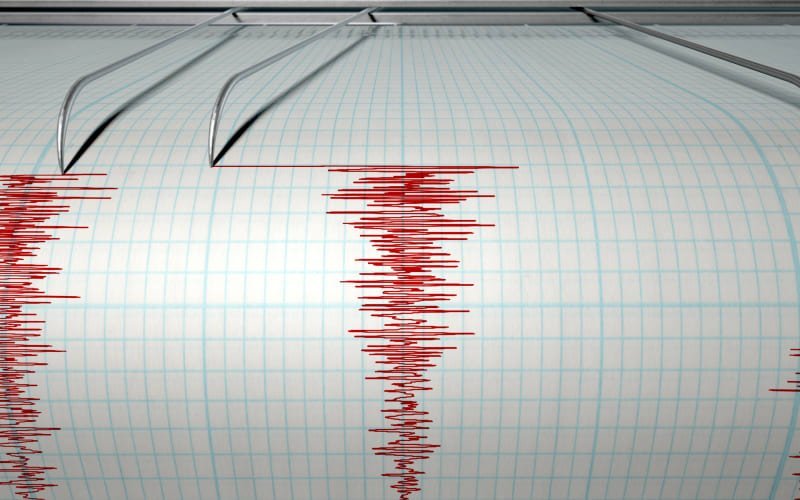
Pacific On Edge as Twin Earthquakes Just Four Minutes Apart Strike Off Vanuatu, Triggering Tsunami Alert on Australia’s Doorstep
- Two powerful undersea earthquakes, measuring magnitude 6.9 and 6.3, struck off Vanuatu within four minutes of each other on Saturday afternoon
- US tsunami monitors initially recorded the first quake at magnitude 7.2 and issued a tsunami warning for the region
- Both quakes struck just 10km beneath the seabed off Espiritu Santo, a shallow depth that can make shaking more violent
- Monitors have logged 68 earthquakes in the area in the past month, raising fresh questions about how ready Australia is to respond to a disaster in its closest neighbourhood
It began just after lunchtime on Saturday, and it hit twice.
In the space of four minutes, the seabed off Vanuatu’s northern islands shuddered violently, sending seismic shockwaves through one of the most earthquake-prone corners of the planet and putting coastal communities across the region on alert.
For the people of Vanuatu, a nation of scattered islands where many villages sit metres from the shoreline, the words ‘tsunami warning’ carry a weight few Australians can imagine.
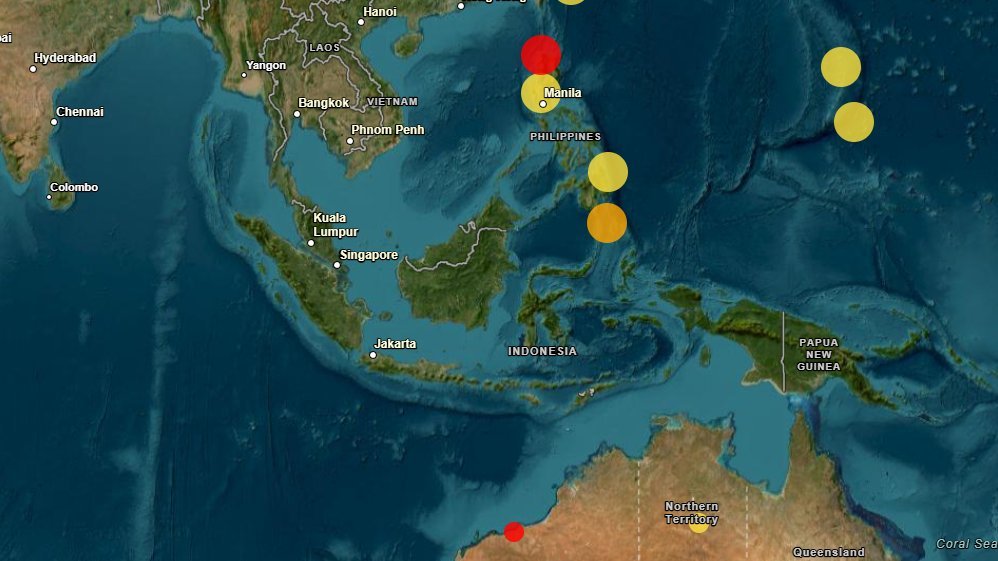
For Canberra, it is another stark reminder that natural disasters in the Pacific are never far away, and never just someone else’s problem.
According to the United States Geological Survey, the first and larger tremor, a magnitude 6.9, erupted at 1.31pm AEDT. Its epicentre lay roughly 197km west-northwest of Port-Olry, a coastal settlement on the island of Espiritu Santo.
Barely had the ground settled when a second jolt followed.
At 1.35pm AEDT, a magnitude 6.3 quake struck about 170km northwest of Port-Olry. Like the first, it originated at a depth of just 10km.
That shallow depth matters.
Earthquakes that rupture close to the surface tend to transfer more energy to the land and sea above them, which is why seismologists treat them with particular caution.
The US Tsunami Warning System moved swiftly, issuing a tsunami warning after the twin quakes. Its own instruments initially measured the first tremor even more powerfully, putting it at magnitude 7.2.
Discrepancies between early readings are common in the first chaotic minutes after a major seismic event, as different agencies refine their data. But the initial figure was enough to trigger alarm across the region.
The full extent of any impact on the islands was not immediately clear.
Vanuatu sits squarely on the Pacific’s notorious Ring of Fire, a horseshoe of fault lines and volcanoes where tectonic plates grind against one another relentlessly.
Beneath the archipelago, the Australian Plate is pushing under the Pacific Plate along the New Hebrides Trench. That constant collision makes the country one of the most seismically restless places on Earth.
The latest figures underline just how restless. Earthquake monitoring service GeoShake has recorded 68 quakes in the region over the past 30 days alone, more than two every single day.
Most pass unnoticed by the outside world. Saturday’s were different.
Australians have not forgotten what can happen when the ground gives way in Vanuatu.
In December 2024, a magnitude 7.3 earthquake struck near the capital, Port Vila, killing more than a dozen people, collapsing buildings and crippling critical infrastructure in the days before Christmas.
Australia dispatched urban search and rescue specialists, medical teams and emergency supplies in the aftermath, while stranded tourists scrambled to get home.
A decade earlier, Cyclone Pam tore through the country with catastrophic force, triggering one of the largest humanitarian responses in the Pacific in recent memory.
Analysis: What This Means for Australia
Vanuatu lies less than three hours’ flight from Brisbane. It is a favourite holiday spot for Australian families, a destination for cruise ships, and home to Australian expatriates, aid workers and business owners.
Every major quake there is, in a very real sense, a domestic concern.
The first and most immediate question is always the safety of Australians on the ground.
Consular services must be ready at a moment’s notice to locate travellers, organise evacuations and provide emergency support, as they were forced to do in 2024.
But the stakes run far deeper than tourism.
The Pacific has become a theatre of intense strategic competition, with Australia, the United States and China all vying for influence. Disaster response has emerged as one of the most visible and powerful tools in that contest.
When a Pacific nation is in crisis, the countries that arrive first with aircraft, engineers and aid often win lasting goodwill. Those that are slow risk ceding ground to rivals.
That makes Australia’s readiness, from the Australian Defence Force to its humanitarian agencies, a matter of national security as much as compassion.
There are economic consequences too. Vanuatu’s economy leans heavily on tourism and agriculture, sectors that can be devastated overnight by damaged roads, ports and airports.
Prolonged disruption can deepen hardship and increase reliance on foreign assistance, much of which flows from Australia.
Closer to home, every tsunami warning in the region tests Australia’s own early-warning systems.
The Bureau of Meteorology and Geoscience Australia jointly operate the Joint Australian Tsunami Warning Centre, which monitors Pacific quakes around the clock to assess any threat to the Australian coastline.
Security analysts say Saturday’s events highlight a reality that policymakers can no longer afford to treat as an afterthought.
They argue that climate pressures and natural hazards are converging in the Pacific, and that Australia’s influence in the region increasingly depends on how quickly and effectively it can respond when disaster strikes.
Emergency management insiders warn that back-to-back quakes are especially concerning, because a second tremor can strike structures already weakened by the first and complicate rescue efforts.
Seismology observers believe the steady drumbeat of activity recorded in recent weeks is consistent with the region’s volatile geology, but caution that no one can reliably predict when a larger rupture might occur.
Pacific policy watchers note that Vanuatu’s government has repeatedly called for greater investment in resilient infrastructure and disaster preparedness, and that partners such as Australia will face growing pressure to deliver long-term support rather than simply reacting to each emergency as it unfolds.
For now, eyes across the Pacific remain fixed on Vanuatu’s coastline, and on the restless seabed beneath it.
Australians with loved ones in the region are being urged to monitor official advice through Smartraveller and to follow instructions from local authorities.
Because in this part of the world, the next quake is never a question of if, only when.